Key takeaways
- Microsoft aims to strengthen Bing's position in the AI search market with recent strategic moves.
- The company claims that rivals misusing Bing's search data for chatbots violates contractual agreements.
- Microsoft is actively communicating with partners deemed out of compliance to enforce its terms of service.
- Several AI search engines, including DuckDuckGo, rely on Bing search data to enhance their chatbot functionalities.
- The ongoing competition in AI search is intensifying as companies develop their own chatbot technologies.
Microsoft has been on the news lately for using OpenAI’s technology in everything and anything. Now, the tech giant has made another sly move to rule the AI search market. According to reports, Microsoft has ordered its rivals to stop using Bing’s search data for building chatbots. Though Microsoft hasn’t revealed which AI search engine company it is talking about, the possibility includes DuckDuckGo, Yahoo, You.com, and Neeva.
The company makes the case that using Bing’s search index for building AI chatbots is a violation of its contract and counts it as “misusing the information”. Microsoft has told Bloomberg that the company is in touch with the partners that are out of compliance, and enforcing their terms of services across the board.
While DuckDuckGo’s DuckAssist uses its own web crawler for providing search results, it still uses OpenAI and Google-backed Anthropic’s summarisation technology. Other AI search engines pull results from Bing. All these companies have been building their own chatbots on search. If Microsoft goes ahead with this plan, the only AI chatbot that will be able to use Bing search index would be ChatGPT or Bing Chat, the company’s own chatbot technology, which is powered by GPT-4.
Microsoft’s early decision to integrate AI into its Bing search engine was a bid to gain a foothold in the search engine market. With OpenAI releasing the new plugins to ChatGPT for accessing the internet, Microsoft might have to rethink the decision of investing in the same type of technology on two fronts. However, for now, integrating AI into Bing and Edge browser has been good for the company—with around 100 million daily active users.
Everything is Fair in War
OpenAI—the company that scavenges data for Microsoft—will now probably be the only one that can access the internet through Bing search API. Recently, OpenAI has given ChatGPT Plus, the chatbot powered by GPT-4, the ability to access the internet through plugins. It is, more or less, obvious that the browser retrieves content from the web using Bing search API, as is also mentioned in the release note.
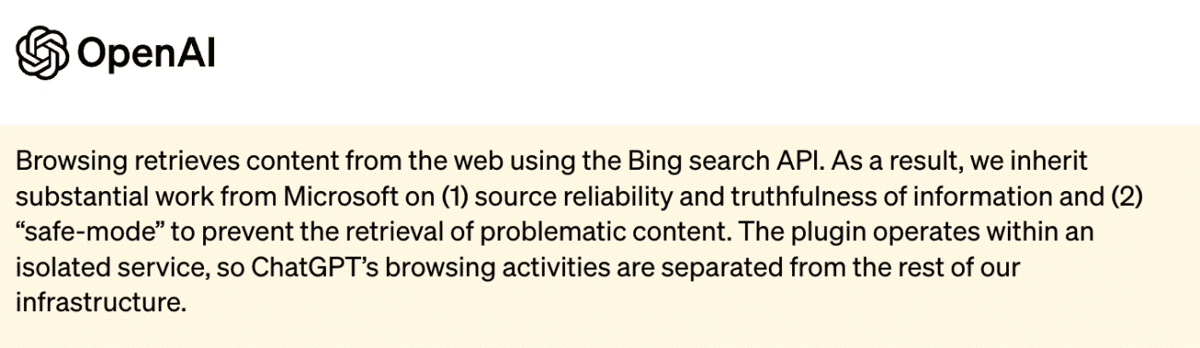
It is also important to note that one of the reasons why the company might be holding back its web search API is for safety reasons. As shown above, OpenAI’s plugin release blog mentions that source reliability and “safe-mode” is important when accessing the internet through chatbots. Microsoft removing other companies might not merely be for competition’s sake, but for ensuring reliable use of the technology as well. Moreover, Sam Altman, CEO of OpenAI, had also said that there are various dangers that are present in this developing AI technology.
The move from Microsoft—though seemingly aggressive—appears plausible. Google recently released Bard, its own chatbot to compete with ChatGPT. Now that Microsoft has invested so much into OpenAI for furthering AI research, the company does not want to fall behind its competitors, of which the biggest one is obviously Google who currently dominates the search engine market.
Another interesting thing to note is that though the web search APIs provided by Google and Microsoft largely include the same features, the new Bing Search APIs are more preferred by other websites. Surprisingly, Bing comes nowhere close to Google when talking about the number of users. But, a significant reason why every other company uses Bing is because Google had set several limitations on the use of its search index.
Search Engine Wars
Capitalism—an idea and system that has built some of the greatest technologies in the world, including AI—comes with a lot of competition. One would assume that humanity would collaboratively approach building AI but now that the power lies in the hands of the big-tech companies, the race has turned into a battle and there is nothing holding anyone back.
There is no doubt that the battle for the best AI search is on. But this also means that search companies that are not supported by big tech would have to make a lot of effort and find alternatives to Google and Bing for indexing the web.
Elon Musk has been criticising OpenAI’s recent transformation into a closed-door and profit driven approach for AI, something that he says goes completely against the founding principles of the organisation. The long proponent of capitalism is also bidding to release his own chatbot to rival OpenAI’s woke one.
The problem begins here. If Microsoft is holding back access to Bing search API for everyone, this would also possibly include Musk’s “based-chatbot”. This might not have been a problem for Tesla’s CEO but, unfortunately, he does not own a search engine and thus would have to rely on either Google or Bing—the biggest players in the market for building a chatbot that can compete in today's market of internet-based conversational chatbots. The fate of Musk’s chatbot possibly lies in the hands of these tech giants.
Spotted an error? Tell our editors. Read our editorial standards and corrections.