
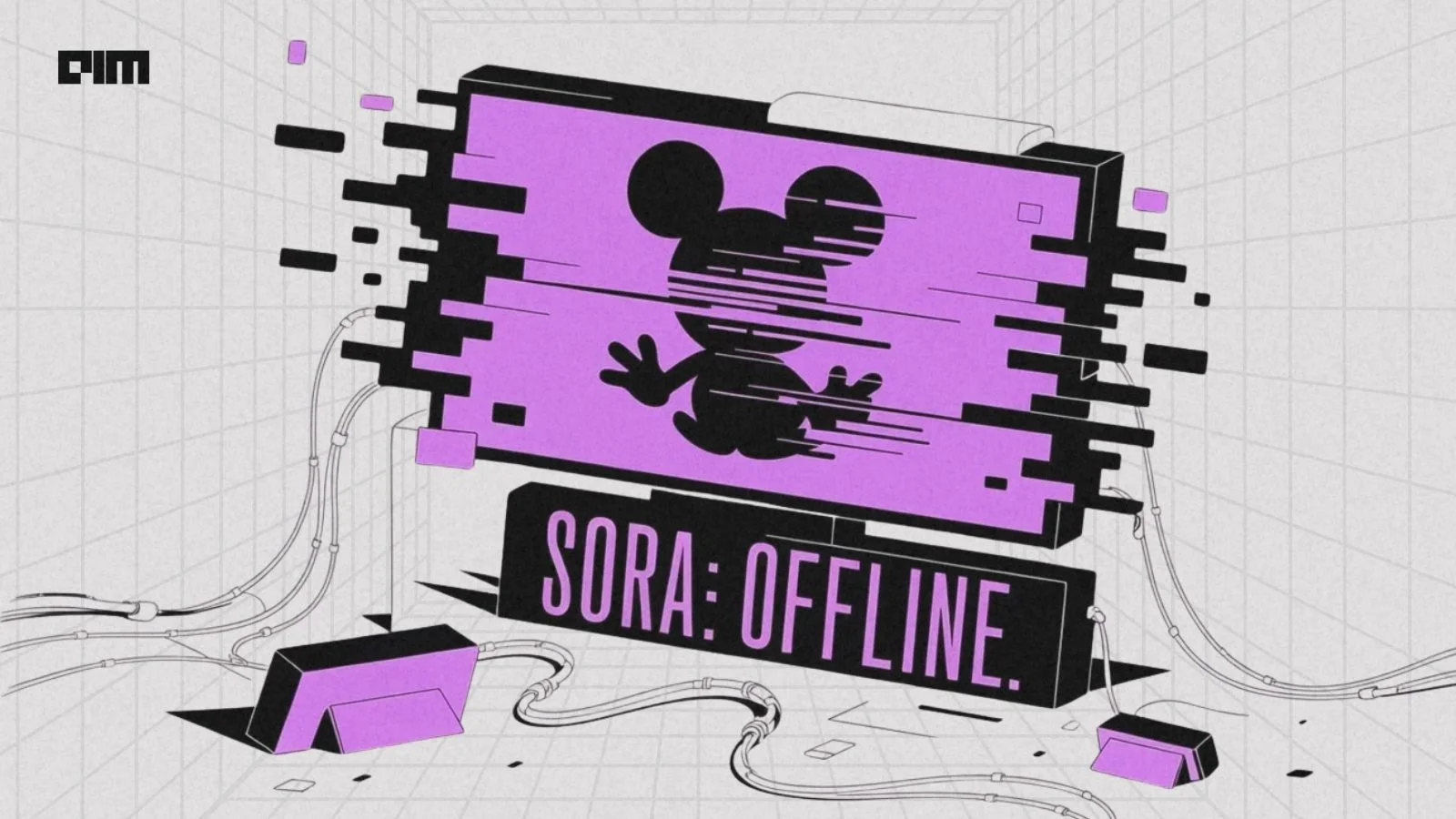
A pelican rides a bicycle. A jellyfish flies through a dense tropical forest. The late Queen Elizabeth II dances in a supermarket. That’s the kind of AI slop and brainrot that many fans of Sora will now miss.
OpenAI has shut down the video generation model, along with the app. The developer API for Sora will also be discontinued, and the video functionality will not be supported inside ChatGPT either, according to WSJ. The AI giant will share more details on how user work will be preserved.
With this development, OpenAI’s deal with Disney has also been terminated, just four months after it was announced.
Sora’s demise isn’t out of the blue, given that the app failed to attract a larger consumer base. While it saw early traction, crossing 9.6 million downloads and hitting 1 million users within days of launch, it remained a niche product compared to ChatGPT, which operates at a vastly larger scale with over 900 million weekly active users globally.
A Technical Leap
Sora 2’s launch in September last year was a massive leap in video generation realism and marked OpenAI’s entry into the consumer social media market. It functioned as a TikTok-style platform where users could share AI-generated videos. Its key features included a cameo capability that allowed users to insert their face and voice into scenes, along with a social feed for sharing and remixing clips.
Sora 2 also generated full audio-visual outputs with sound effects and dialogue, while maintaining continuity across multi-shot sequences.
“Sora was an app catering to the consumer segment. I think people are realising that using heavy compute resources to generate funny cat videos is not an economically sustainable model,” Ritwika Chowdhury, Founder and CEO of B2B video generation platform unScript AI, tells AIM.
The compute sure was costly as it was impressive. According to an estimate by Factorial Funds, it would take an hour of one NVIDIA H100 chip—costing between $25,000 and $40,000—to produce five minutes of video on Sora. It is also estimated that approximately 89,000 H100 GPUs would be needed to support the creator community on TikTok and YouTube, with that number hitting 720,000 during peak demand.
Moreover, Forbes estimated that OpenAI was burning $15 million a day to produce AI slop.
Back to Basics
More importantly, OpenAI is prioritising core, revenue-generating products. Executives have made it clear that productivity and enterprise tools come first, with the CEO of Applications, Fidji Simo, warning against ‘side quests.’
“We cannot miss this moment because we are distracted by side quests,” Simo told staff earlier this month, according to WSJ. “We really have to nail productivity in general and particularly productivity on the business front.”
For example, OpenAI’s Atlas browser project, music model, and shopping/advertising features are being re-evaluated. Instead, heavyweight projects like AGI research and robotics are being promoted.
OpenAI is also making internal leadership and strategic changes. CEO Sam Altman has stepped back from overseeing the company’s safety and security teams, reallocating his focus to infrastructure, capital, and compute as OpenAI is building a new model codenamed ‘Spud,’ according to The Information.
The company’s annualised revenue surged past $20 billion in 2025, up from $2 billion in 2023, as the company rapidly expanded its compute capacity, increasing from 0.2 GW in 2023 to 1.9 GW in 2025. But the AI giant saw what was coming. In October 2025, it struck a deal with Broadcom to design and develop 10 GW of custom AI chips and systems to power ChatGPT and Sora. According to Reuters, that deal would use as much power as 8 million US households.
But even that wasn’t enough.
Meanwhile, in January 2026, OpenAI CFO Sarah Friar hinted that the firm’s financial focus would be on practical adoption, particularly in health, science, and enterprise use cases where improved intelligence can directly translate into measurable outcomes. That sounded the death knell for Sora.
Disney Partnership and Its Collapse
With Sora’s shutdown, OpenAI has also discontinued its deal with Disney to bring iconic characters into AI-generated videos. It looked like a breakthrough moment. It didn’t last.
Disney had plans for a $1 billion equity investment in OpenAI and a three-year content licensing agreement that would let Sora users generate videos featuring over 200 Disney, Marvel, Pixar, and Star Wars characters. According to Reuters, the deal was never finalised, and no funds were exchanged.
However, for startups and developers using Sora’s API, the shutdown is a setback. With Sora gone, creators can turn to alternatives such as Google’s Veo 3, Seeddance 2.0, Kling, and Runway.
However, for them, distribution is still a challenge.
“Video model startups celebrating Sora’s shutdown don’t realise that the consumer use case requires something they lack: distribution,” wrote Zeeshan Patel, a former xAI member who worked on image models, on X. He added that xAI, Google, ByteDance, and Kuaishou are likely to dominate video model usage for the foreseeable future.
OpenAI Let a Thousand Flowers Bloom
Bilawal Sidhu, former product manager at Google and AI Creator, described the move as a predictable outcome of OpenAI’s broad experimentation. “This is what happens when you let a thousand flowers bloom—the garden gets overrun,” he wrote on X, pointing to the company’s sprawling set of parallel bets across products.
He contrasted this with a more focused approach from competitors. “Anthropic basically just made Claude really good at coding—and it’s working,” he said.
Sidhu also highlighted the gap in resources compared to Big Tech. “Google doesn’t have this problem—they’ve got the compute, the data, the distribution, so they don’t have to choose,” he said. “OpenAI tried to be both Google and Anthropic at the same time, and didn’t have the resources for either.”
The recent pullback, he argued, reflects a necessary correction. “Focusing back on ChatGPT and Codex makes sense,” he said, adding that ChatGPT remains the company’s strongest brand while coding is a critical battleground.
Meanwhile, Chowdhury believes that AI video models are likely to largely focus on business video production use cases.
Also, UC San Diego Professor Hao Zhang, who also heads LMNet.ai and LMSYS Org that aim to make LLM training accessible, believes that AI-generated content, such as from Sora, can only have a limited lifetime on social media, as the platforms, for most users, remain centred on human interaction.
“A mostly human feed with some AI content can feel fun. A mostly AI feed feels synthetic and eventually gross,” he wrote on X.
OpenAI’s decision to discontinue Sora suggests the AI market is entering a more disciplined phase, where experimentation is giving way to consolidation around fewer, more scalable bets.

Your reaction
Discussion
What's your take on this story?
No comments yet — be the first to share your view.