
GCC Salary Trends in India 2026: What the Numbers Actually Tell Us
AIM Research's GCC Salary Trends in India 2026 report examines compensation across roles, sectors, experience bands, and geographies, offering a clear read on where the market is heading and where structural tensions are building.
The GCC Pay Premium Is Widening, and That Is Deliberate
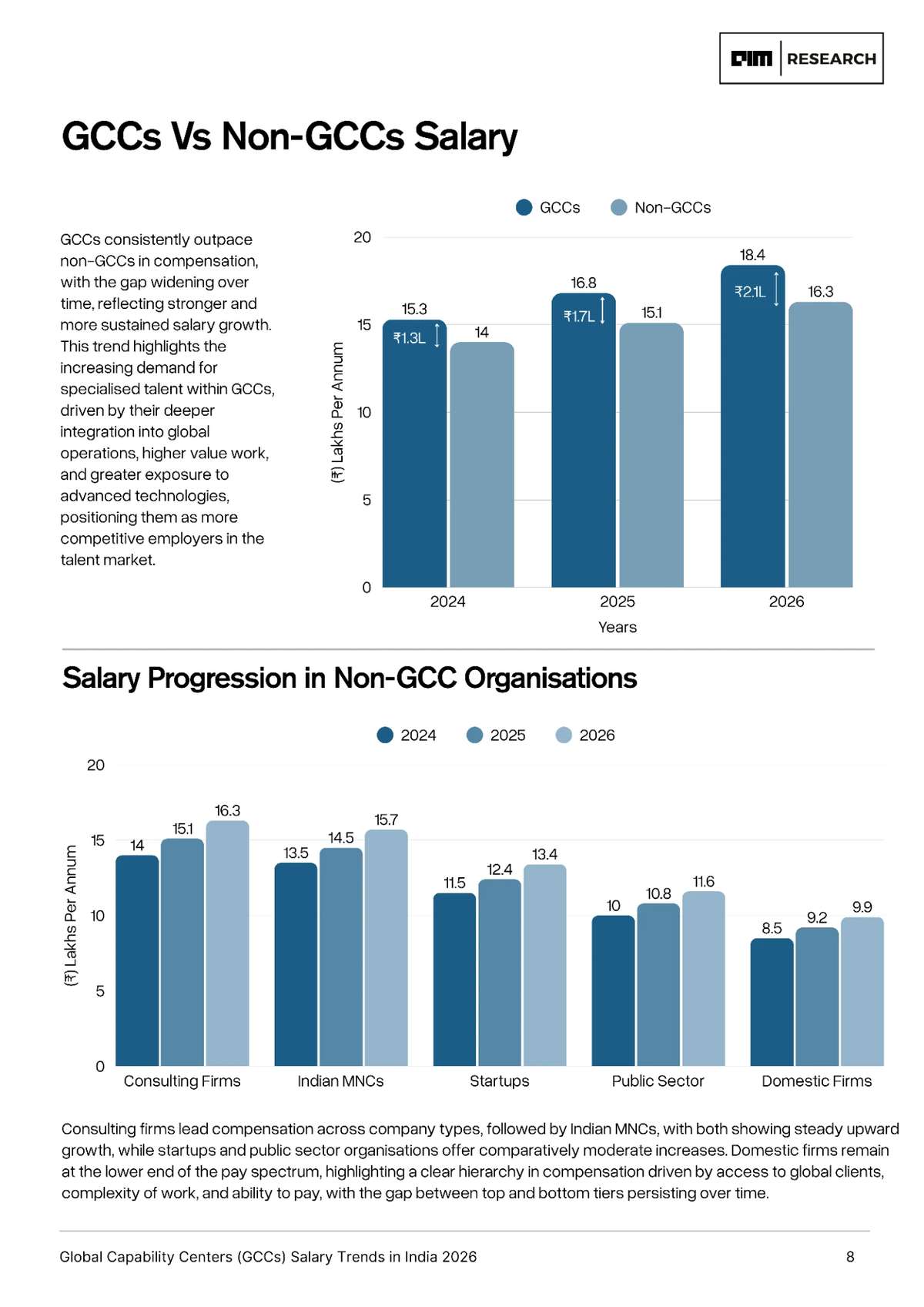
GCCs now offer a median salary of ₹18.4 LPA, with the pay gap over non-GCC employers growing from ₹1.3 LPA in 2024 to ₹2.1 LPA in 2026. As GCCs take on more complex, innovation-led mandates, they are competing for the same talent that Big Tech, product unicorns, and consulting firms are chasing. Among non-GCC employers, consulting firms lead at ₹16.3 LPA, while domestic firms sit at the bottom at ₹9.9 LPA.
Experience Is Still the Sharpest Dividing Line
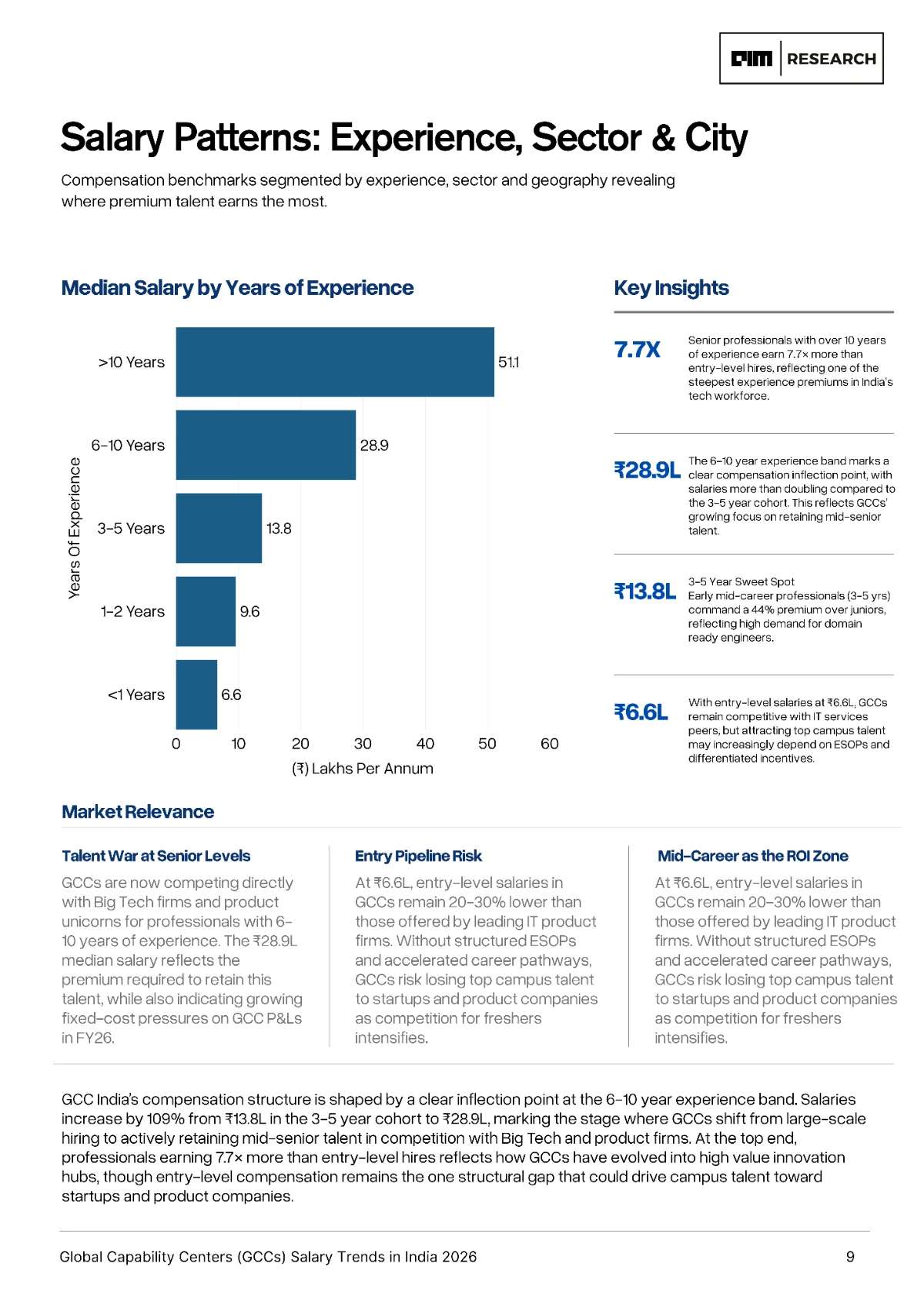
Entry-level professionals earn ₹6.6 LPA, competitive with IT services peers but below leading product firms. The real inflexion comes in the 6 to 10 year band, where median compensation more than doubles to ₹28.9 LPA from ₹13.8 LPA in the 3 to 5 year cohort. Senior professionals earn ₹51.1 LPA, a 7.7x multiple over entry-level pay, one of the steepest experience premiums in India's tech workforce.
Sector Hierarchy: BFSI Leads Overall, but the Story Is More Nuanced
BFSI commands the highest overall median at ₹30.1 LPA, driven by fintech complexity and regulatory talent scarcity. Software and Product Development follows at ₹27.1 LPA and overtakes BFSI at senior levels, with top roles reaching ₹69.0 LPA. The more surprising finding is Pharma and Life Sciences, whose top senior roles average ₹62.3 LPA, slightly ahead of BFSI's ₹61.8 LPA, as AI-led drug discovery investments make it increasingly competitive for specialist talent.
City Tier Dynamics: Convergence at the Top, Sharp Drop at the Bottom
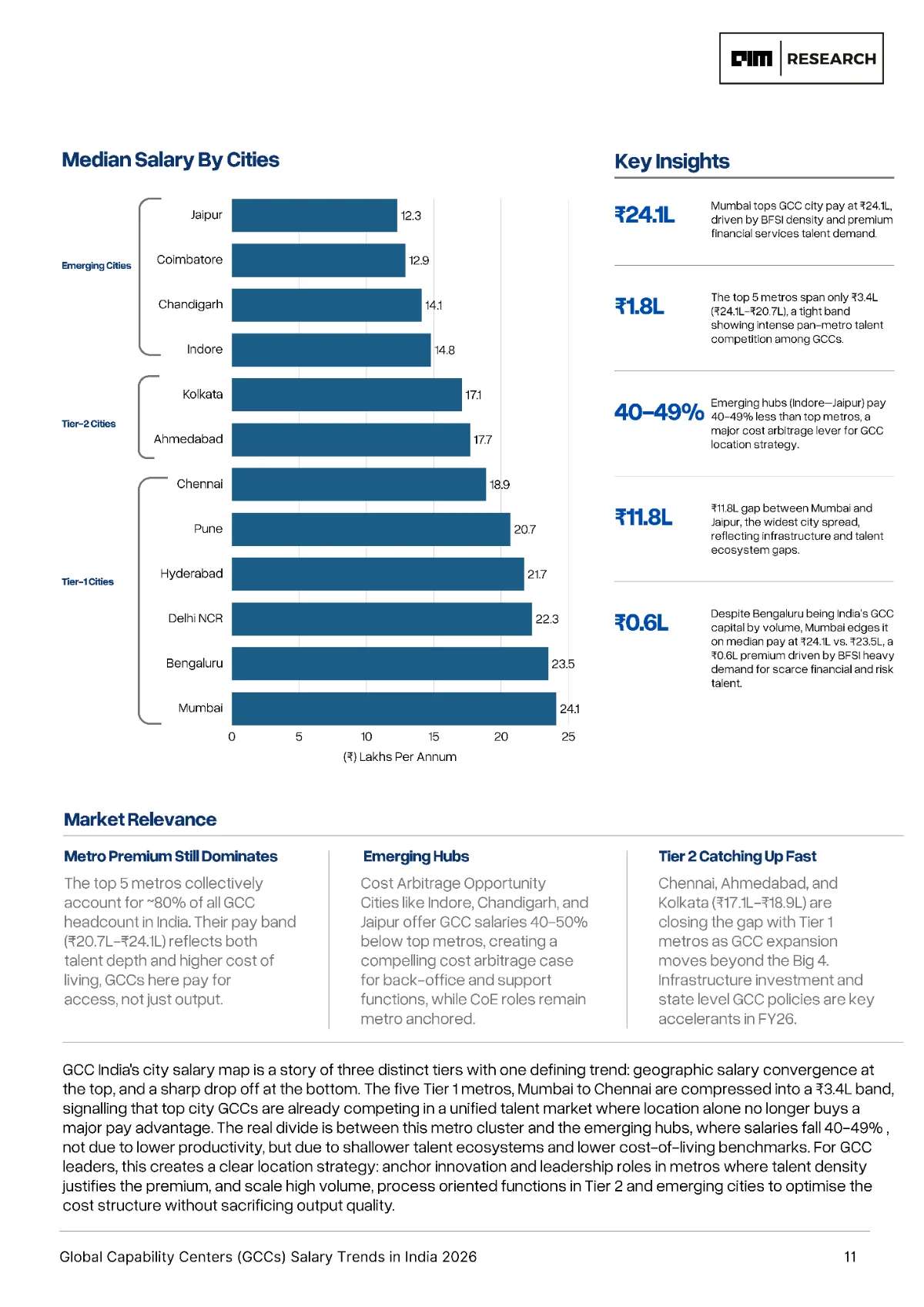
Mumbai tops the city pay table at ₹24.1 LPA, with Bengaluru close behind at ₹23.5 LPA. All five Tier 1 metros are compressed within a ₹3.4 LPA band, signalling that location alone no longer buys a major pay advantage. Tier 2 cities such as Ahmedabad and Kolkata are closing the gap, while emerging hubs like Indore, Chandigarh, and Jaipur offer salaries 40% to 49% below top metros, a compelling case for scaling support functions outside the big cities.
The Two-Tier Tech Divide Is Structural, Not Cyclical
Software Architects, AI/ML Specialists, and Data Scientists form a distinct upper tier, all crossing ₹50 LPA at senior levels. The remaining roles, including DevOps, Cloud, Full Stack, and UI/UX, operate in a meaningfully lower band. AI/ML and Software Architecture are converging at senior levels, reflecting the re-pricing of AI capabilities as a core engineering function. UI/UX, however, remains structurally undervalued across every sector and experience band despite growing investment in digital products.
The Non-Tech Picture: Narrower Than Expected
Tech professionals earn a median of ₹17.4 LPA against non-tech's ₹16.5 LPA, a narrower gap than most assume. Legal leads non-tech roles at ₹30.7 LPA at the senior level, while Content Writing sits at the bottom at ₹17.4 LPA, with AI already compressing pay at this end.
What does this mean for GCC Strategy?
GCCs are strengthening their position as preferred employers, but structural gaps around entry-level compensation, UI/UX undervaluation, and mid-tier compression will require deliberate intervention. The most durable competitive advantage will come from compensation architectures differentiated by role criticality and complemented by non-monetary value propositions that genuinely resonate with the talent segments that matter most.
- The Economics of Continuous Inference
- [Webinar Alert] Building Secure and Scalable Enterprise Applications in the Age of AI With Aurigo
- Hexaware Certified as Best Firm for Forward-Deployed Engineers by AIM
- Meet the Winners of AIM Chess League 2026
- Cypher 2026: AIM’s Best Firm Awards Spotlight 22 Companies Shaping India’s AI Workforce
- 2026 Minsky Awards for Excellence in AI Winners