
When OpenAI struck a deal with the Pentagon, after Anthropic backed out, citing ethical differences, the reaction online was swift and fierce. Within days, the ‘Cancel ChatGPT’ movement began trending across social platforms, with critics accusing the company of drifting from its safety-first origins towards closer ties with military power.
The backlash was not merely rhetorical. Mobile app data suggested a 295% spike in uninstalls in the days following the announcement. App stores were flooded with one-star reviews, and campaign organisers claimed that more than a million users had pledged to cancel their subscriptions.
OpenAI’s loss, at least temporarily, appeared to be Anthropic’s gain. Anthropic’s Claude climbed to the No. 1 spot on Apple’s App Store over the weekend, dethroning ChatGPT.
While OpenAI continues to see record-breaking financial growth, the movement has nevertheless caused a noticeable dent in its consumer market share.
The question now is whether this represents a structural problem—or simply a momentary storm.
The Numbers Behind the Noise
OpenAI’s deal with the US Department of War may be a strong business move, but so far it has proven less favourable for the company’s public image.
Before Anthropic aired its Super Bowl advertisements—which took a dig at OpenAI’s move to introduce ads in ChatGPT—the Claude app ranked 42nd on Apple’s App Store. Since then, it has remained in the top 10 most downloaded apps, but OpenAI’s Pentagon contract controversy helped push it into the top spot over the weekend.
ChatGPT users protested the defence deal across platforms such as Reddit and X, amplifying the ‘Cancel ChatGPT’ call. Some users posted guides for deleting ChatGPT accounts and migrating to Claude. Others accused OpenAI of opportunism, pointing out that Sam Altman had previously supported Anthropic’s stance before signing the deal that Anthropic had rejected.
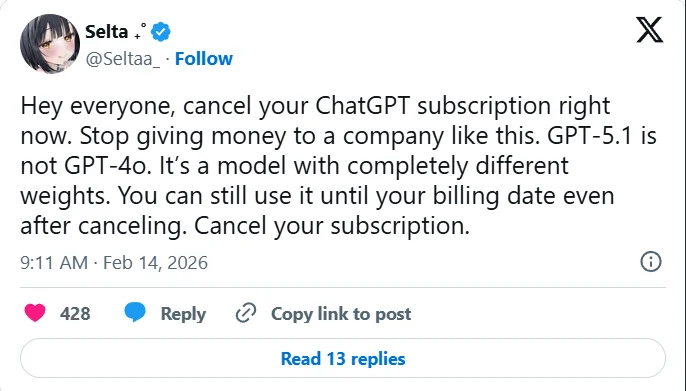
The backlash translated into measurable app-store activity. ChatGPT saw a 775% surge in one-star reviews on Apple’s App Store. Meanwhile, Claude climbed to the top position on the US App Store. The chatbot also reportedly lost approximately 1.5 million Plus subscribers who cancelled their subscriptions. While that number is not large enough to threaten OpenAI’s overall position, it does signal a shift in public sentiment.
Experts caution, however, that uninstall spikes reflect mobile behaviour rather than total usage, and may not capture the sentiment across the globe.
“OpenAI’s long-term valuation and revenue growth depend far more on enterprise contracts and infrastructure partnerships than on individual mobile subscribers. But OpenAI currently faces a balancing act in maintaining credibility with policymakers and retaining trust among individual users,” Ankur Bisen, Senior Partner at The Knowledge Company.
Reputational Risk
While reputational tremors do not automatically translate into financial shock, it does malign brand reputation over time.
The greater risk for OpenAI may lie not in user churn but in brand positioning.
OpenAI was founded with a mission centred on developing safe and broadly beneficial AI. Critics argue that defence contracts complicate that narrative, particularly amid growing concerns about surveillance and autonomous weapons.
The company now faces a delicate balancing act: pursuing commercial opportunities while maintaining its commitment to safety and public trust. This tension is not unique to OpenAI. As AI systems become embedded in national security, healthcare, finance and defence, every major AI firm is likely to face similar trade-offs.
Jaspreet Bindra, founder of AI&Beyond, believes OpenAI is navigating a particularly delicate situation. “The current situation certainly needs handling. It’s not the time for OpenAI to panic but to get cautious, particularly considering the increasing backlash around AI,” Bindra says, adding, “Sam Altman has been backpedalling because his reputation is already damaged.”
Despite the controversy, ChatGPT remains one of the most widely used AI tools in the world, with hundreds of millions of weekly users globally. Against that backdrop, even a seven-figure protest—while symbolically significant—represents a relatively small portion of the total user base.
Yet, the ‘Cancel ChatGPT’ campaign exposes a more subtle vulnerability: trust volatility.
AI companies operate in a uniquely fragile public environment. Users are not merely customers; they are participants in a technology that shapes labour markets, information flows and national security. When public perception shifts, it can shift quickly.
If future controversies stack up, whether related to defence applications, data governance or safety failures, reputational shocks could begin to compound.
For now, however, the ‘Cancel ChatGPT’ movement appears to be a sharp but contained backlash.
Is Anthropic Benefiting?
In the short term, Anthropic appears to be gaining.
In contrast to OpenAI’s Pentagon partnership, Anthropic positioned itself as maintaining firmer ethical boundaries. For users seeking alternatives, that contrast created a clear narrative.
Whether this momentum translates into sustained market share gains remains uncertain. AI users frequently experiment across platforms, and switching costs at the consumer level remain low. Claude’s surge may therefore reflect protest-driven curiosity as much as lasting migration.
Moreover, Anthropic itself has engaged with US defence officials in discussions over AI use, suggesting the ethical divide between the companies may be narrower in practice than in perception.
Bindra offers an interesting point. “From a business standpoint, Anthropic is in bigger trouble than OpenAI. They can’t be at loggerheads with the US government for the simple reason of survival, unless they decide to shift to Spain.”
His remark may not be far off the mark. Reports suggest that Anthropic CEO Dario Amodei is already back at the negotiating table with the US Department of War.

Your reaction
Discussion
What's your take on this story?
No comments yet — be the first to share your view.