Key takeaways
- Rethink AI adoption by integrating human decision-making with AI for better outcomes.
- Recognize the high failure rate of AI pilots, with 95% not reaching production.
- Balance instinctive and strategic thinking to enhance decision-making in AI workflows.
- Clarify the role of humans in AI systems for improved efficiency and accountability.
- Address anti-patterns in AI design to avoid pitfalls and enhance performance.
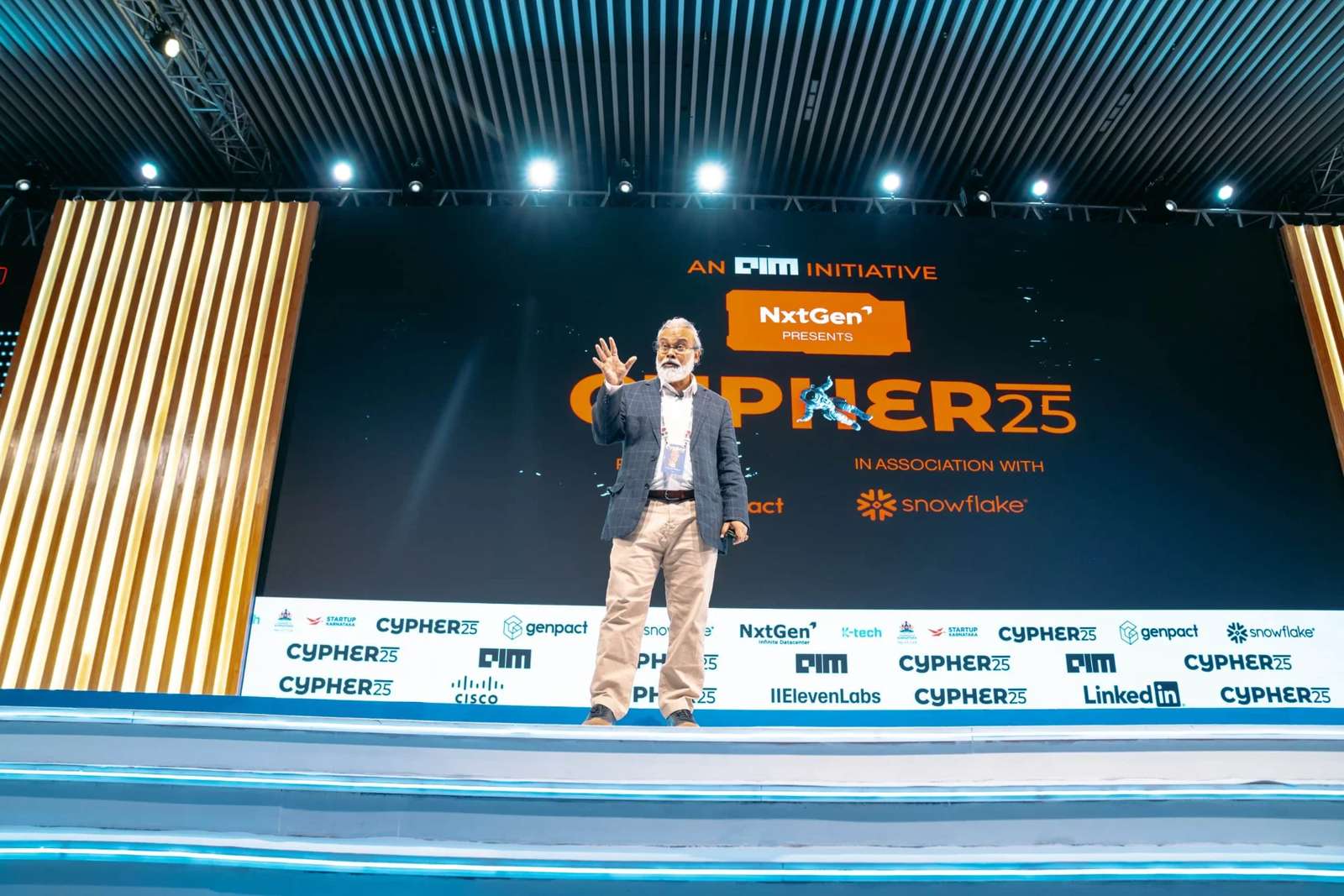
Soumendra Mohanty, chief strategy officer at Tredence, wants the industry to rethink AI. Human instinct and cognition, when combined with AI, form the foundation for decision-making and innovation, he said while terming this approach as IA, or individual dexterity.
Mohanty was addressing the audience at Cypher 2025, India’s largest AI conference organised by AIM from September 17-19.
Drawing a parallel between human evolution and the rise of AI, he said that instinctive, fast responses need to coexist with deliberate, strategic thinking.
While AI tools are solving narrow problems, Mohanty said strategic decision-making remains a challenge. Citing MIT research, he noted that about 95% of GenAI pilots fail to reach production. Managing paradoxes, bounded rationality, and human cognition are key to strategic decision making, he said.
He explained that people struggle when faced with multiple options involving value trade-offs. At the same time, they face information overload from the rapid pace of AI innovation. Balancing instinctive “fast thinking” with deliberate “slow thinking,” described by Daniel Kahneman as System 1 and System 2, is critical, Mohanty said.
As organisations test autonomous systems, he questioned the role of humans in the workflow. Should humans remain in the loop, above it as observers, or outside it entirely, setting rules and policies? Developing clarity on this balance, he said, is vital for both efficiency and accountability.
Mohanty argued that many AI pilots fail because they are designed around patterns, but ignore anti-patterns. “In software engineering, we also think about anti-patterns. But in the case of AI and agentic AI, especially LLMs at the core of things, we actually don't understand how it does,” he said.
To bridge this gap, he proposed Agentic Operating Systems—engines that orchestrate scale, performance and governance with built-in guardrails. Governance, he said, cannot be an afterthought. It must be visible, calibrated, and embedded in the system.
He also introduced the Ambidex Framework, a blueprint for balancing AI and IA. It is designed to assess workflows, mitigate anti-patterns, build skills for agentic systems, integrate mechanisms, and design for ambiguity. “We live in a world full of uncertainties. Ambidex is about creating systems that can adapt to ambiguity, just like humans do,” he said.
Closing his session, Mohanty unveiled Milky Way, a workflow system developed by Tredence aimed at analysis-oriented workflows, which he called one of the hardest problems in AI.
Mohanty concluded that the future of AI is not just about smarter machines but about amplifying human dexterity. “AI will only reach its true potential when it works in harmony with IA, which is you and me,” he said.