

India’s ambition to become an AI-first economy may hinge on a deceptively simple idea of making its vast public data usable.
To tackle this challenge, the EkStep Foundation, a Bengaluru-based non-profit established by Nandan Nilekani in 2014, is working on a new concept it calls ‘Data Passport’. It is essentially a framework that prepares datasets for safe sharing, connection, and use by AI platforms.
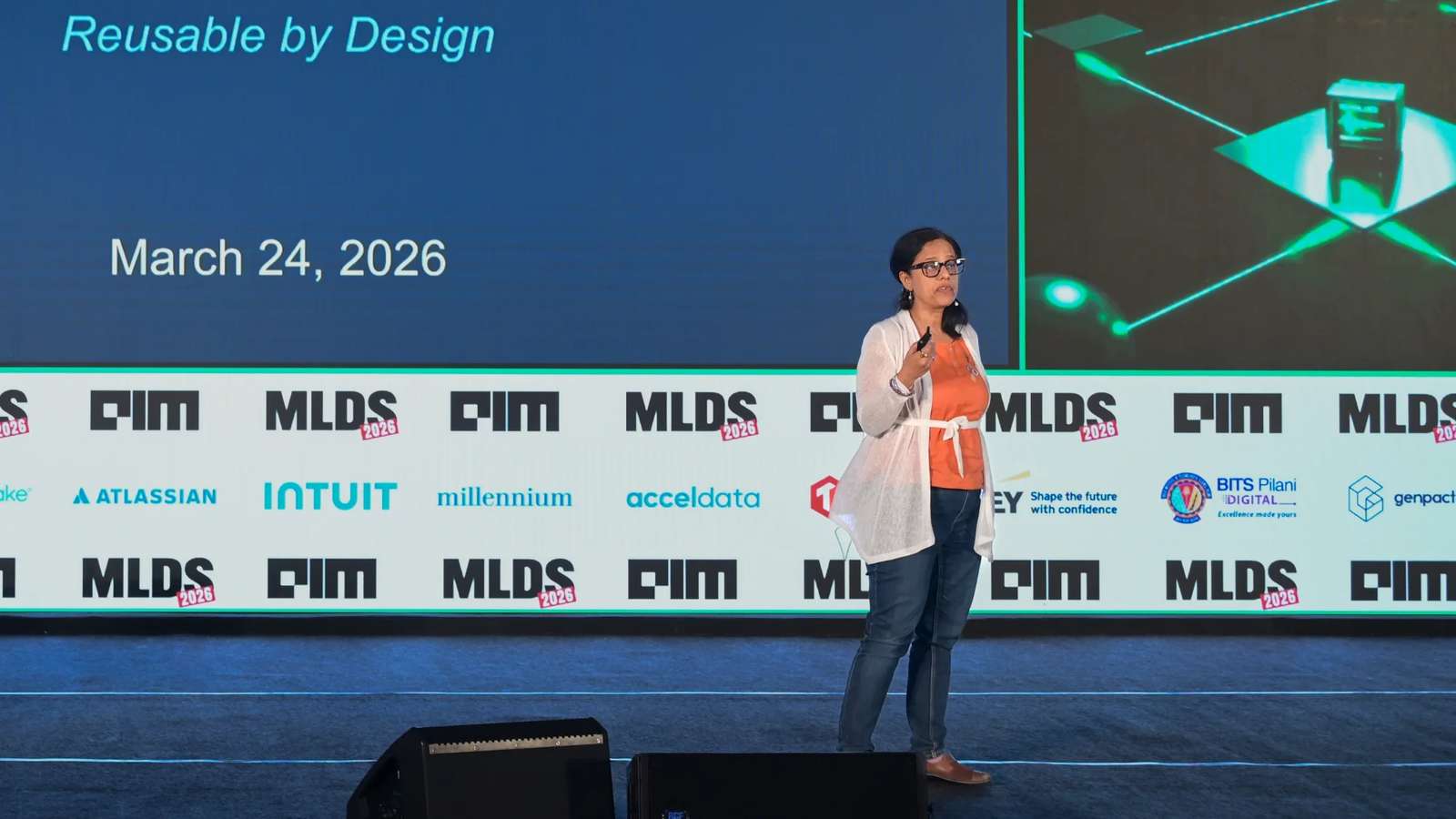
Speaking at MLDS 2026, India’s largest agentic AI conference organised by AIM Media House, Shalini Kapoor, Chief Strategist for Data & AI at EkStep Foundation, talked about why India’s data remains underutilised and how a structural rethink could unlock its true value.
Data is Plenty, But it Doesn’t Talk
India is not short on data. Kapoor breaks it down into three broad categories: administrative data (like GST and UPI transactions), census data, and survey data used to compute GDP. Together, they form a rich but fragmented ecosystem.
“Data in the country is huge, humongous, but it doesn’t talk to each other because it has been created in different systems,” she explained.
From farmer IDs, health IDs, to PAN records, datasets have been built in silos over decades. This has created a structural disconnect that limits their usefulness, especially for AI models that depend on interconnected data.
India has already built world-class digital public infrastructure, including Aadhaar, UPI, and DigiLocker. But Kapoor argued that AI requires the next layer of innovation.
“If this data is not connected, the businesses cannot grow,” she said, linking the issue directly to India’s “Viksit Bharat 2047” vision.
While individuals and organisations are experimenting with AI, large-scale societal impact remains limited. The missing piece is not AI capability but how data can be made to work together.
Learning From the Web’s Playbook
Kapoor drew a parallel with how the internet developed.“The web was made linkable across thousands of documents, and that's what is feeding the LLMs,” she said.
Just as HTTP and URLs standardised how web pages connect, India now needs a similar mechanism for data. Although frameworks like the National Metadata Standards exist, awareness and adoption remain low.
Kapoor used agriculture as an example to explain how data fragmentation is a challenge and what opportunities lie ahead. Farmers need insights that combine weather data, soil conditions, market prices, and scientific research. But these datasets exist across disconnected institutions, often in incompatible formats, sometimes even locked in PDFs.
She mentioned that today, a lot of data is held by agricultural scientists and institutes like the Indian Council of Agricultural Research on products, pests, and crops. Also, she lamented that there are research papers in PDF format which have just not been put together yet.
However, EkStep is trying to change this. Through initiatives like MahaVISTAAR-AI and BharatVistaar, the organisation has built AI platforms that unify these data sources.
Kapoor said farmers can now ask questions in their local language through voice interfaces and receive actionable answers. This required extensive groundwork, including cleaning data, standardising formats, and building glossaries.
“We had to identify the gaps and the quality of the data sets. We had to look at formats, spellings, and mismatches because the systems were in different institutions,” she explained.
Moreover, it was also important to link datasets correctly at the district level so the information could be used reliably.
Enter the Data Passport
Kapoor expressed that the challenge today is not the availability of tools but the hesitation in public institutions to share data. “The fear of sharing the data in public sector institutions is at an all-time high.”
To address this, EkStep is building a framework called the ‘data passport’.
“It’s like your passport… it makes you ready for travel, it doesn’t take you anywhere,” Kapoor explained.
A data passport certifies that a dataset is AI-ready, standardised, structured, and safe to share. It includes specifications around schemas, knowledge graphs, vector databases, and interoperability protocols.
This is complemented by the concept of a data boarding pass, which allows purpose-driven, temporary data sharing, similar to how DigiYatra seamlessly links identity, flight, and security systems without storing data centrally.
Kapoor described the ecosystem as having two sides: data holders, including government systems and institutions, and data consumers, including businesses, investors, and platforms.
The goal is to create a trusted exchange layer between them.
“Data passport holders can declare that their data is AI-ready and ready to be consumed,” she explained.
Kapoor’s core argument is that India’s AI future will not be defined by models alone but by how well its data is prepared and connected.
The country has already shown what is possible with digital public infrastructure. The next leap toward a true AI economy will depend on whether it can build a similar foundation for data.
- Anthropic Makes $2.08 in Revenue for Every $1 Spent on Compute — Here’s the Full IPO Story
- OpenAI Says AGI is Here. But Not Everyone is Buying It
- Why Oracle is Bringing Post-Quantum Security to Java
- What Really Happens When You Turn Your Selfie Into a 1980s AI Pic?
- AI Agents Are Making Data Security A Bigger Enterprise Problem
- OpenAI is Getting Nervous About Reinforcement Learning