
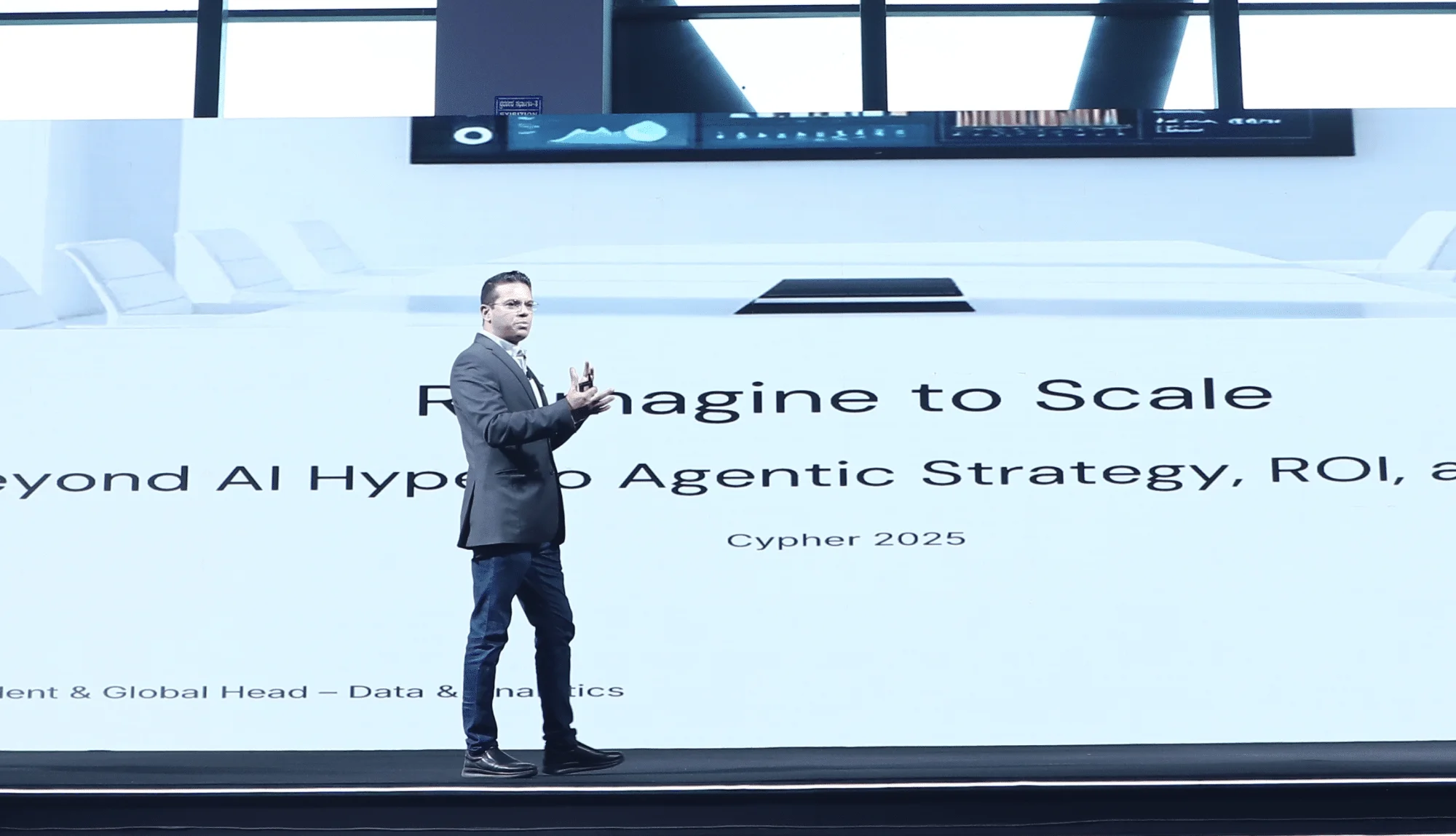
AI should be seen as a transformative force to reinvent businesses and industries, not just as a tool for marginal efficiency, according to Saurabh Jha, SVP and global head (Data and Analytics) at Tech Mahindra.
Speaking at Cypher 25, India’s largest AI conference organised by AIM from September 17-19 in Bengaluru, Jha argued that most large enterprises are underutilising AI by focusing only on incremental process improvements—like automating customer service—rather than reimagining and reinventing their entire business models.
Studies back this concern. MIT’s GenAI Divide report found that 95% of generative AI projects fail to deliver results. An IBM survey of 2,000 CEOs showed only one in four AI initiatives delivered expected ROI, with just 16% scaling enterprise-wide. CEOs cited disconnected technology, risk aversion, and short-term investment pressures.
During his session on “Reimagine to Scale: Beyond AI Hype to Agentic Strategy, ROI, and Trust,” Jha questioned why so few leaders are satisfied with AI investments. “Less than 30% of CEOs are satisfied. My question is, why? How has your business changed? Has it transformed your industry, your customer, your processes?” he asked.
A Gartner report also showed that despite an average spend of $1.9 million on generative AI in 2024, fewer than 30% of AI leaders said their CEOs were happy with the returns.
Jha criticised the narrow focus on customer service. “Wherever I go, the first thing they talk about is customer service. They want to use agents to replace service reps. Is that the potential of AI? It’s way beyond that,” he said.
He compared the arrival of generative AI in 2022 to the launch of the iPhone in 2007, which disrupted industries and created new businesses. “There’s a huge lack of imagination. We are trying to harness transformative technology with linear thinking,” he said.
To illustrate, he described a “faceless app” that could manage the entire home-buying process—from search to financing—by coordinating multiple businesses in the background. “Which CEO will stand up and say, let’s change the entire game of house purchase for our customers? Because that’s what AI is capable of. If they don’t do it, a startup will,” he warned.
Jha urged enterprises to move from being “AI enabled” to truly “AI first.” Resisting AI or restricting it to enablement, he said, would lead to obsolescence. “The only way to exist 10 or 20 years down the line is the third one—total business model reinvention,” he said.
He also pushed back against job cuts as the default approach. “Why not the other way around? Let’s keep all the people, make them super agents, and perform 20 times better?” he asked.
Measuring AI through old ROI metrics such as cost savings or turnaround times, he argued, misses its transformative value. “It’s a transformative technology, which we are trying to measure with tools from the 1990s. The hardest question is, how did you change your company or industry, and what competitive edge did you gain?” he said.
On governance, Jha warned of challenges as companies deploy “thousands of agents talking to each other 24/7.” Leaders must decide who owns these agents, who can stop them, and how to explain their actions. “The CEO cannot say AI did that, because the next question will be, why did it do that? And you will have no answers,” he said.
He cited a packaged food company that created a parallel startup arm to experiment with transformation, planning to absorb or replace the legacy business once the new AI-first model scales.
Jha ended by noting AI could solve bigger problems such as urban traffic, but also stressed the role of “common sense” solutions and cross-sector collaboration with government and startups.

Your reaction
Discussion
What's your take on this story?
No comments yet — be the first to share your view.