
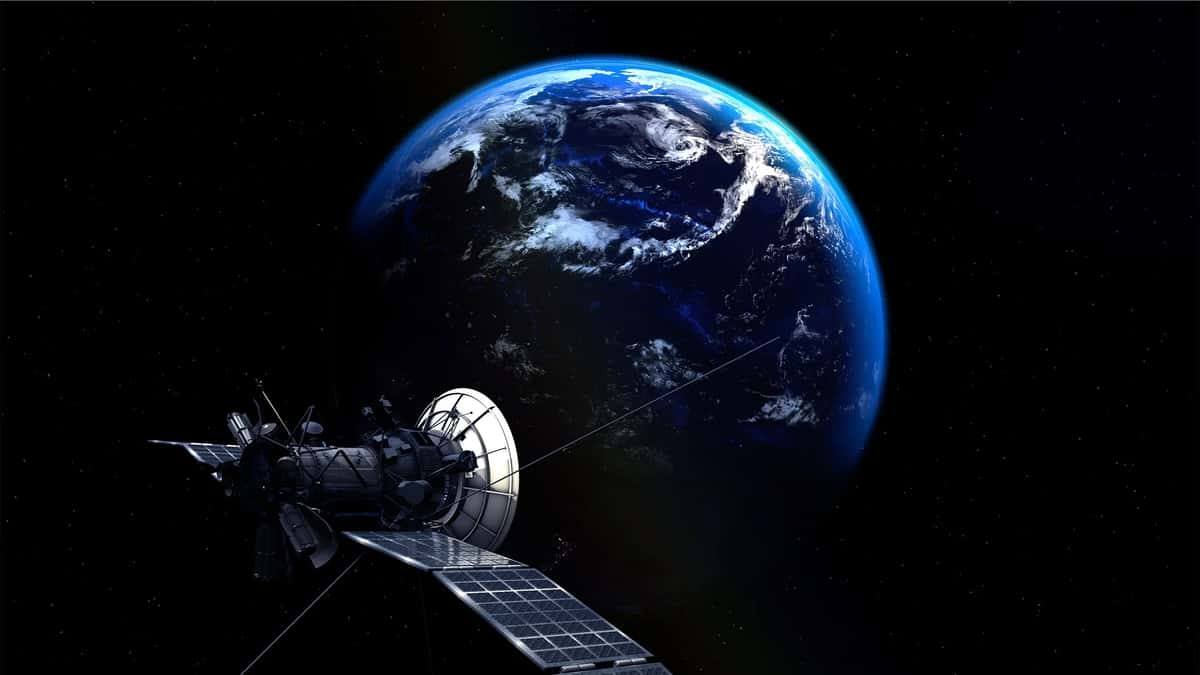
We don’t know when humanity first dreamed of travelling into outer space, but we have not shut up about it ever since. We’ve been telling stories about alien worlds for longer than anyone has been alive. We’ve been making movies about flying to the moon since the dawn of cinema.
With fast-moving technology being innovated every other day, the reality is similar to those movie plots now. With the ethos of the sky is not the limit, the industry is gearing up and making some marvellous innovations.
Here are the ten biggest developments in space tech in 2022!
- Microsoft partnered with NASA
NASA’s Jet Propulsion Laboratory partnered with Microsoft’s Azure Quantum team to communicate efficiently with spacecraft. With the increased frequency of space missions, communicating with spacecraft is becoming increasingly challenging.
With intensive computing resources, these missions also require access to key communication, resulting in several hundred weekly requests for each spacecraft to be visible to the antenna. This is where Microsoft applied some of its quantum algorithms to tackle NASA’s scheduling headache. Using its Azure network, Microsoft created a schedule in 16 minutes. Finally, a further “custom solution” allowed it to make one in a duration of two minutes.
- ANANTH launched a spacecraft manufacturing facility
Hyderabad-based aerospace and defence manufacturer ANANTH launched a spacecraft manufacturing facility in Bengaluru. ISRO chairman Dr S Somnath inaugurated the facility in June 2022.
The state-of-the-art spacecraft manufacturing facility can conduct assembly integration and testing of four large spacecraft simultaneously. It’s also India’s first-ever private spacecraft manufacturing and testing facility.
- Webb shows off the deepest infrared image of universe
In a press conference, NASA shared James Webb Space Telescope’s first images. According to the space agency, it is “the deepest and sharpest infrared image of the distant universe to date”.
“Bear in mind that 90% or more probably, of the analysis tools, the simulators and so on, are developed in Python and use Python”, remarks Dr Patrick Kavanagh, astrophysicist and software developer, while speaking at the 2022 EuroPython event.
Kavanagh further explains that the final images differ from the images transmitted from Webb. This is because the telescope sends raw data, which requires refining, to Earth and that’s where Python comes in.
- Accenture invests to monitor Earth’s health
Accenture invested in Pixxel, a space tech company building the world’s highest-resolution hyperspectral imaging satellite constellation. The terms of the deal are yet to be disclosed by the firm. The investment has been made through Accenture’s start-up venture arm, ‘Accenture Ventures’, to offer AI-powered insights to predict, discover, and solve climate issues at a fraction of the cost incurred from traditional satellites.
- SpaceX’s Starlink enters all continents
Elon Musk’s Starlink is now available on all continents, including Antarctica. According to agency reports, the National Science Foundation (NSF) announced the testing of one of Starlink’s internet terminals at McMurdo Station in Antarctica.
A part of Musk’s Space Exploration Technologies Corp (SpaceX), Starlink delivers internet broadband from a constellation of satellites that orbit the lower earth. The company’s recent findings show that it has launched over 3,000 satellites and serves over 400,000 subscribers.
- NASA crashed an aircraft into an asteroid
NASA intentionally flew a spacecraft right into an asteroid to alter its trajectory. To many, this may sound like the plot of a science fiction novel—only it’s not. In the 1998 film, Armageddon, directed by Micheal Bay, NASA hires oil driller Harry Stamper (played by Bruce Willis) and his team to destroy an asteroid the size of Manhattan headed towards earth.
NASA, through its Double Asteroid Redirection Test (DART) Mission, did something similar this time. The DART demonstration was part of the overall planetary defence strategy developed by NASA to counter threats from celestial bodies. It was the world’s first planetary defence test mission.
- NASA revealed 3D-printed LINA
NASA and AI Space Factory developed a 3D-printed outpost, LINA (Lunar Infrastructure Asset). The aim is to expand civilisation to the moon and explore its sustainability that minimises human disturbance.
The project is involved with the Relevant Environment Additive Construction Technology (REACT), a partnership developing technologies within the timeframe of the Artemis Mission for lunar surface constructions.
- Sierra Space collaborates with IBM
Sierra Space has been at the forefront of establishing the future of space transportation and infrastructure for low-Earth orbit (LEO).
The MoU between Sierra and IBM is a draft of the companies’ plans to incorporate IBM’s technology to deduct the Sierra Space astronauts’ workload through data analysis and collection. Furthermore, IBM plans to support Sierra Space by building a first-of-its-kind technology platform in space.
- ISRO’s Vyommitra gets lift-off with digital grey matter
ISRO’s ‘Vyommitra’, the humanoid designed to fly uncrewed test missions aboard, is undergoing pre-flight ground tests at the ISRO Inertial Systems Unit (IISU).
The AI-enabled robot is designed to fly aboard a rocket while resisting vibrations and shock. Furthermore, it resembles a human with facial expressions, speech, and sight capabilities.
- NASA initiates independent UAP study
NASA selected 16 participants for its independent study team on unidentified aerial phenomena (UAP). Events observed in the sky apart from aircraft or natural phenomena are categorised as UAPs.
The study began on October 24, 2022. Over nine months, the team will lay the foundation for future studies on UAPs for several organisations. The study will focus solely on analysing civilian government entities and commercial data to shed light on UAPs.
A report containing the team’s findings is likely to be released by mid-2023.
- ‘Nobody Wants a Proprietary Platform,’ Says Coforge’s Anup Nair
- Why Buying Specialist Engineering Firms Won't Fix Indian IT’s Growth Problem
- The Anthropic-Indian IT Partnership Is a Two-Way Bet
- Coforge Is Outgrowing Its Larger Rivals. Is AI the Reason?
- Are Boutique AI Firms India’s Next Big Thing?
- Indian IT’s New Workforces Come with a Margin Challenge