Why N Chandrasekaran Wants TCS to Have as Many AI Agents as Employees
By Ajay Rag ·
For the past several months, India's IT sector has been living through an AI crisis. The Nifty IT index has shed nearly 40% from its December 2024 peak. TCS's own market capitalisation briefly dipped below ₹10 lakh crore for the first time since 2020.
For Indian IT investors and employees, a central concern is now challenging their raison d’etre: if artificial intelligence can write code, test software, and run technology operations autonomously, what exactly is the industry for?
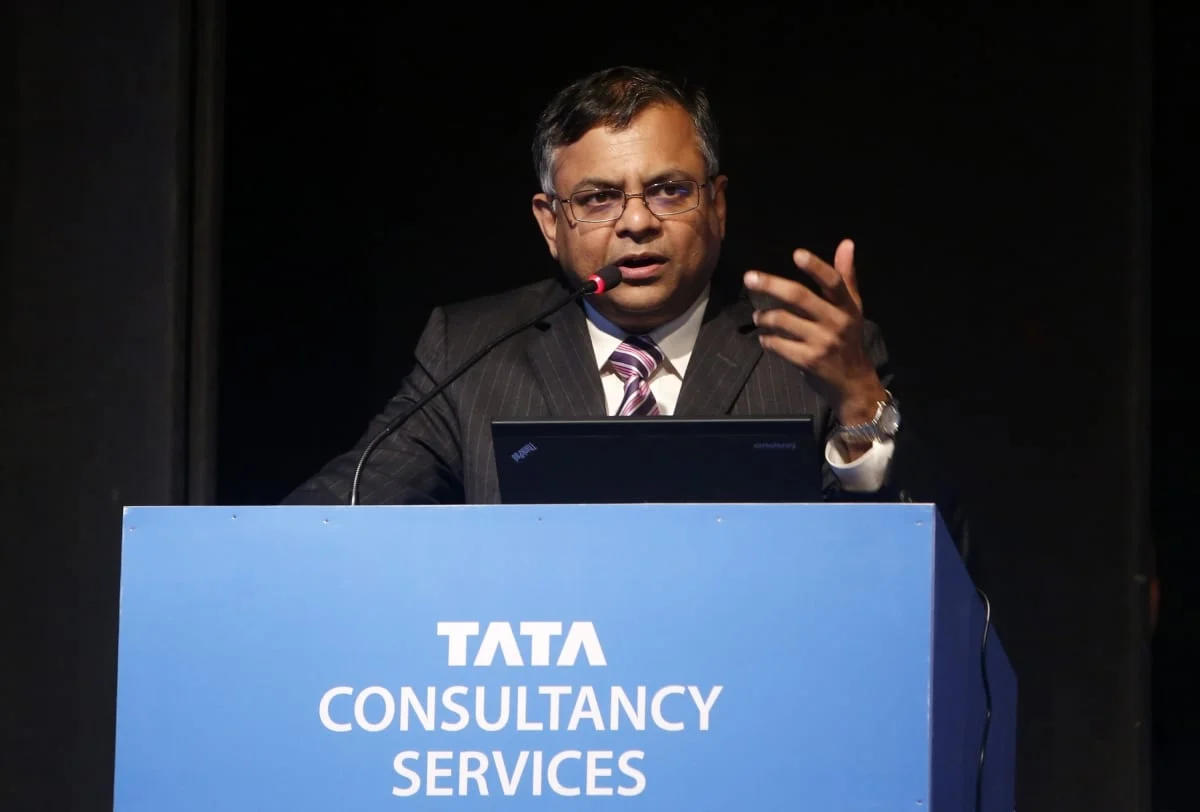
At TCS's 31st Annual General Meeting on June 9, Chairman N Chandrasekharan offered his answer.
"The day is not very far when TCS will have an equal number of AI agents or AI workers as their physical workers," Chandrasekharan told shareholders in his speech.
In May, OpenAI launched what it called the OpenAI Deployment Company—a $4 billion venture backed by TPG, Brookfield, and Bain Capital, designed to embed ‘forward deployed engineers’ directly inside corporations to build, integrate, and manage AI systems. Anthropic wasn’t far behind either, launching a $1.5 billion joint venture with Blackstone, Hellman & Friedman, and Goldman Sachs to build an enterprise AI services company.
The move was read as a direct play for the kind of high-value enterprise transformation work that has traditionally been the domain of companies like TCS and Infosys.
Yet, when Chandrasekharan looks at the same landscape, he sees something different. He challenged the narrative that has hammered IT stocks for the better part of two years: that AI is a mortal threat to the industry's business model.
"Far from being a mortal threat, AI is the most significant opportunity yet for TCS and in fact for the IT industry as a whole," he said.
TCS's AI revenues have grown every quarter for four consecutive quarters, compounding at over 22% each quarter, near-doubling on an annualised basis. The most recent quarter saw those revenues run at an annualised rate approaching $2.5 billion. This is a two-thirds increase over when TCS disclosed its AI revenues for the first time at TCS's Analyst Day in late 2025.
Interestingly, TCS's total workforce has also been contracting. The company shed nearly 20,000 employees in a single quarter in 2025, one of the steepest declines in its history, as part of a workforce restructuring.
‘We Did Not Use Less Coal’
In late 2024, agentic AI systems began to look genuinely enterprise-ready—capable of writing code, testing software, and running technology operations autonomously. The Nifty IT index lost more than a third of its value. If machines could do the work, the logic went, what need would the world's largest corporations have for an army of engineers?
To make sense of the shift, Chandrasekharan recalled the Industrial Revolution. "When steam engines made coal more efficient, we did not use less coal," he said. "We used more because it unlocked new uses and opportunities." AI, he noted, will do a lot more than any of these examples at a greater scale and across a wider canvas.
It is an "infrastructure of intelligence", and as its cost falls, the number of processes, decisions and interactions across every industry that become candidates for AI-driven transformation will expand dramatically.
A Message to the Market
Markets, he acknowledged, have not yet fully come around. But he noted that despite the stock rout, TCS's margins have held steady, revenues have grown, and the deal pipeline is stronger than ever—evidence, he argued, of a gap between perception and underlying reality.
“I believe the disparity fundamentally stems from the misconception surrounding the relationship between AI and IT services,” he said.
At its core, Chandrasekharan's address was a confidence statement, directed as much at nervous investors as at his own workforce.
The India IT sector's global standing was built, he reminded, on a reputation for taking complex, high-stakes technologies and making them work reliably inside demanding institutions. That capability, he argued, is precisely what AI deployment at enterprise scale will require.
TCS’ shares on June 9 remained relatively flat at ₹2,152 apiece.