
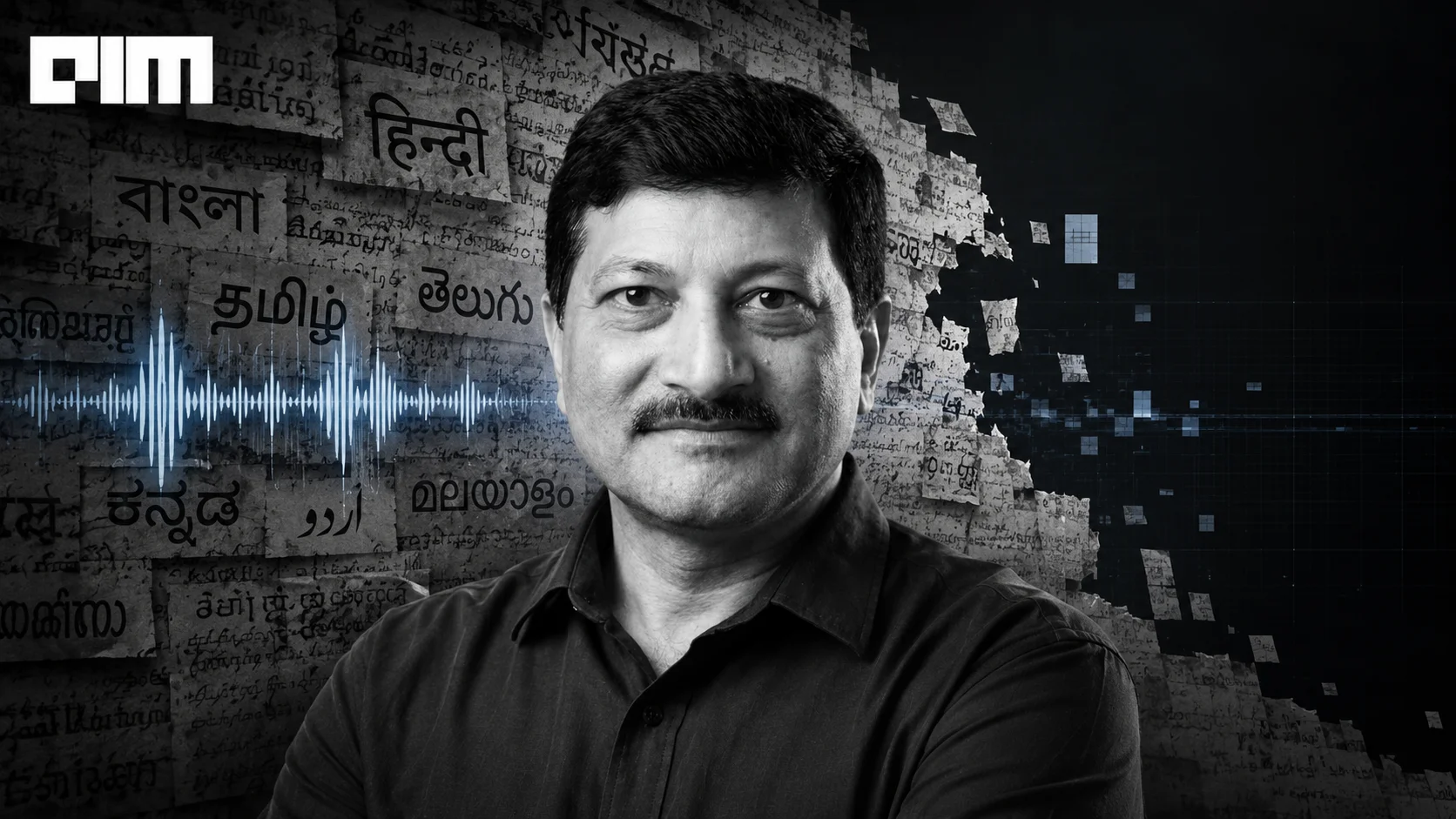
In 2019, Reliance Industries paid roughly ₹190 crore (~$27 million) to acquire Reverie Language Technologies, the Indian language technology company solving local language computing limitations on feature phones and early smartphones. Vivekanand Pani, his brother Arvind Pani, and S K Mohanty built it in 2009.
The deal was notable not just for its size, but for how little capital had gone into building the company: Reverie had raised just over $4 million.
For most founders, that would have been the end of the journey. Build, scale, sell, move on.
Pani did something different.
After nearly 30 years working on Indian language computing, he came back with Coremantle, a new company built to solve the problem his first company had exposed. The data needed to make AI actually understand how Indians speak is still painfully inadequate.
The problem is particularly acute now, as AI companies race to build voice systems that can work across India’s languages. India has over 22 official languages, a hundred other major languages, and thousands of dialects. Once accents, code-switching, regional variations, and domain-specific vocabulary enter the picture, the problem compounds exponentially.
Pani believes the industry is also looking at the problem the wrong way. The answer, he argues, is not simply to generate more data, particularly synthetic data, but to collect more natural conversations.
He points to an uncomfortable example. On leaderboards, speech-to-text systems for English can show word error rates below three. But in real-world conversations, he says, that number can jump six times, reaching 15 or even 18.
English has an enormous advantage: decades of digital data. But Indian languages are nowhere near that depth of documentation.
“If the error rate jumps six times in real-life conversations for the most that’s a huge resourced language, then we can as well imagine how it would be like for low-resource languages,” Pani tells AIM.
That is where the Coremantle thesis begins.
The Complexity of Indian languages
The obvious assumption is that if AI models are struggling with Indian languages, companies simply need to collect more data.
Pani believes that is too simplistic.
Consider Odia, his native language. It is already a relatively low-resource language online, with comparatively little digital material available to train models. But even that hides the complexity underneath.
People in Odisha may speak Odia, but they do not necessarily speak the same Odia. Regional dialects, differences between textbook and conversational language, and extensive mixing with Hindi and English create variations.
That makes ‘Odia data’ an almost meaningless category on its own.
“Every Indian speaks more than one language and also understands and probably speaks more than one dialect,” Pani observes.
A single language problem then quickly becomes thousands of smaller data problems.
Coremantle uses 2,000 hours of usable, model-ready data for a single language as an illustrative starting point, but Pani stresses that this is not the finish line. The harder question is how to obtain that kind of data organically.
The Synthetic Data Trap
With Indian-language data in short supply, many AI teams are turning to synthetic data. That can mean generating content using AI, translating English material into an Indian language, or giving people scripts and asking them to produce recordings around predetermined situations.
However, none of these approaches can recreate spontaneous human communication.
For a language that already has limited digital representation, generating more artificial examples from existing models can create a circular problem. The model learns from data that was itself generated from models that may never have properly understood the language, dialect, or context in the first place.
Pani’s concern is therefore less about whether synthetic data can produce volume and more about whether that volume actually improves a model.
“I can probably synthesise any amount of data. And it will help me with nothing,” he adds.
That is particularly relevant in speech.
People do not speak like textbooks. They interrupt themselves, shorten sentences, switch languages, change words midway, and use local expressions. A scripted recording can therefore make a model look considerably better than it actually is in the real world.
Pani says scripted speech can achieve 90–97% accuracy, but conversational performance drops sharply.
India spent decades building the wrong digital language world
For Pani, this is also a historical problem.
India has been developing Indian-language technology since the 1980s, but much of that work was eventually buried as global software platforms became the primary gateway to the internet. By the time smartphones and the web became genuinely accessible to the masses, an entire generation had grown up with an internet that was effectively English-first.
Pani has been working in Indian-language computing for almost 30 years. When he started Reverie in 2009, Indian-language technology was hardly considered a viable business. Reverie’s early pitch argued that India had less than 5% English fluency while literacy was nearing 70%, but those numbers did little to convince investors or customers.
The assumption was simple: the people who did not speak English would not pay.
Reverie remained bootstrapped for its first six years. That had consequences.
Coremantle Wants to Bridge the Missing Layer
English had decades of head start. Indian languages did not. This is the gap Coremantle is attempting to address.
Pani argues that AI companies should not necessarily try to build every part of their data pipeline internally. Companies already buy data and specialised services externally. What matters, he says, is whether the provider understands how model training works well enough to know what data actually matters.
A company collecting recordings may understand data collection. But if it does not understand how models consume that data, it may optimise for volume rather than usefulness. Pani argues that his experience building language technology in an environment where data was scarce forced his team to learn how to extract more from less.
Coremantle is still early. Pani says the company has been working for only a few months and is currently focused on validating its approach before trying to convince more AI labs.
But the company’s bet is particularly interesting.
Rather than obsessing over how much data on Indian languages an AI company has, the AI ecosystem needs to ask a more uncomfortable question: How much of that data sounds like a real human being?

Your reaction
Discussion
What's your take on this story?
No comments yet — be the first to share your view.