
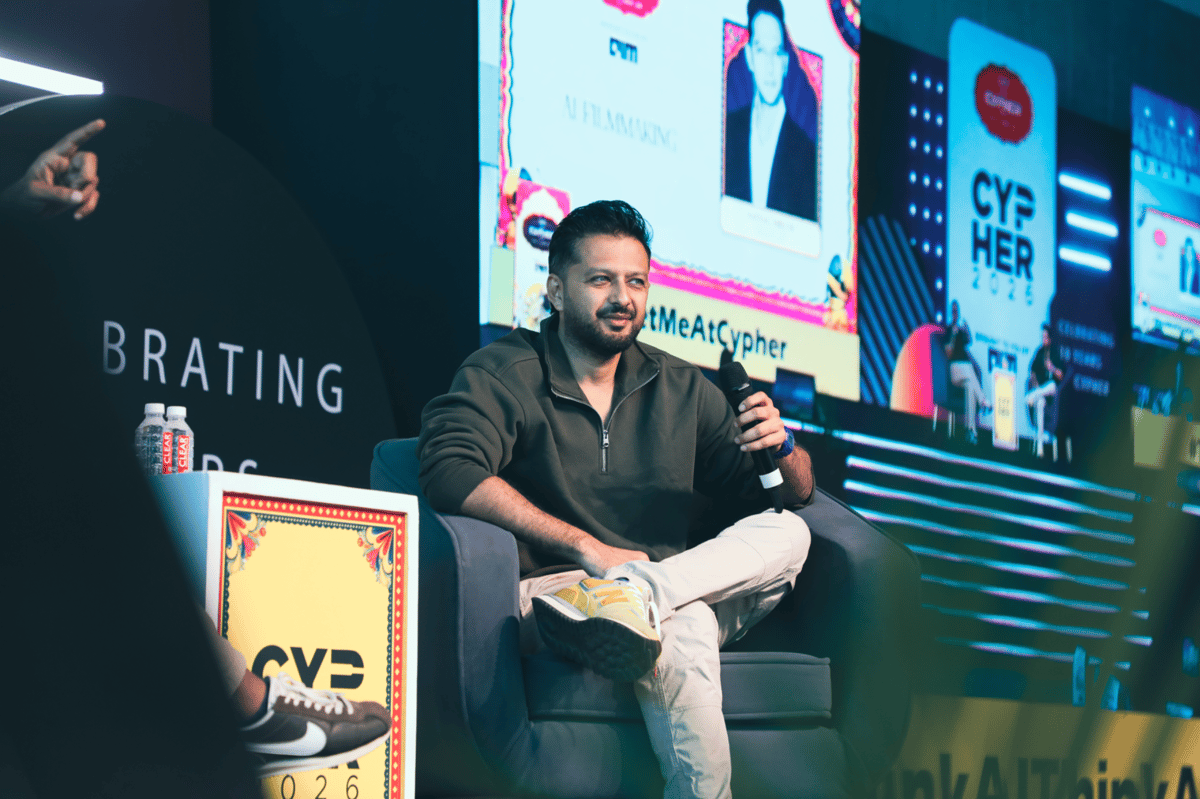

For actor and filmmaker Vatsal Sheth, the journey into AI filmmaking began long before generative AI became part of the creative industry.
As a student, Sheth was introduced to computers and spent time writing games in BASIC, GW-BASIC, and Pascal. He later moved into acting, with iconic roles in television and films including Just Mohabbat and Taarzan: The Wonder Car, before returning to technology through filmmaking.
Today, Sheth is Co-founder and CEO of Prismix Studios, where he is exploring how AI can be incorporated into film production. Speaking with AIM at Cypher 2026, India’s biggest AI summit and expo, he sees the shift as a change in the tools available to filmmakers.
“I was very fascinated with this AI thing coming in, and I thought that there's a great use case in films and cinema, and that's how Prismix Studios happened,” Sheth said.
From Technology to Cinema
Sheth said Prismix was among the early studios to bring AI visuals into films. He also spoke about Happy Birthday Joshi, an AI-driven short film based on the story of the Happy Birthday Joshi computer virus.
The Joshi virus was a boot sector computer virus from the early 1990s that famously froze infected computers every January 5th until the user typed "Happy Birthday Joshi!"
The actor and entrepreneur described the virus as “the first ever virus of the world from India.” The project also received support from actor Ajay Devgn.
For Sheth, however, the project was not primarily about showing how visually impressive AI could be. He wanted to test whether AI characters could communicate emotions in a way that audiences could connect with.
“People think that when you make an AI film, it has to be very flashy, it has to be very futuristic,” he said. “But Happy Birthday Joshi was one film which is about emotions.”
The production still involved many of the conventional filmmaking roles behind the AI tools. It features actors, voiceover artists, and musicians, and includes input from a cinematographer, stylist, director, and writer.
The approach reflects Sheth’s broader view that AI does not remove the need for filmmaking expertise. Instead, the technology becomes another part of a workflow that still requires people to make creative decisions.
The Human Layer
As AI tools develop rapidly, there are growing and urgent concerns around their effect on creative jobs.
He argues that the human role will remain important even as more parts of production become automated. “Behind AI there has to be a human intervention,” Sheth said.
That intervention can happen at different stages of filmmaking—from deciding how a character should look to determining whether a production should use real actors, AI-generated characters, or a combination of both.
Sheth said the choice will ultimately depend on the project. “You have to decide whether you want to go with a real actor, whether you want to go with an AI artist, whether you want to go hybrid or whether you want to go 100% AI.”
Teaching AI Filmmaking
The shift has also created a new requirement for filmmakers: learning how to use AI alongside existing filmmaking skills.
Sheth said Prismix has hired filmmakers and filmmaking students, and teaches them how to work with AI. The company has also developed a curriculum covering filmmaking fundamentals, the use of AI in filmmaking, and a capstone project where students can create a film.
“We have started creating a curriculum. We already have a curriculum in place, and we’re going to deploy it very soon,” he said.
Prismix is also partnering with universities across India to deliver the curriculum.
The focus is specifically on combining filmmaking knowledge with AI tools. Rather than treating AI as a separate technical discipline, the programme aims to teach filmmakers how the technology can fit into the creative process.
The Audience Still Decides
For Sheth, technology alone cannot determine whether a film succeeds. He pointed to the evolution in how audiences consume content, with shorter formats becoming increasingly common. He compared the shift to cricket, where the sport now exists across different formats.
Creators are already producing very short videos, including reels that can attract millions of views. The challenge is therefore not simply learning a new AI tool, but understanding how to use technology while still creating something audiences want to watch.
“The film needs to have the right emotion. The story has to be amazing,” Sheth said.
He recalled showing Happy Birthday Joshi to a friend who knew it was an AI-generated film. “One minute into the film, he forgot that he was watching an AI film,” Sheth recalled.
For Sheth, that reaction captures what matters most about AI filmmaking. The technology may shape how something is created, but the audience ultimately responds to the story and the experience.
A Hybrid Future
Sheth does not see AI filmmaking developing separately from conventional filmmaking. Instead, he expects the two approaches to overlap.
“AI and films, eventually, it’s going to happen. It’s going to be hybrid. It’s already happening,” he affirmed.
That hybrid future could give filmmakers more ways to create characters and content while leaving the decision about how those tools are used to humans.
- Industry Wants Faster Approvals and Cheaper Power in India’s Data Centre Policy
- Inside Jio Platforms: Its Tech Bets, Loss-Making Subsidiaries and Hidden Risks
- India’s GCCs to Add 1.4 Million Jobs, Drive 170 Million Sq. Ft. Office Demand by 2031
- AI Can Be Cyborg or Centaur. But Can Enterprises Monetise It?
- AMD’s Server CPU Business Faces a New AI Boom
- How an Engineer Is Using AI to Bridge the Accessible Education Gap