

The sentiment was aptly captured by one of India’s seasoned journalists in her recent episode of ‘Vantage with Palki Sharma’, in the backdrop of the latest high-profile visits by Google and Microsoft executives to the country.
Microsoft chief Satya Nadella is currently on his trip to India, and plans to engage with promising AI startups. Nadella has high hopes for the country in terms of its potential contribution to the development of AI. “If the Indian economy is going to be, let's say, 5 trillion, the AI-driven part of it could be something like, maybe, 10% of it—perhaps 500 billion,” he said.
A week ago, Google hosted its first-ever Research@ Bangalore event, bringing together leading researchers, developers, and startups. Dr Jeff Dean, chief scientist of Google DeepMind and Google Research, attended the event in person, along with several other Google leaders, to discuss the future of AI and its implications in India.
"India is well-positioned because you have an incredibly strong culture of respecting engineering, science, and computer science. Many amazing computer scientists have come from India and are studying computer science,” he said.
“The young students that I meet in India are amazing. They're all excited and eager to understand the shift from traditional computer science to learning-based approaches for solving all kinds of problems,” added Dean.
While AI startups in the West are looking for young talent, India has no dearth of it.
Recently, many local foundational models have popped up in India, and interestingly, they are mostly created by young individuals. For instance, Tamil Llama by Abhinand Balachandran and Kannada Llama by Adarsh Shirawalmath, who is a second-year BTech student at Vellore Institute of Technology. Similarly, Telugu Llama was created by Ravi Theja, who is under 30.
Moreover, many new startups are emerging in India, with a focus on creating bilingual LLMs catering to the Indian market. One such startup is Sarvam AI, which recently introduced OpenHathi and Microsoft has partnered with them.
"I am excited to see innovative startups in India. I had the chance to meet founders Pratyush [Kumar] and Vivek [Raghavan] from Sarvam AI. Pratyush previously worked at Microsoft Research. We are excited to support them and build out their LLM, which is trained in all the Indic languages. The demo they showed me is tremendous," said Nadella during his visit to Bengaluru.
Microsoft is also backing another AI startup BrainSightAI which uses AI and machine learning to map the human brain, which aids thousands of clinicians, including neurosurgeons, psychiatrists, and neurologists, across the country.
Lately, Indian startups are experiencing a funding surge. India witnessed its first AI Unicorn, Krutrim AI, which raised $50 million in funding from Matrix Partners. Meanwhile, Google is looking to invest approximately $4 million in the Indian conversational AI startup CoRover.
Interestingly, nearly 84% of Indian CEOs are raising new capital or reallocating budgets to invest in generative AI, compared to 70% globally.
The Rise of AI Engineers
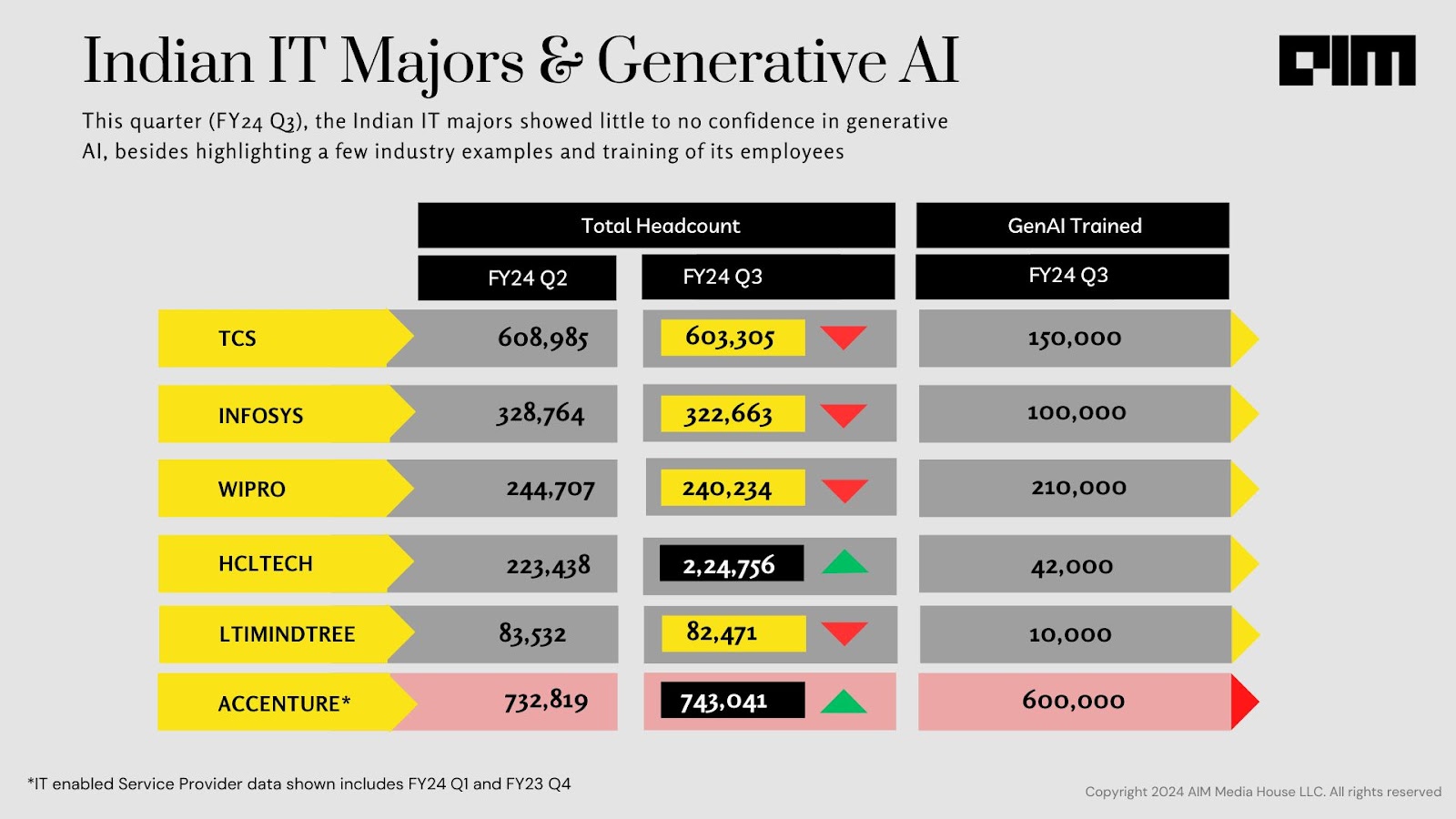
Indian IT giants have been making every possible effort to train their employees in generative AI. TCS recently announced that it has trained over 1 lakh-strong pool of GenAI ready consultants and prompt engineers who are engaged in hundreds of GenAI projects for clients across segments.
Similarly, last year, Infosys announced its plans to train over 1 lakh employees in partnership with NVIDIA & Google Cloud. Wipro, on the other hand, has globally trained 210,000 employees in AI and is integrating generative AI across its platforms.
HCLTech has internally trained close to 42,000 people across various areas of generative AI, while Accenture claims to have trained over 600,000 employees in AI. Indian IT firms are seeing a combined ~450 GenAI projects currently in the pipeline.
"Software developers, who are already working, would want to pick up these (generative AI) skills if they don't already have them. This is something that will transform basically every software developer's workflow and the way they approach problems. This holds true not just in India but all across the world," said Dean.
Similarly, Nadella spoke how about Copilot has increased the productivity of Indian IT employees across Infosys, HCL Tech and MindTree.
‘Unique’ Data
One of the primary attractions for big tech companies in India is its wealth of data. During his visit to India, Nadella praised the work being done by Bhashini and Karya. Karya creates datasets in several Indian languages to train AI models and for research, simultaneously generating job opportunities for Indians, particularly in rural areas.
On the other hand, Bhashini is Indian government's initiative to create an open-source Indic language dataset and has also partnered with Karya. AI4Bharat is another initiative from IIT Madras dedicated to developing open-source resources for Indian languages, including datasets, models, and applications.
Google and Microsoft, along with other companies, are actively seeking to acquire both datasets and the companies producing them. Their aim is to ensure that the LLMs they develop surpass the ones currently trained on publicly available internet data.
“The upcoming wave of mergers and acquisitions might be spearheaded by companies like Google, Microsoft, and Meta (formerly Facebook), evaluating data companies as potential contributors to their extensive language models or other machine learning and AI endeavours,” said Chamath Palihapitiya, Social Capital Founder & CEO.
Moreover, India is generating terabytes of enterprise data monthly due to increased 5G penetration, OTT services, and social media usage. With an abundance of data available in India, there is a high likelihood that the next major hyperscaler could emerge from the country.
Recently, laptop maker Lenovo announced its plans to start manufacturing servers locally to support its data centre business.
- AMD’s Server CPU Business Faces a New AI Boom
- How an Engineer Is Using AI to Bridge the Accessible Education Gap
- AI Agents are Making Human Customer Service a Specialist Job
- Why Nandan Nilekani-Backed F2A Believes India's Investment Opportunity Lies in Edge AI
- India Needs to Build the AI 'Brain' for Robotics, Not Just Import Hardware
- Why Enterprise AI Prototypes Break in Production