

We’re witnessing a ‘ChatGPT’ moment for AI agents. They’re no longer the artisanal workflows that only AI-savvy folks could assemble.
Thanks to Muse, Instinct, and a growing number of agents which need zero setup, everyone can simply chat away to get work done. This also puts the CPU back in the spotlight after years of being relatively overshadowed by GPUs.
And what does this mean for AMD, a chip maker fairly successful in the x86 server CPU market? Dereck Dicker, corporate vice president of AMD’s enterprise business group, explains in an interview with AIM how the company’s growth is spilling into the CPU ecosystem.
In the early years of generative AI, which, funnily, was just 2022, CPUs primarily fed data to GPUs, managed execution, and ran the surrounding software. Agentic AI today adds multiple layers of work
“It is the shape of the agentic workloads that makes it super unique, where you’re no longer having a single request going into a GPU that runs inference and gives you a response,” says Dicker. “It is not just reasoning work that GPUs would traditionally do, but on top lie a series of activities that are running and being orchestrated by the CPUs.”
While GPUs handle the computationally intensive task of LLM inference, CPUs must coordinate the tools, APIs, databases, and execution environments that agents rely on to complete tasks across multiple steps
Dicker explains that AI infrastructure is moving towards a near one-to-one ratio of GPUs to CPUs, compared with the multiple-GPUs-per-CPU configurations, which he says are ‘things of the past’.
He says this shift is driving a substantial increase in CPU demand.
Server CPUs are a $200 Billion Market, Says AMD
Recently, the company announced Helion, an open rack-scale blueprint designed specifically for agentic AI infrastructure.
Its CPU-only configuration, powered by AMD’s sixth-generation EPYC processors, can support up to 32,768 CPU cores for running agents at hyperscale.
Alternatively, another configuration combines EPYC CPUs with Instinct MI350P GPUs, letting enterprises run agent workflows and model inference in the same rack.
This follows AMD’s announcements from its Advancing AI event in July, where it announced its 6th Gen EPYC ‘Venice’ server CPU line, while it raised its forecast for this segment from roughly $25 billion today to more than $200 billion by 2030.
“Each flavour of CPU carries a different role,” says Dicker.
Unlike conventional server processors, Venice is built as a family of CPUs tailored to three distinct roles in AI infrastructure.
Dicker describes the socket-level split as two families: SP7, which targets high-performance workloads, and SP8, which prioritises a balance of compute, memory and capacity.
The SP7 family is designed for high core density and performance, with its flagship configuration packing 256 cores and 512 threads per socket.
Dicker says this makes it well suited to the next generation of agentic AI applications, which require CPUs to coordinate and execute numerous concurrent tasks alongside GPU-based inference.
The SP8 family, meanwhile, targets general-purpose enterprise computing. Rather than maximising core count alone, AMD has prioritised a balance of processing capacity, performance, and memory to support workloads such as databases, virtualisation, and enterprise applications.
The family scales from eight to 128 cores, letting organisations choose configurations that suit their workloads.
AMD vs. Intel vs. NVIDIA
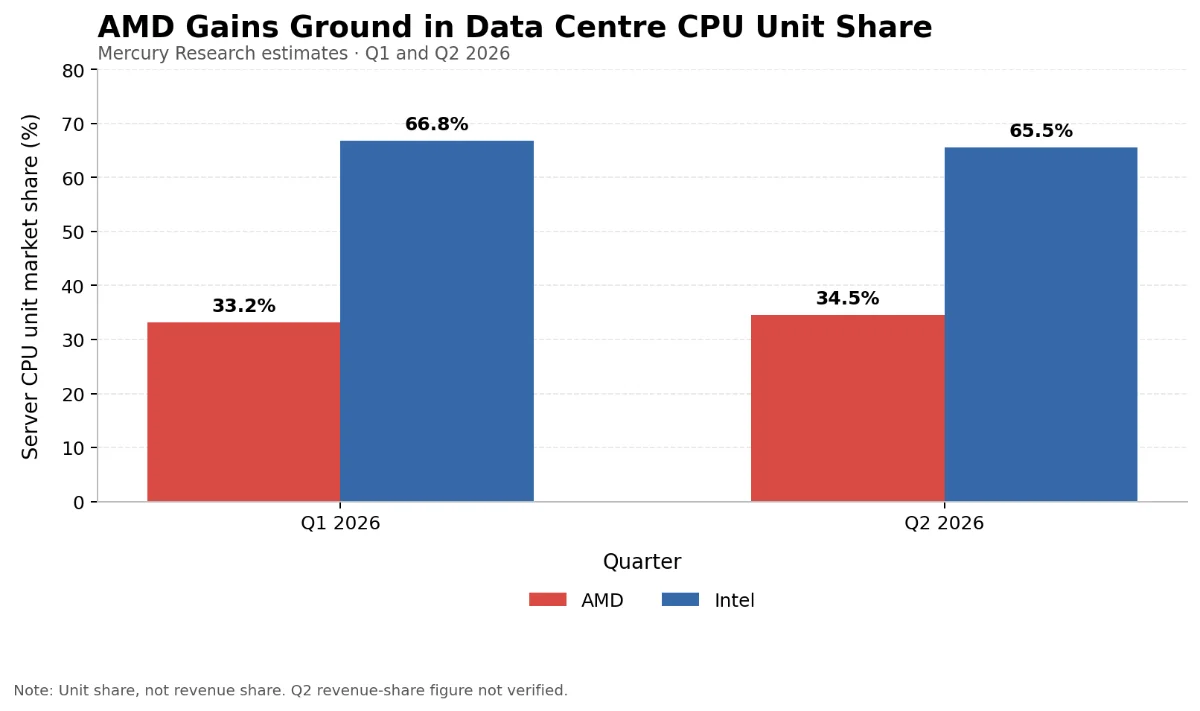
Market research firm Mercury Research shows AMD steadily closing the gap with Intel in the x86 server CPU market.
In the second quarter of 2026, AMD accounted for 34.5% of x86 server processor shipments, up 130 basis points quarter-on-quarter, while Intel's share fell 130 basis points to 65.5%.
When the comparison narrows to AMD EPYC and Intel Xeon SP processors used in data centres, AMD's share rises to 46.4%, while Intel's is 53.6%.
In published SPEC CPU2017 integer-throughput tests, a two-socket server powered by AMD's fifth-generation EPYC 9965 scored 3,230, compared with 2,510 for a two-socket Intel Xeon 6980P system.
However, the AMD configuration used 384 cores, compared with Intel's 256, and differed in memory capacity and compiler software.
NVIDIA, meanwhile, is competing through Arm-based server CPUs rather than x86. Mercury Research estimated that Arm-based processors accounted for 13.6% of server CPU shipments in Q2 2026, up approximately 50 basis points quarter-on-quarter.
NVIDIA is the undisputed king of GPUs. However, it only entered the market with the Arm-based Grace data centre GPUs, made available only in 2023, and AMD, on the other hand, set foot nearly a decade ago
While NVIDIA is betting on a custom Arm CPU, AMD argues that x86 remains better suited to enterprise AI because existing software already runs natively on the architecture.
But how long will AMD’s CPU dominance last before NVIDIA catches up?
Recently, cloud provider Modal said its initial tests showed Vera completing twice as much agent work as the Intel and the fifth-generation AMD CPUs already deployed in its infrastructure.
Modal tested 50 Terminal-Bench tasks, covering operations such as code compilation, file searches and Git commands, across multiple concurrently running containers.
Vera's advantage became more pronounced under heavy loads, where its memory bandwidth allowed Modal to pack more workloads onto a host without the same performance degradation seen on competing CPUs.
Based on these results, Modal plans to add NVIDIA’s Vera CPUs to its infrastructure while continuing to run its existing x86 fleet.
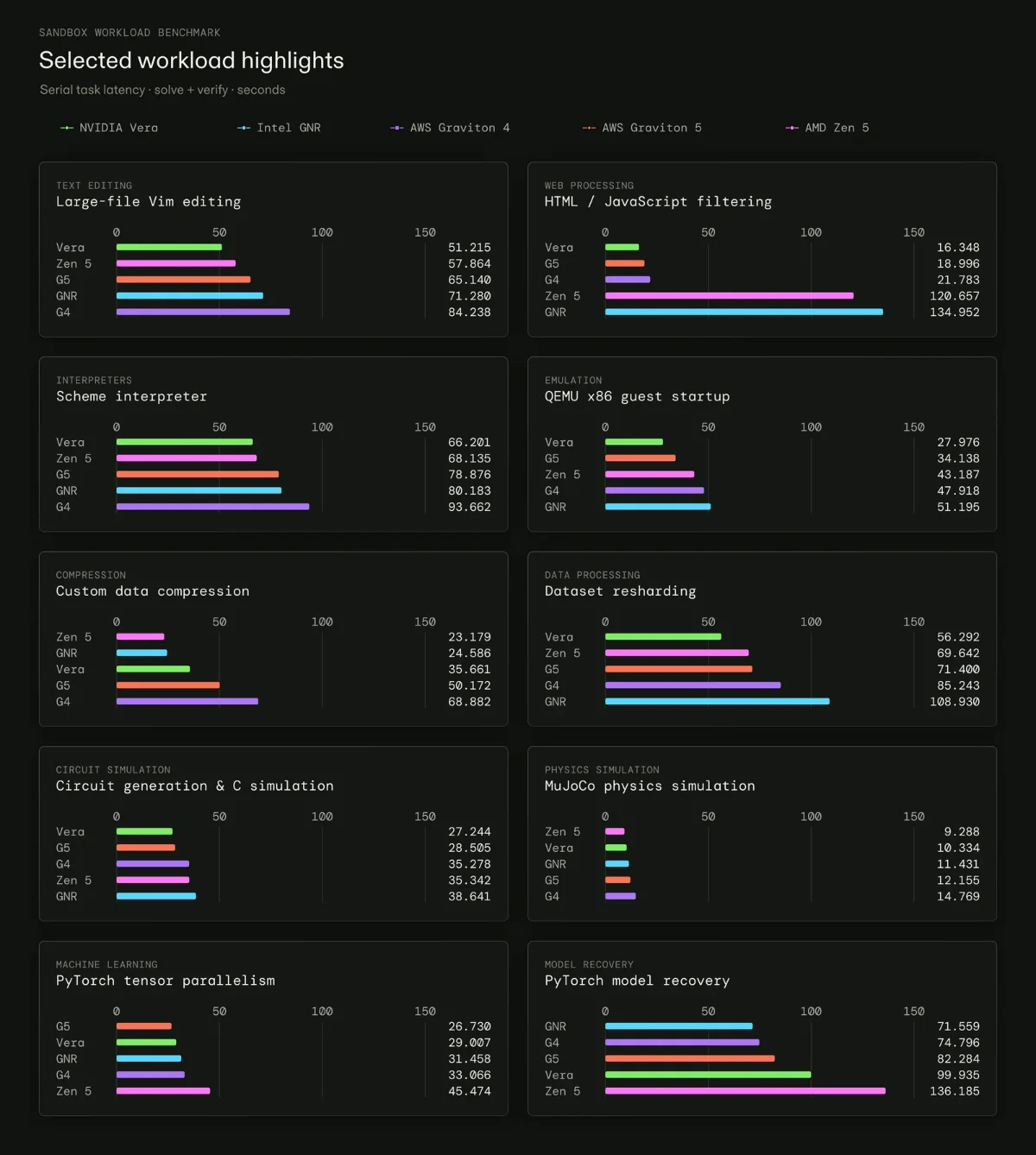
However, with its latest, sixth-generation Venice CPUs, AMD claims to outperform NVIDIA's Vera in SPEC CPU 2026 benchmarks.
AMD estimates that its 256-core EPYC 9996 delivers 2.24 times the aggregate throughput of NVIDIA's 88-core Vera, with estimated scores of 2,070 and 925, respectively.
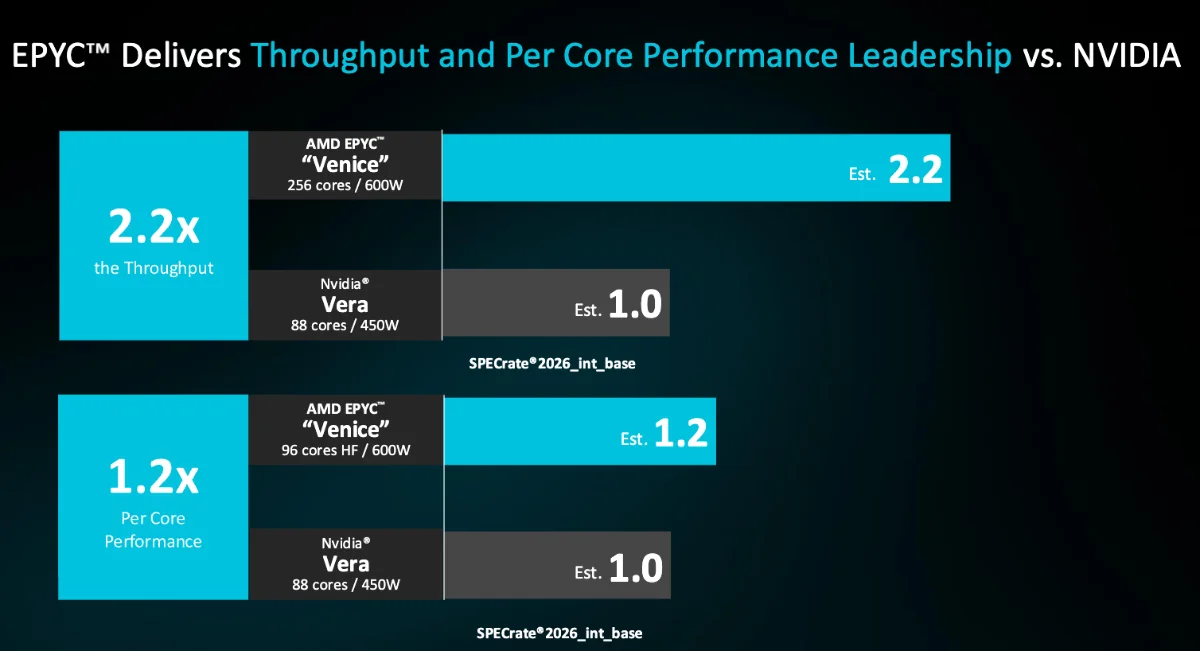
In a closer comparison, AMD's 96-core Venice configuration is estimated to deliver around 20% higher performance per core than Vera.
Independent testing on shipping systems, using matched software and realistic agent workloads, is needed to establish which CPU delivers better performance and cost per completed task.
How AMD Wants to Free Up Space in Data Centres
“What we hear quite regularly is that data centres are packed, and the available space is fairly limited,” says Dicker. “And the fastest way to create headroom for AI is to go through a consolidation effort.”
Dicker says a ‘beautiful’ advantage of AMD’s EPYC family is its ability to consolidate workloads running on older servers, freeing up data centre space and power for AI infrastructure.
He claims that organisations refreshing servers installed roughly five years ago could achieve a 13-to-1 consolidation ratio with sixth-generation EPYC processors.
In other words, AMD estimates that workloads running across 13 older servers could be consolidated onto a single newer server, freeing up rack space and power for AI deployments.
Fewer servers can reduce cooling requirements, networking complexity, and software licensing costs, especially when enterprise software is licensed per CPU core.
“You free up the power, reduce the complexity of managing the infrastructure, and give data centre operators the capacity to deploy AI infrastructure where they need it,” says Dicker.

Your reaction
Discussion
What's your take on this story?
No comments yet — be the first to share your view.