

In an AI ecosystem accustomed to fast-paced developments, Anthropic’s Fable 5 made everyone stop in their tracks. It was too powerful. Too powerful to be out in the public.
Amid pressure from the United States government, Anthropic took down the model briefly before allowing its release, sending the global community into a frenzy and bringing up questions about AI access and sovereignty.
However, Fable 5 is also inevitably becoming one of the first models to challenge the assumption that everyone, especially large enterprises, would pounce on game-changing technology. Recent data from corporate spending company Ramp suggests otherwise.
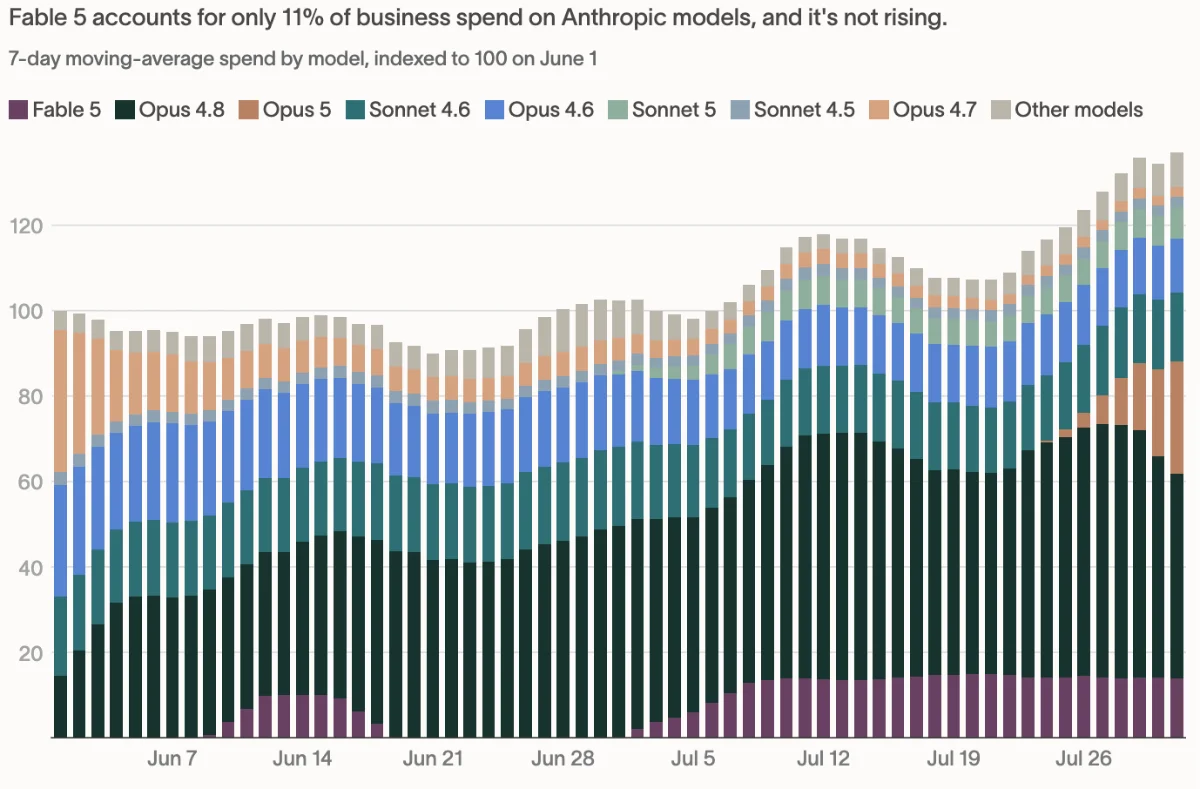
According to Ramp, Anthropic continued to extend its gains over the last month as the leading model provider for business AI adoption, with 43.5% having paid subscriptions or tokens from the company. However, in the first two months of its release, it accounted for only 6% of the tokens businesses purchased from Anthropic, and 11.4% of dollars spent on Anthropic models.
And that share is not growing either.
Source: Ramp
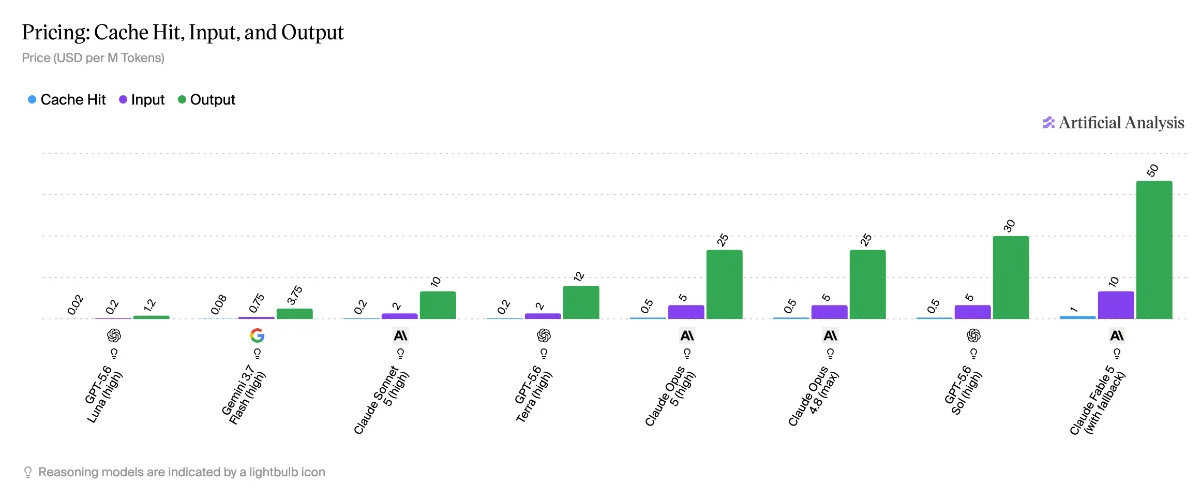
The key factor is cost. Even as AI spending per employee continues to rise across the top 1%, top 10%, and median companies, businesses remain reluctant to spend heavily on Fable 5. Its API pricing is $10 per million input tokens and $50 per million output tokens.
That reluctance is less apparent with competing flagship models.
OpenAI’s GPT-5.6 Sol accounted for 25% of OpenAI tokens and 23% of its model-attributed spending, while costing $5 per million input tokens and $30 per million output tokens—roughly half the input-token price of Fable 5 and less than 40% on output.
The contrast is also sharper when compared with Anthropic’s other models.
Opus 4.8 rose from 14.5% of Anthropic usage at the start of June to 47.8% by the end of July, while Opus 5 climbed to 26.2% after its launch. Together, the two models accounted for nearly three-quarters of Anthropic usage by the end of last month.
Does this spell trouble for Anthropic, a company that derives roughly 80% of its revenue from businesses, while those same customers appear reluctant to use its most powerful model?
‘Like Putting Rocket Fuel into a Minivan’
“Fable 5 is great for tasks that require some sort of discovery—and is pretty confined to mathematicians, physicists, and other research scientists,” Jaya Gupta, Partner at Foundational Capital, tells AIM.
She adds that this simply accounts for less than 1% of US employment, pointing out that other industries such as customer support and nursing that employ millions of workers are less likely to require the kind of open-ended discovery Fable 5 is designed for.
“Enterprises today are thinking through the best performance per dollar, or intelligence per watt,” says Gupta.
Gupta also shares her own experience using Fable 5, describing its outputs as increasingly difficult to read and follow. She says the model often uses dense language, unfamiliar terminology and long, meandering explanations that can make the user feel as though they are struggling to keep up with the model rather than benefiting from it.
The problem, she argues, is not simply that the model is highly capable, but that its communication style can create an “intelligence delta” between the model and the person using it. In practice, this can make Fable 5’s answers more cognitively demanding to interpret, particularly for users who do not share the specialised knowledge or vocabulary embedded in its responses.
Similarly, Sathya Narayanan Annamalai Geetha, a senior principal architect at Google and a fellow of the British Computer Society, notes, “Enterprises have realised that 80–90% of their everyday tasks—like basic data extraction, summarisation, and standard customer support routing—can be handled perfectly well by smaller, vastly cheaper, and faster models.”
He adds that model providers are learning the hard way that businesses will not pay a premium for ‘surplus intelligence’ that doesn’t have a use case.
“Average enterprise today isn’t simply mature enough to support the complex, multi-step reasoning and long-horizon agentic workflows [of Fable 5],” Sathya observes.
He adds that most companies today are still deploying AI in isolated environments that rely on human-in-the-loop approvals before making any agentic decisions. “They still lack the robust data pipelines, API integrations, and governance frameworks required to let an autonomous agent run wild in their systems.”
“Buying Fable 5 is like putting rocket fuel into a minivan while you're still driving on dirt roads,” he quips.
Anthropic’s Data Retention Policy
Another factor that may have slowed down Fable 5’s adoption is Anthropic’s data-retention policy, which mandates 30-day retention for all traffic on Fable 5, even for business customers.
Anthropic swears it won’t use the data to train new Claude models or for non-safety-related purposes, but it will retain it to detect sophisticated attacks, identify multi-turn misuse patterns and jailbreaks, and improve its safety systems.
“For many regulated and risk-sensitive organisations, data governance requirements can be a hard gating factor that outweighs both price and performance,” comments Biswajeet Mahapatra, Principal Analyst at Forrester Research.
He says security, privacy, trust, and governance consistently rank among the biggest barriers to enterprise AI adoption, particularly at larger organisations with more extensive compliance obligations. They increasingly apply AI governance frameworks, zero trust principles, data minimisation requirements, and approved-tool policies before assessing a model’s capabilities.
As a result, if a model’s retention policy conflicts with an organisation’s regulatory, contractual or governance requirements, it may effectively be excluded from consideration regardless of its performance or cost.
“For highly regulated industries, using a model with a 30-day data retention policy is like leaving your most sensitive data on a post-it note in a public lobby and hoping for the best,” Sathya observes.
He calls Anthropic’s policy an ‘automatic disqualifier’ and says the company will soon realise that the ultimate enterprise capability isn’t reasoning or autonomous action, but trust.
What’s Next for Anthropic?
But what does this mean for a company like Anthropic? Has it hit a possible ceiling of what it can offer enterprises today?
As base models improve and open-weight models become more competitive, Gupta expects the lower end of the intelligence frontier to continue rising, absorbing more workloads where the underlying level of intelligence required does not change significantly.
For Anthropic, she believes this could mean expanding beyond its current model business into specialised domains such as drug discovery—something the company has already explored through its work with life sciences organisations. Anthropic CEO Dario Amodei has also repeatedly emphasised AI’s potential to accelerate scientific discovery, including predicting that AI-enabled biology and medicine could compress decades of progress into years.
That’s where perhaps Fable 5’s moat lies.

Your reaction
Discussion
What's your take on this story?
No comments yet — be the first to share your view.