
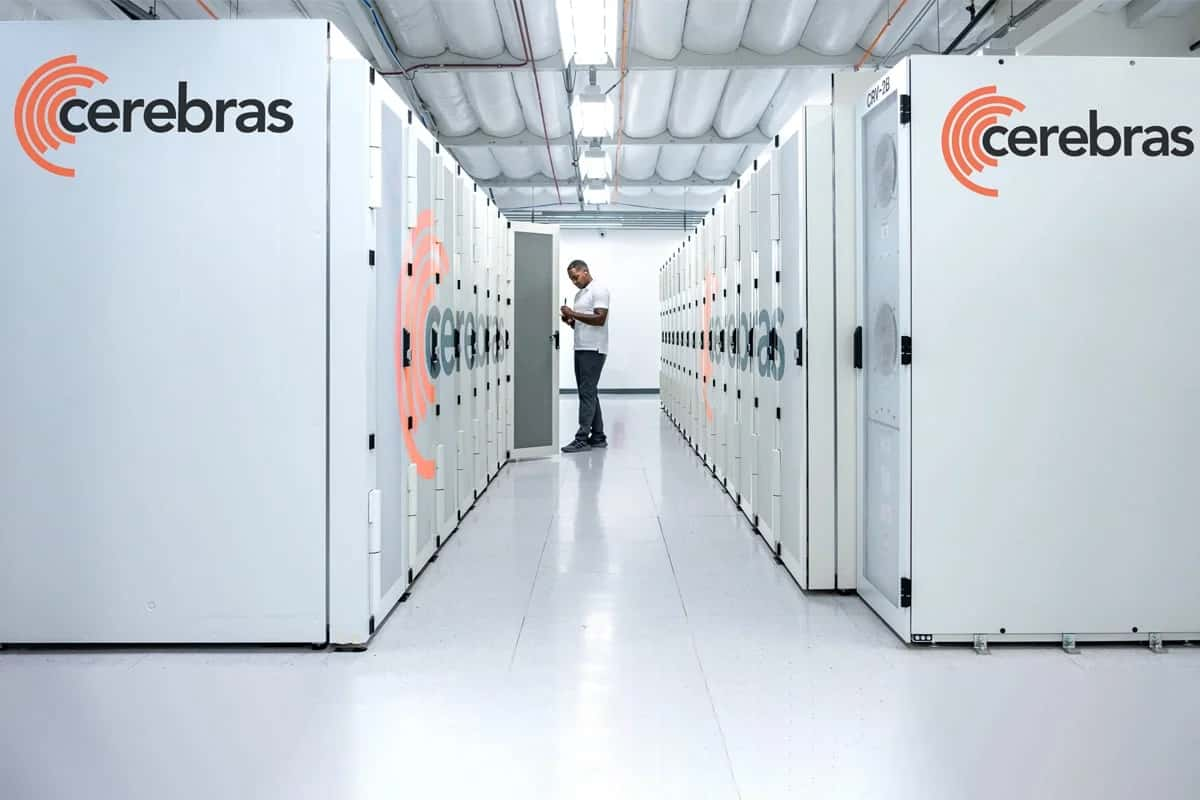
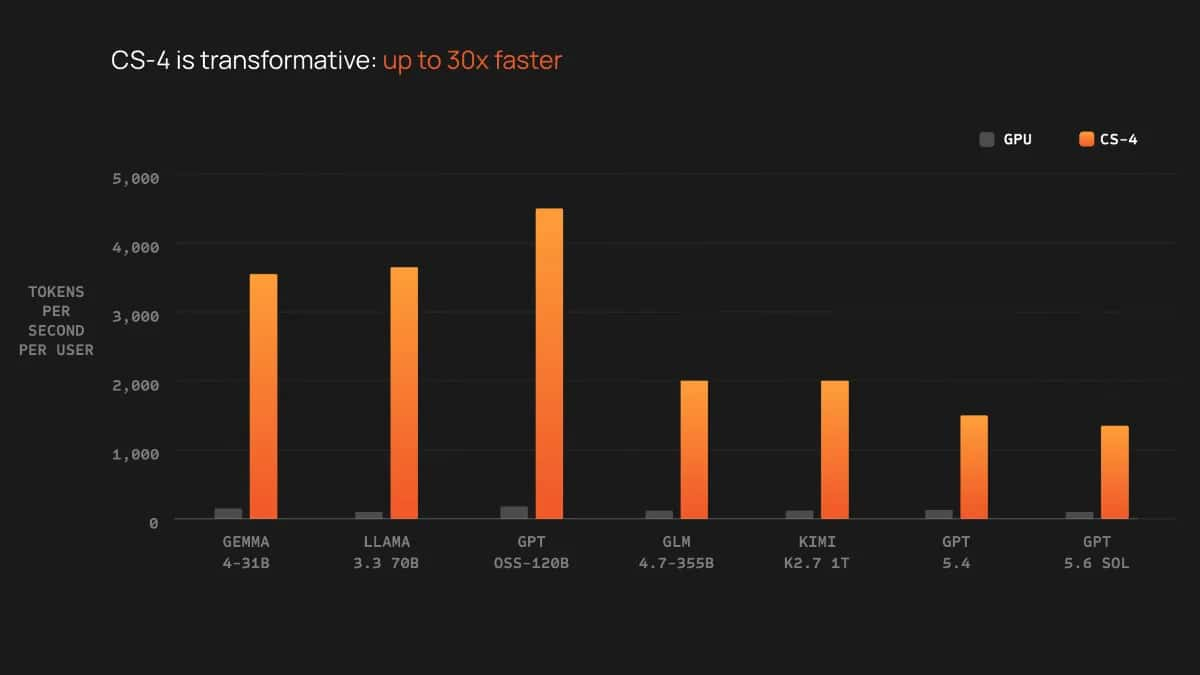
Cerebras has unveiled CS-4, its fourth-generation AI accelerator, claiming up to 30x faster inference than GPU-based infrastructure across a range of models.
Built from three Wafer-Scale Engine 3 (WSE-3) Turbo processors, CS-4 combines the wafer-scale chips with a redesigned rack architecture aimed at reducing communication latency, power losses, and deployment time.
First shipments are expected to begin this quarter.
The company is targeting the increasingly latency-sensitive inference market, particularly reasoning and agentic workloads where response time directly affects how quickly applications can complete tasks.
Cerebras said CS-4 can generate more than 1,000 tokens per second on models exceeding 10 trillion parameters, enabled by wafer-to-wafer communication latency as low as two microseconds.
CS-4 is built around Cerebras’ new Nexus architecture, which reorganises compute, power, and I/O into modular assemblies. The company said the design uses 50% fewer components than the previous generation and can reduce installation from days to hours.
Its Wafer-Scale Backpack integrates power conversion, direct liquid cooling, high-speed I/O, and control electronics around the wafer.
Cerebras is also positioning CS-4 as part of heterogeneous inference infrastructure rather than a replacement for every accelerator in a data centre.
Its disaggregated architecture separates prefill from decoding: GPUs or other accelerators can process incoming prompts, while CS-4 handles the low-latency generation phase.
Cerebras said the architecture can be paired with AMD Helios and AWS Trainium.
The launch comes days after Cerebras reported record second-quarter core revenue of $209.9 million, up 103% year on year.
Cloud revenue was $126 million, up 281%, as customers increasingly consumed Cerebras compute through its cloud offering.
The company raised its full-year core revenue forecast to 880–890 million and said it had more than $25.4 billion in remaining performance obligations.
Cerebras said it now has more than 600MW of data-centre capacity live or under contract for delivery by the end of 2027, while manufacturing capacity is expected to increase more than tenfold during 2026.
Founded in 2016, Cerebras focuses on wafer-scale AI processors that replace the conventional GPU-plus-HBM architecture with a single, wafer-sized chip built around large amounts of on-chip SRAM.
Its WSE-3 packs 44GB of SRAM directly onto the processor and delivers 21 petabytes per second of memory bandwidth, avoiding the off-chip HBM used by conventional AI accelerators.
- GitHub Expands Infra With 4 Mn Cores, Debuts Copilot Fusion for Multi-Model Routing
- IIIT Hyderabad and NPCI Sign MoU to Strengthen Cybersecurity in Digital Payments
- KPIT Bets on AI for Margin Growth as Q2 Revenue Growth Stays Weak
- Akamai Launches AI Inference and Agent Sandbox Services
- OpenAI Sued Over ChatGPT’s Alleged Role in Woman’s Death After Seizure Medication Taper
- Live2.ai Raises ₹130 Cr in Pre-Series B Round Led by IvyCap Ventures