Apologies, Robots, Sovereign AI: How Day 2 of India AI Impact Summit Unfolded
By Pallavi Chakravorty ·
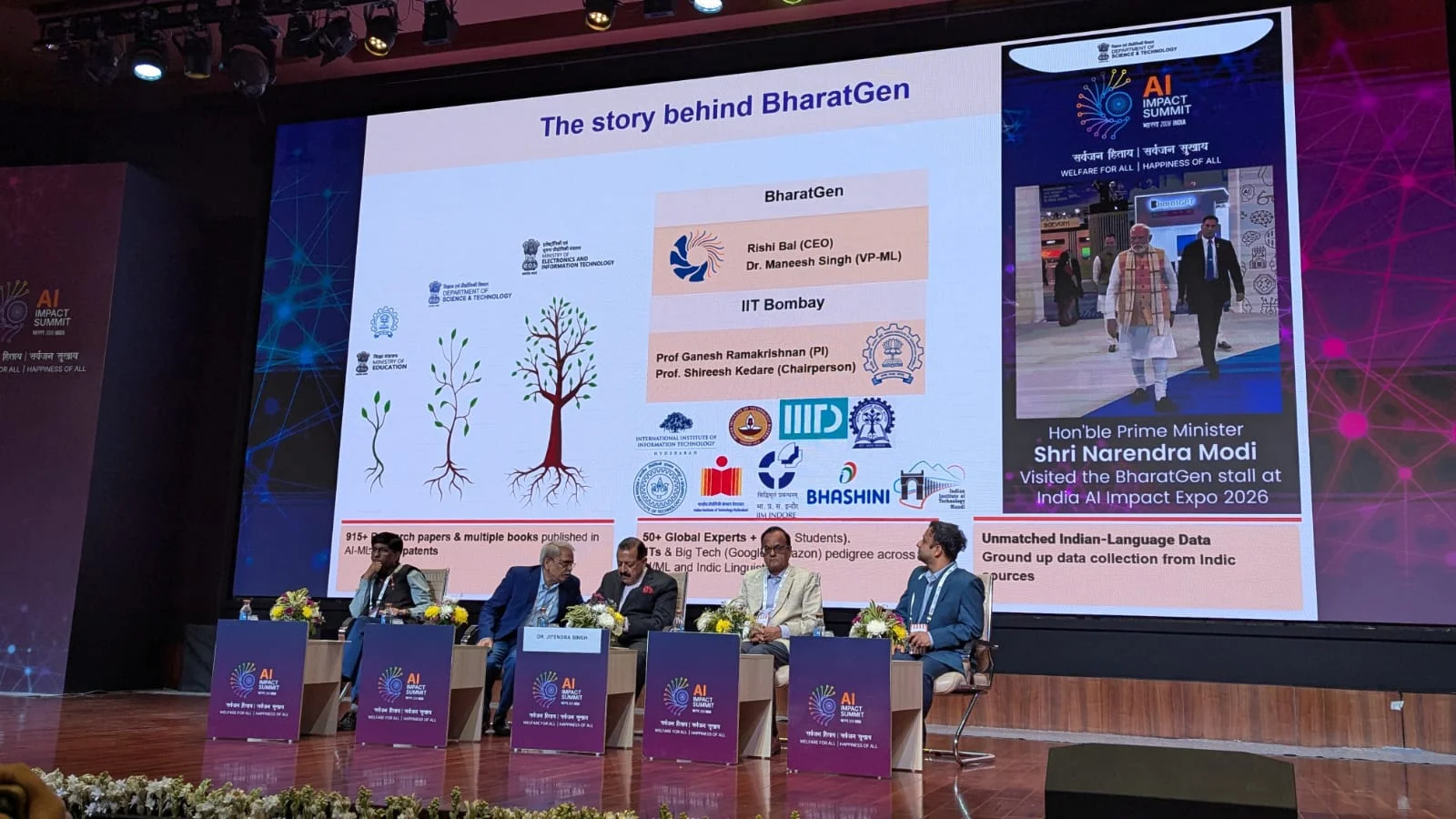
Day 2 of the India AI Impact Summit 2026 was far less chaotic than the inaugural day, when several attendees expressed on social media that they faced issues when it came to registrations, internet access, online payments, and crowd control. Even Ashwini Vaishnaw, Union Minister for Electronics and Information Technology, had to apologise to attendees and startup founders who faced problems yesterday.
Thankfully, there was a lot more emphasis on crowd management.
Curtains Up
The second day of the summit was heavy in terms of announcements and launches.
On the innovation front, BharatGen launched several sovereign AI models. These include Shrutam, an LLM-based automatic speech recognition platform; Sooktam, a text-to-speech model; and Patram, a vision-language model for document understanding. The launches reflect India’s push toward sovereign AI capabilities spanning language, speech and document intelligence.
Professor Ganesh Ramakrishnan, Principal Investigator and Board Member at BharatGen, told AIM that its sovereign AI models are meeting the benchmarks and will be useful to industry, academia, and government. He now hopes to expand the core team.
Also, Gnani.ai unveiled Inya VoiceOS, a voice-to-voice foundational model that operates directly in acoustic and semantic space, eliminating intermediate speech-to-text and text-to-speech pipelines, a step toward real-time spoken intelligence.
Meanwhile, Qualcomm introduced its Robotics System and Dragonwing IQ-10 processor for humanoids and advanced autonomous mobile robots, marking its entry into the premium robotics segment and signalling the convergence of AI and physical systems.
Government Initiatives
There was also a slew of announcements from the government.
Vaishnaw announced that an additional 20,000 GPUs will be added in the coming weeks. He described the expansion as “the next phase of India’s AI strategy, focused on scaling infrastructure while ensuring responsible deployment across sectors such as healthcare and education.”
He also outlined plans for what he termed an “AI version of UPI”—a digital public infrastructure framework that would allow developers and countries to build AI solutions atop India’s stack, much like the success of Unified Payments Interface in digital payments. Of the projected $200 billion AI investment pipeline, the majority is expected to flow into infrastructure, with about $17 billion earmarked for deep tech and application-layer innovation.
The government also released the ‘AI Impact Casebooks on Energy and Accessibility’. Developed in collaboration with the International Energy Agency, the Energy compendium explores AI’s dual role in the energy transition—driving increased electricity demand through compute growth while enabling grid optimisation, renewable integration and data centre efficiency.
Taken together, the announcements reflect India’s attempt to balance scale with stewardship—expanding compute, nurturing talent, and promoting sovereign models while positioning itself as a key architect of global AI governance.