
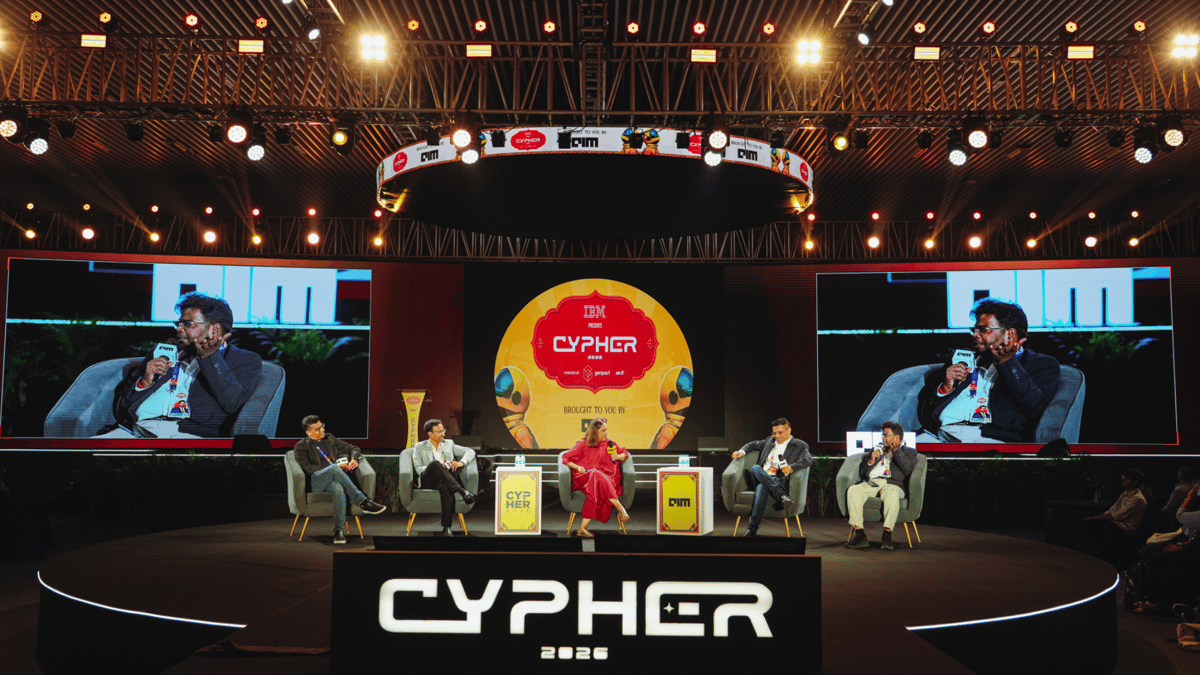

The 10th edition of Cypher, Analytics India Magazine’s flagship AI conference, is back in Bengaluru with a question that goes beyond the AI model itself: once AI gives an answer, what happens next?
Across Day 1 of Cypher 2026, speakers moved from AI pilots and model costs to decision-making, governance, agent infrastructure and India’s ambitions to build its own AI capabilities.
Powered by an exceptional lineup of industry leaders, IBM spearheaded the day as the Presenting Partner, with vital support from AI Cloud Partner Neysa, and set the tone. Platinum Partners Toast, Tredence, and D.E. Shaw further amplified the momentum, alongside Gold Partners EPAM and Lowe's India. Together, their presence and tech insights gave attendees valuable perspectives from the start.
Rashmi Tambe, Head of AI Product Engineering at Tredence, said the starting point is how companies define what they are building.
“You cannot think of a model as a product. You have to start thinking about a decision as a product,” She said.
The Gap Between an Answer and a Decision
Tambe used retail assortment planning to illustrate the problem. An AI system could recommend changing a product mix and project 2.3% margin incrementality. But the recommendation can still get stuck in meetings, emails, spreadsheets, supplier negotiations, and approvals.
“The intelligence dies” between the recommendation and its implementation, she said.
Her framework runs from sensing and prediction through simulation, recommendation, approval and execution, followed by outcome measurement, feedback and audit. It also accounts for human overrides and the need to explain how a decision was reached.
Meanwhile, Kavita Vishwanath, SVP and India Country Lead at Toast, approached the issue from a restaurant economics perspective. With restaurants often operating on margins of 3–5%, she said AI deployments need to show measurable results quickly.
Vishwanath cited figures suggesting that 95% of organisations had yet to see measurable P&L impact from AI, while 42% had abandoned AI initiatives in 2025. The 95% figure resembles a statistic from a 2025 MIT NANDA report, although that study focused on enterprise generative AI pilots rather than organisations as a whole.
Her rules were simple: solve a daily pain point, show impact in weeks, and measure outcomes rather than usage.
Vishwanath described a customer who uses AI every day to ask how the business is performing and what the forecast looks like, but still says, “I don't know what it means. I don't know how to apply it.”
Ankor Rai, CEO of Straive, who spoke about operationalising AI in Fortune 500 environments, cited a master context layer that reduced answer latency from five minutes to 30 seconds, cut token costs by 22% and made new use cases five to seven times faster to deploy.
Rai also described using frontier models to generate training data before moving routine workloads to smaller open models, reducing the need to use expensive models for every task.
Governing Unpredictable AI
Kunal Das, Developer Advocate (APAC) at Cast AI, focused on another challenge: AI does not always behave predictably. The same prompt, he said, can produce five different answers when run five times.
Das argued that governance needs to extend to the routing layer connecting employees, data and models. His framework covered spending, resilience, the data perimeter and the division of work between humans and AI.
In a workshop, Das compared a cheaper-model-first approach with using a flagship model throughout. For 100 people working for three hours, the routed approach cost about $54, compared with roughly $3,800 for the flagship-model approach, he said.
“We use a very small cheaper model to decide which model is best for that prompt,” Das said.
He also described systems that plan before executing and a “teleport” feature that moves long-running agent tasks into a temporary cloud sandbox rather than tying them to a single laptop.
Looking ahead, Saurabh Jha, SVP and Global Head of Data and AI at Tech Mahindra, questioned where human oversight stops being useful.
Using insurance claims as an example, Jha said an AI agent could process 1,200 claims in an hour while a human processes six. If a person still has to approve every claim, the human becomes the bottleneck.
Instead, he suggested determining the level of human intervention based on an action’s reversibility and impact. Can the damage be contained? Can the action be undone? Can a kill switch be triggered? Who is accountable?
For lower-risk, reversible actions, humans can sit at the edge of the system through guardrails and exception handling. Higher-impact decisions may still require direct intervention.
How Much AI Should India Own?
The question of control took a different form during Paytm Founder and CEO Vijay Shekhar Sharma’s keynote.
Sharma argued that India has spent too long building applications on technology developed elsewhere. “We're unambitious,” Sharma said.
He offered ₹1–2 crore from his personal funds to founders building AI models and said he could increase the amount if more serious builders came forward.
Sharma argued that India can continue using foreign models while developing domestic capabilities, particularly for strategic use cases. He also acknowledged that India is unlikely to build frontier models entirely on its own.
“Why should we stay as the IT services capital of the world? Why shouldn’t we build the systems and technology for the world?” he asked.
The Sovereign AI Test panel later explored what India actually needs to control.
Srinivas Chamarthy, SVP Engineering and India Site Lead at Diligent, argued that complete sovereignty is impractical. Open standards, APIs, open-weight models and portable infrastructure can instead give enterprises the flexibility to switch suppliers.
He also distinguished data residency from operational sovereignty. Keeping data within India does not necessarily mean an organisation controls the systems processing that data.
Jha argued that India needs enough domestic capability to protect critical infrastructure, while frontier models can be rented when necessary. He also called for diversification among GPU suppliers.
“Owning a model is not the definition of sovereignty,” he said.
Building for the Agent Era
The shift from models to systems was also visible in Soket AI Labs’ launch of Loop, an open-source harness for running agents on long-duration tasks.
“Agents are no longer a quick chat window. They're running for hours, days, weeks on real work,” said Abhishek Upperwal, founder and CEO of Soket AI.
Built in Rust, Loop supports parallel tool execution, shared memory, multiple model connections and the Model Context Protocol. Soket AI is targeting cybersecurity, defence, banking, finance and legal workloads where agents may require air-gapped environments, zero-trust execution and auditability.
Upperwal also announced that Soket AI is training a 26-billion-parameter model it plans to release as open source, along with its dataset and training stack.
Across the first day of Cypher’s 10th edition, the message was consistent: getting an answer from an AI model is only the beginning. The harder questions are what the system does with that answer, who controls it, how its actions are governed, and whether the business can measure the outcome.
- India’s GCCs to Add 1.4 Million Jobs, Drive 170 Million Sq. Ft. Office Demand by 2031
- AI Can Be Cyborg or Centaur. But Can Enterprises Monetise It?
- AMD’s Server CPU Business Faces a New AI Boom
- How an Engineer Is Using AI to Bridge the Accessible Education Gap
- AI Agents are Making Human Customer Service a Specialist Job
- Why Nandan Nilekani-Backed F2A Believes India's Investment Opportunity Lies in Edge AI