
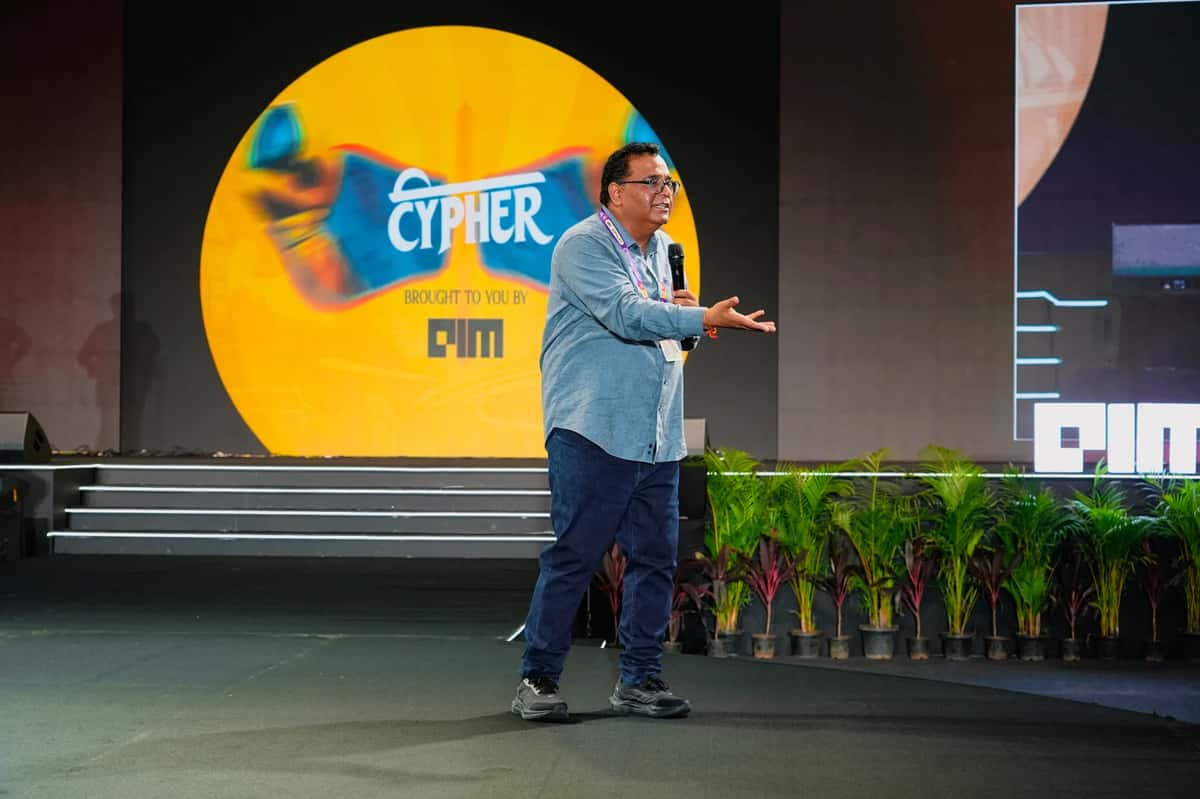

In 2025, Paytm Founder and CEO Vijay Shekhar Sharma said India should settle for being the “AI use case capital”. At Cypher 2026 in Bengaluru, he made the case for a more ambitious approach.
Sharma argued that India has spent too long building applications on top of technology developed and owned elsewhere.
“The problem is we're unambitious,” he says.
He then backed his argument with his own money, offering ₹1-2 crore from his personal funds to founders willing to build their own AI models. Sharma says he could increase the amount if enough serious builders come forward.
'Use Case Capital' Is a Choice, Sharma Says
Sharma began with payments. He recalled predicting years ago that India would become a global benchmark in the field, and said that prediction had held up. But he sees most Indian AI builders working at the application layer rather than further down the stack, where he believes more value will accrue.
To make his point, Sharma drew parallels with earlier technology cycles. He compared telecom equipment makers, network operators and mobile operating systems, arguing that companies that controlled the underlying technology held a different position from those building businesses on top of it.
He sees a similar pattern emerging in AI.
Indian companies, he argued, have become good at building applications on top of models developed elsewhere, while much of the underlying capability remains outside the country.
He questioned why Indian builders were operating so far from the core of AI development.
Sharma put the cost of building an AI model at less than $100 million (~₹964 crore) and pointed to China's willingness to distill and retrain models.
“Why should we stay as the IT services capital of the world? Why shouldn’t we build the systems and technology for the world?”
India is not part of the “big boy club” of AI powers yet, Sharma says, because too few people are ambitious enough to make it there.
Owning Models Without Giving Up Foreign AI
Sharma frames the goal as ownership, not isolation. India can continue using foreign models, he says, while also owning some of the underlying capability.
India should not depend entirely on AI capabilities built and controlled by others, Sharma said. It should develop and own some of its own.
Sharma points to geopolitics as one reason for that distinction. He says he is not arguing from nationalism, and acknowledges that India cannot build frontier models alone. The aim, he says, is to have multiple models of its own rather than leave the field to a handful of countries.
Sharma points to Paytm as an example of what he wants Indian companies to do. He says the company's risk engines and fraud systems are built internally, and that it has retrained models for its requirements.
Paytm's recent AI work includes a 4-billion-parameter model that Sharma has described as an optimised version of a 200-billion-parameter model for Indian languages. Paytm runs the model on its own machines.
Sharma has also said on an earnings call that Paytm will have to become a completely AI company, while its AI Soundbox answers merchants in 11 Indian languages.
Paytm is also expanding beyond its internal operations through Paytm Intelligence (Pi), a new AI business that can deploy agents across functions such as sales, customer service and operations.
A personal offer and a call to commit
Sharma said he could not commit Paytm's money to the effort because it is a listed company. The offer therefore comes from his personal funds.
“Either come over, join us, or build your own and take money from me,” he said.
He offered ₹1-2 crore as a starting cheque to founders building their own AI models and said he could increase the amount if enough serious builders committed to the effort.
But Sharma argued that capital is not the only constraint.
“There is enough capital, enough resources, and enough intention to support that,” he said.
The bigger issue, he argued, is the willingness to commit to building something difficult over the long term.
“The ambitious guy commits to it and does not let it go,” Sharma said.
He also offered Paytm's distribution network to founders, saying they could use the company's reach to get their products in front of users.
'You are the ecosystem'
During the Q&A, the discussion moved from ambition to jobs and India's broader AI ecosystem.
Asked by a young attendee for a single piece of advice, Sharma gave a simple answer: “Life gives you what you aim for. The problem is we aim very low.”
The discussion then turned to AI and jobs. Sharma argued that higher productivity across India's billion-plus population could turn AI into a source of national economic power, rather than framing the technology primarily around jobs being replaced.
Another attendee argued that India lacks an AI ecosystem. But Sharma rejected the premise. “You are the ecosystem. Everything that you need is inside you.”
- India’s GCCs to Add 1.4 Million Jobs, Drive 170 Million Sq. Ft. Office Demand by 2031
- AI Can Be Cyborg or Centaur. But Can Enterprises Monetise It?
- AMD’s Server CPU Business Faces a New AI Boom
- How an Engineer Is Using AI to Bridge the Accessible Education Gap
- AI Agents are Making Human Customer Service a Specialist Job
- Why Nandan Nilekani-Backed F2A Believes India's Investment Opportunity Lies in Edge AI