

As the India AI Impact Summit opens, Gnani.ai arrives with more than a routine product announcement. The company is set to unveil Inya VoiceOS, a new voice-to-voice foundational model it has kept closely under wraps.
Inya VoiceOS is India’s first five-billion-parameter voice-to-voice foundational AI model. It will sit alongside the company’s existing stack, which already powers voice AI agents, speech models and vertical-specific small language models for banks, insurers, non-banking financial companies, retailers and consumer businesses across India.
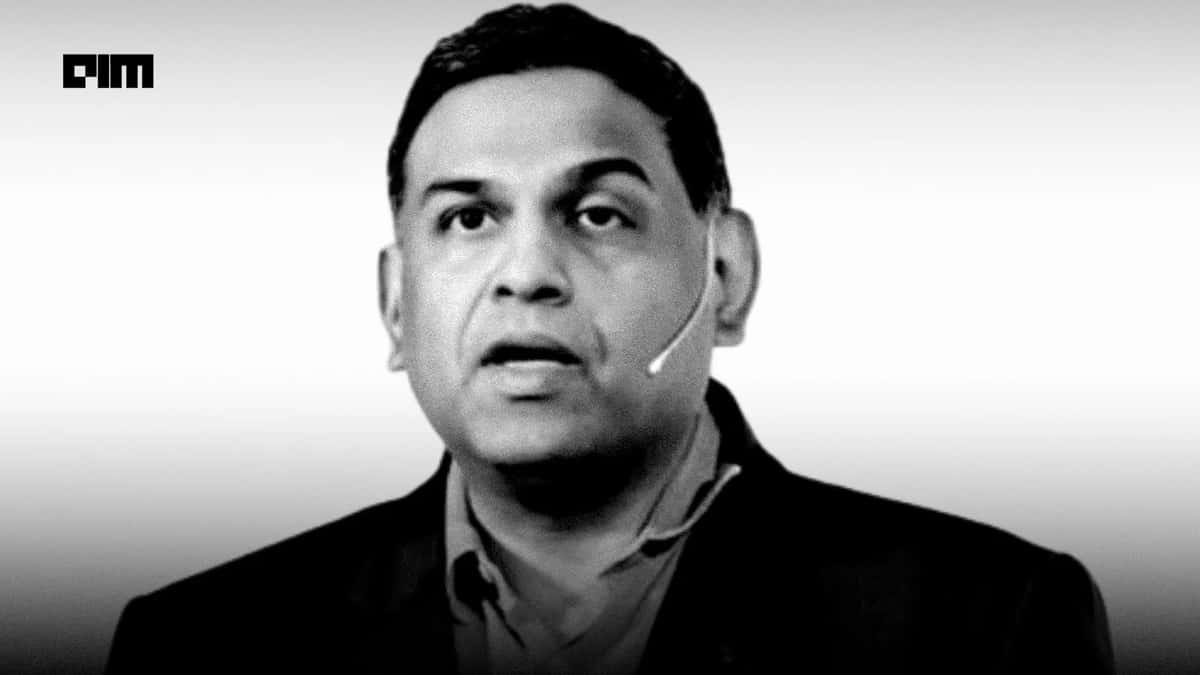
In an exclusive conversation with AIM, Ganesh Gopalan, CEO of Gnani.ai, offered a preview of the system and its capabilities. Inya VoiceOS enables end-to-end spoken intelligence by operating directly in acoustic and semantic space, eliminating the need for intermediate speech-to-text and text-to-speech pipelines.
The model is trained on one of the largest sovereign voice datasets of over 14 million hours of multilingual speech pretraining data and more than 1.2 million hours of task-specific speech fine-tuning data. It also includes over eight trillion text tokens for linguistic grounding and reasoning.
Unlike traditional cascaded systems, Inya VoiceOS consumes and generates speech tokens directly, without converting them to text. It also jointly encodes phonetics, prosody, semantics, and intent, preserving paralinguistic cues such as tone, emotion, pacing, and pauses.
It supports 24 kHz audio output with natural prosody, with native support for over 15 Indian languages.
Gnani.ai is also developing a sovereign, 14-billion-parameter voice AI foundational model focused on multilingual, real-time speech processing and emotion-aware AI. The initial focus would be on six languages before scaling to 22 languages.
Gnani is Doing What Others Can’t
While speaking with AIM, Gopalan described the moment with unusual clarity. The company now has more than 200 customers, adding around 80-90 new logos in the past year alone. Monthly additions average about 10 customers.
Most are Indian enterprises, though Gnani.ai has begun expanding into Japan, the Philippines and parts of the US, while actively evaluating the Global South as a growth market. Demand, Gopalan says, is already outstripping capacity.
“The demand is like we’re not able to cater to demand,” he says. At the centre of this growth is an observation that runs counter to popular narratives about AI adoption in India. According to Gopalan, enterprise AI adoption is not lagging—it is accelerating, driven by ROI pressure rather than experimentation.
“No, it is actually there. According to me, it’s the reverse. It’s an absolute reverse.”
The driver is language. In most customer interactions, English barely ranks among the top three. “What we have seen is that Hindi comes first, probably Telugu or Tamil comes second. But English we somehow always find at number four.”
Gnani.ai’s thesis is simple. Products are sold to Bharat, and Bharat speaks in many tongues. Voice is the most natural interface for this reality. Text-based AI struggles with latency, cost and cultural nuance in Indian settings. Voice, if built locally and end-to-end, scales faster.
Instead of large general-purpose models, Gnani.ai relies on SLMs tuned for specific sectors. Today it runs models in the three- to four-billion-parameter range, which Gopalan describes as the optimal point for real-time accuracy and speed. Earlier iterations ranged from 800 million to nine billion parameters before settling on this range.
These models are trained and inferred in Indian data centres, largely using domestic cloud providers. Costs are lower, latency is tighter, and regulatory compliance is simpler. According to Gopalan, inferencing, not training, will define the economics of AI infrastructure in India.
This approach has also shaped how Gnani.ai sells. Earlier, it focused on end products like voice AI agents. That has changed. Banks and enterprises increasingly want to build internally. Gnani.ai now exposes deeper layers of its stack through products like Vachana, allowing customers to build their own systems on top.
In December last year, Gnani.ai introduced Vachana STT, a foundational, enterprise-grade Indic speech-to-text model trained on over one million hours of real-world voice data, released as part of the IndiaAI Mission. This was the first public release on the VoiceOS roadmap, now officially called Inya VoiceOS.
What Makes Gnani Stand Apart?
Gnani.ai’s credibility rests on years of invisible groundwork. Founded in 2016 by engineers from Texas Instruments, the company spent its first three years doing no commercial business at all. Instead, it built speech models for Indian languages from scratch, manually collecting data across cities and colleges.
Its earliest releases were Kannada and Tamil speech-to-text models, followed by Hindi in 2018. That investment paid off when Samsung benchmarked Gnani.ai’s Hindi model against Google and Microsoft. The result led to Samsung’s first investment in an Indian AI company to power local language experiences in Bixby.
The company’s commercial pivot came in 2019 through a partnership with TVS Credit, where Gnani.ai built India’s first voice AI agent for collections. During COVID-19, the system expanded rapidly. According to Gopalan, within months, the bots outperformed human agents.
“Unless you support the local languages, you will not.” Customers spoke freely. Issues surfaced that human systems missed. Payment dates could be adjusted. Penalties were reduced. Recovery rates improved.
This insight now informs newer products like Avataar, a voice- and video-based onboarding avatar designed to replace physical branch visits for document collection and verification.
The aim is to remove friction without sacrificing trust. In a live demonstration, Gnani’s engineering team showed AIM how the platform works while reading and replying to an elderly woman’s conversation on a video call.
Positioning Against Competition
Gnani.ai sees competition but views many global players as misaligned with Indian realities. Messaging platforms dominate WhatsApp, and chat-centric AI firms struggle with the complexity of Indian voice interactions. Global voice startups, including ElevenLabs or Yellow AI, face latency and cost constraints in local deployments.
“I don't see any hope for MNCs in India. Short term, yes. And the reason is the price points.”
Against this backdrop comes Inya VoiceOS. The goal is to bypass text entirely and preserve emotional signals—pitch, tone and conversational nuance. “The emotions are missing. The pitch, the tone… also convey a lot of information.”
This model merges speech recognition and language processing into a single system, reducing latency while improving contextual understanding. Few companies globally have attempted this at scale.
“We thought we would have everything India-focused. Now I think we need to come up with things that are also globally appealing.”
- The AI Slowdown Narrative Doesn’t Reflect Enterprise Reality
- India’s Enterprises are Scaling AI. Is the Infrastructure Ready?
- Industry Wants Faster Approvals and Cheaper Power in India’s Data Centre Policy
- Inside Jio Platforms: Its Tech Bets, Loss-Making Subsidiaries and Hidden Risks
- India’s GCCs to Add 1.4 Million Jobs, Drive 170 Million Sq. Ft. Office Demand by 2031
- AI Can Be Cyborg or Centaur. But Can Enterprises Monetise It?