
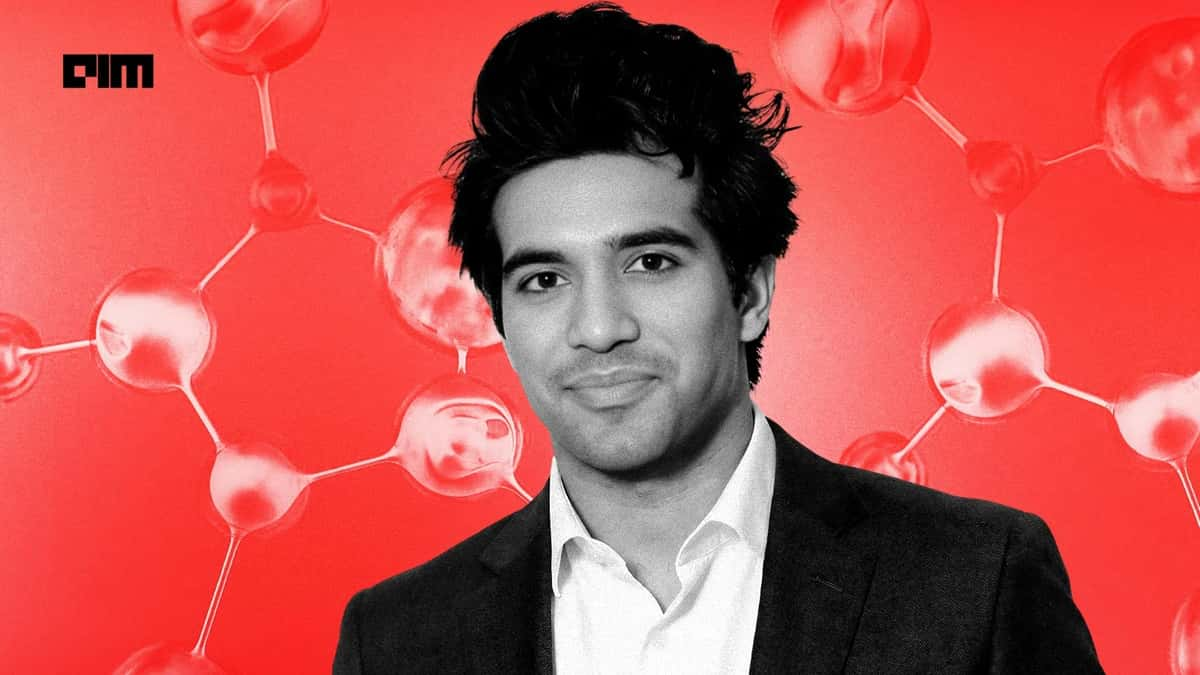

Shodh AI says it wants to build the “brain” of India’s energy future.
On February 18, the Delhi-based deep tech startup announced Project Skanda, which it describes as India’s first sovereign generative AI model for material science.
Developed in collaboration with NVIDIA under the Government of India’s IndiaAI Mission, the announcement signals a shift in the country’s AI ambitions. While most domestic efforts have centred on language models, Shodh AI is placing its bets on physics-driven intelligence.
“Shodh AI isn’t just building another chatbot; we are building the ‘brain’ that will design the physical future of India’s energy sector,” Arastu Sharma, Founder and CEO of Shodh AI, tells AIM.
The company was selected under the phase-2 of the IndiaAI Mission to lead the ‘AI for Science’ initiative. At the India AI Impact Summit, it unveiled the alpha release of Project Skanda, positioning it as one of the world’s first mesoscale foundation models for energy storage, focusing on generative material intelligence.
The distinction is significant. Most computational models in battery research operate at the atomic scale, analysing chemical interactions. Skanda instead focuses on the mesoscale, the internal 3D architecture inside a battery cell that determines cycle life, safety, and charging speed. At this level, pores, particles, and pathways govern how lithium ions actually move.
Arastu Sharma, CEO of Shodh AI showcasing Skanda AI model to Prime Minister Narendra Modi at the India AI Impact Summit
Unlike Language Models
According to the company, optimising this structure is key to solving the battery bottleneck. Skanda is what Sharma calls a ‘large material model’. The current version, SkandaMeso-1, runs at roughly 350 million parameters. In an era of multi-billion-parameter chatbots, that number appears modest. Sharma argues the comparison misses the point.
“Unlike ChatGPT, which processes simple 1D text, Skanda processes high-fidelity 3D volumetric data, complex, microscopic architectures where battery chemistry happens,” he says. “Generative AI tools like ChatGPT or Gemini hallucinate science. They can write a poem about a battery, but they cannot invent a working battery. Project Skanda is a scientist, not a search engine.”
At its core, the system uses a generative surrogate architecture built on NVIDIA’s PhysicsNeMo framework and GPU-accelerated solvers. It employs diffusion models to generate detailed 3D electrode microstructures based on performance targets.
Engineers can specify a goal, such as 1,000 cycle life or faster charging, and the model performs inverse design, generating a manufacturable microstructure that meets those constraints. A physics-informed surrogate model then predicts electrochemical performance in milliseconds, replacing slower numerical solvers.
Sharma credits NVIDIA’s stack as the accelerator that made this feasible.
“NVIDIA’s PhysicNeMo was the ‘time machine’ for our development,” he said. “Simulating battery physics usually takes hours or days. By leveraging NVIDIA H100 Tensor Cores and the PhysicNeMo framework, we accelerated these simulations by orders of magnitude. It allowed us to train our model on a ‘Physics Hypercube,’ compressing what would have been years of trial and error simulation into a training run that took days.”
“AI is accelerating the pace of scientific discovery, enabling researchers to tackle complex challenges that were once considered intractable,” says Tim Costa, General Manager of Industrial and Computational Engineering at NVIDIA. “Shodh AI’s use of NVIDIA PhysicsNeMo to develop Project Skanda provides a powerful foundation for building sovereign AI models that can help transform India’s energy and technology sectors.”
The compute footprint was significant. Shodh AI built a synthetic data factory to overcome a structural problem in materials AI: the lack of accessible datasets. “You can scrape the internet for text to train a chatbot, but you cannot ‘scrape’ battery microstructures. They don’t exist online,” Sharma said.
To overcome this, the company simulated more than one million unique electrochemical scenarios, creating what it claims is the world’s largest structured dataset for battery microstructures.
The effort required a dedicated cluster of NVIDIA H100 and A100 GPUs running continuously to solve complex physics equations. The heavy lifting, according to Sharma, is now complete. The model has been distilled so inference can run in seconds via an API, without requiring a supercomputer on the user side.
The Focus on Self-Reliance
The symbolism behind the name is deliberate.
“Skanda is the Indian deity of war and the commander of divine forces,” Sharma points out. “In our context, Project Skanda is the ‘Commander of Electrons.’ It directs how energy moves through matter. Solving energy storage is a strategic battle for India’s future, and this model is our greatest weapon.”
The immediate focus is on lithium-ion and sodium-ion batteries for electric vehicles and grid storage. Today, India imports much of its battery technology design from East Asian manufacturers. Shodh AI’s pitch is that a sovereign material model could change that equation.
“Currently, India imports battery technology designs from China or Korea. Skanda empowers Indian engineers to create indigenous intellectual property,” Sharma explains. “It democratises R&D, allowing an Indian startup or researcher to design world-class materials without needing a billion-dollar R&D lab.”
The company plans a full-blown sim-to-real launch later this year. The next phase will fine-tune the model on real-world lab data, including SEM imaging and physical cycling results, to bridge digital simulation and manufacturing.
To close the loop, Shodh AI is also setting up what it calls India’s first autonomous robotic material foundry. The facility will generate high-fidelity experimental data to continuously retrain and refine the foundation model.
The roadmap for Shodh AI extends beyond batteries. The company is already working on Skanda Large, a seven-billion-parameter diffusion transformer designed to fuse text instructions directly with 3D structural generation.
An engineer could type a prompt such as “design a fast-charging drone battery”, and the system would generate a corresponding microstructure blueprint. Sharma describes this as a first-of-its-kind multimodal architecture in materials science.
He expects what he calls a ‘Cambrian explosion’ in material design once the platform opens. Faster charging EV batteries, high-power drone cells that do not overheat, and ultra-durable storage for India’s solar grid are among the early use cases he envisions.
“We are giving engineers the power to say, ‘I want a battery that does X’, and having the AI provide the recipe to build it,” he says. “It shifts the industry from trial-and-error to target-driven design.”
The broader ambition is political as much as technical. “True sovereignty isn’t just about having your own chatbot; it’s about owning the blueprints of the physical world,” Sharma says.
“By building the brain that designs these materials in India, for India, we reduce our reliance on foreign technology transfers. Project Skanda ensures that the next breakthrough in battery technology can happen in a lab in Bengaluru or IIT Madras, rather than being imported. It is sovereign intellectual property.”
In an AI landscape crowded with language models, Shodh AI is staking its claim on matter itself. If Skanda works as advertised, India’s sovereign AI story may move from words to atoms.
- The AI Slowdown Narrative Doesn’t Reflect Enterprise Reality
- India’s Enterprises are Scaling AI. Is the Infrastructure Ready?
- Industry Wants Faster Approvals and Cheaper Power in India’s Data Centre Policy
- Inside Jio Platforms: Its Tech Bets, Loss-Making Subsidiaries and Hidden Risks
- India’s GCCs to Add 1.4 Million Jobs, Drive 170 Million Sq. Ft. Office Demand by 2031
- AI Can Be Cyborg or Centaur. But Can Enterprises Monetise It?