
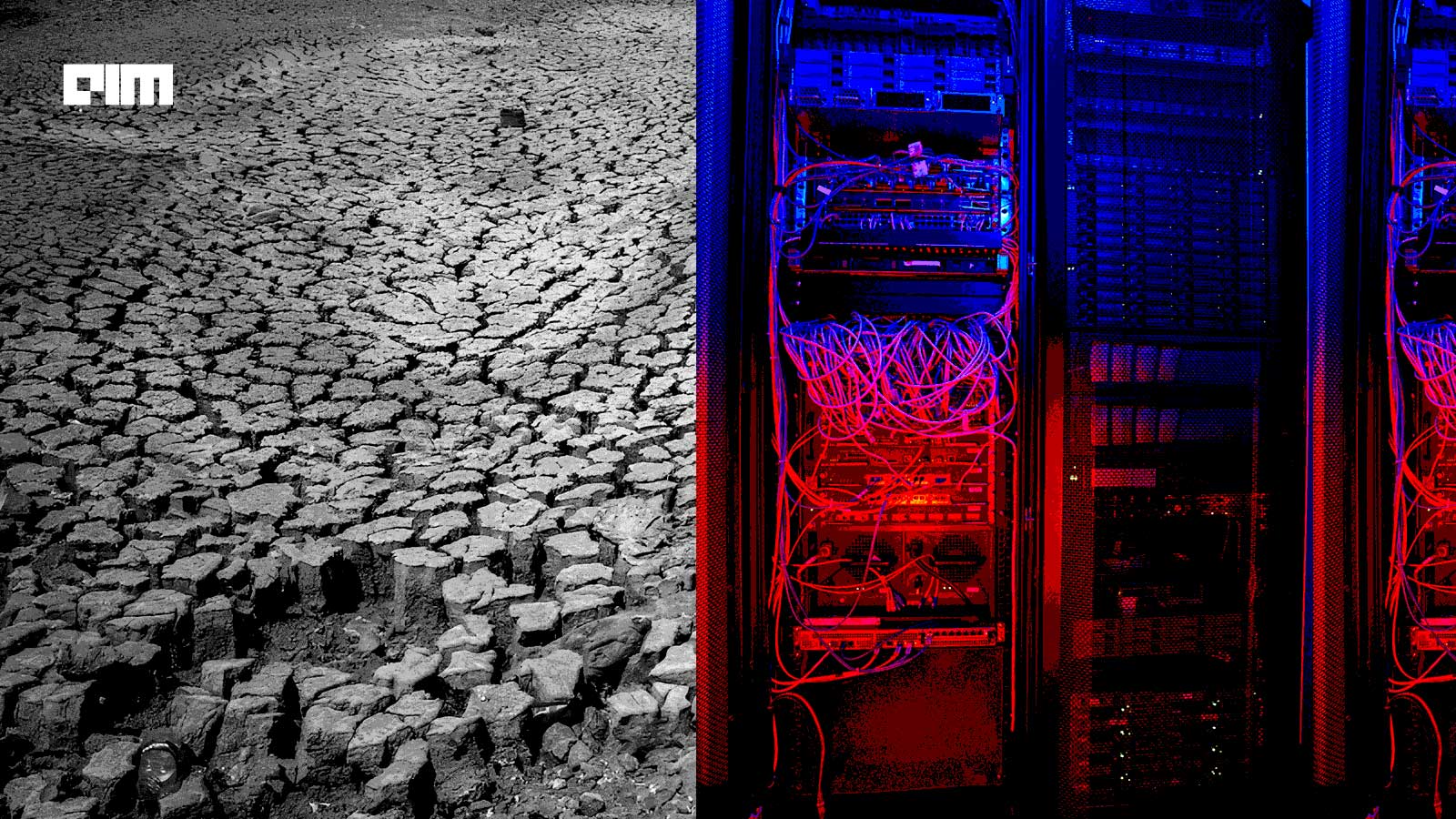
India has faced a challenging two months due to widespread heatwaves in cities. Although some cities have begun to receive rainfall recently, the Indian Meteorological Department (IMD) cautions that this is only a temporary break before another heatwave occurs.
Speaking to AIM, Mrutyunjay Mohapatra, Director General of Meteorology at the India Meteorological Department, says that another heatwave is expected to arrive between mid and late June.
Yet, across the very heat corridors that are suffocating millions of Indians, a building boom of an altogether different kind is underway. Hyperscale data centres, the cavernous, power-hungry facilities that keep AI chatbots answering, streaming platforms playing, and cloud infrastructure humming, are going up at a pace with no historical precedent in this country.
India's data centre capacity stood at 1.5 gigawatts by the close of 2025, quadrupling from 0.4 gigawatts in 2020. Deloitte projects a further expansion to eight to ten gigawatts by 2030, a six-fold increase in four years, while the Union Budget 2026 extended a tax holiday until 2047 for foreign companies building data centres in India. The ambition is staggering. So is the cost, not merely financial, but environmental.
The Heat Tax on Cooling
Data centres require cooling to prevent server overheating, which generates huge thermal energy. Cooling is essential for operations. In temperate climates, this is manageable, but in India's hot summers, it becomes very expensive.
Analysis by the World Economic Forum finds that extreme heat, drought, and other climate hazards could drive annual costs at data centres globally up to $81 billion by 2035, rising to $168 billion by 2065.
The latest AI chips consume more than ten times as much energy as their predecessors, generating so much heat that air conditioning is no longer sufficient. Operators must now use liquid cooling, with cold water pumped into server rooms to remove heat.
Heatwaves are becoming more severe with each passing year, staying longer and striking harder. This translates to higher electricity consumption, rising water demand, and increasing operational costs. “A large portion of electricity is needed for computing, but much of it is consumed by cooling systems, backup infrastructure, and power management,” says Mahak Agrawal, Head of India, Riding Sunbeams.
Indian data centres have traditionally used air-cooled chillers or water-based cooling systems. Air-cooled chillers do not require water, but they are relatively expensive to operate — and in ambient temperatures above 40°C, their efficiency drops sharply, driving electricity bills even higher.
For operators already committing tens of billions in capital expenditure, this thermal penalty could erode the very cost advantage that made India attractive in the first place.
Chandra Bhushan, CEO of iForest, says it is high time the government issued guidelines for data centres. We already lack proper guidelines for waste, energy and water consumption.
“Data centres are not something of the past, but they are here, and India is going to build a lot of these centres in the coming years. Data centres are also going to use huge amounts of energy for the data generated, and they are going to result in more water usage,” says Bhushan.
Bhushan highlights that the Urban Heat Island significantly contributes to heat in cities, as increased pollution and higher population density trap more heat, leading to hotter conditions than in rural areas.
“Our cities are designed for 100 years of adaptation, but they are built as hot ovens that trap heat. Simple changes in structures and growing green roofs can bring down temperatures,” he says.
Noting that heatwaves are not going to vanish anytime soon, Bhushan calls for simple changes like growing kitchen gardens, planting on the facade, colouring roofs white, using less energy-intensive cooling tech, among others.
Draining the Wells of the World's Most Water-Stressed Cities
The greater catastrophe, however, is not financial. It is hydrological. Most data centres in India rely on evaporative cooling, which uses water evaporation to absorb heat from servers. A typical 1-megawatt system consumes roughly 25-26 million litres of water annually for cooling, and higher temperatures in India further increase this demand.
The scale of cumulative consumption is alarming. India's data centres collectively consumed approximately 150 billion litres in 2025. A single 100-megawatt facility can consume roughly two million litres of water per day. That figure is projected to more than double, reaching 358 billion litres by 2030, with most facilities concentrated in urban clusters such as Mumbai, Hyderabad, Chennai, and Bengaluru, cities that already face competing water demands from households, agriculture, and industry.
These are not abstract numbers. They describe a collision between industrial demand and human survival. Bengaluru's data centres are concentrated in its most water-stressed eastern and southeastern corridors. Hyderabad faces a projected water deficit of 870 million litres per day by 2027. Chennai hit Day Zero in 2019 when its four main reservoirs fell below 1% capacity.
Abhijit Bhaduri, industry leader and executive coach, captured the stakes with stark clarity: "When there is a water shortage, the servers will simply move to the next country that forgot to ask the right question first. India, in its rush to become the world's AI infrastructure hub, is sleepwalking into a water catastrophe that will outlast every MOU it signs today."
Protests, Politics, and a Governance Gap
The friction between data centre expansion and water rights is already producing conflict. In early 2026, residents in Andhra Pradesh raised objections to Google's $15 billion data centre project, citing land acquisition practices described by activists as opaque and a lack of transparency over water and energy consumption commitments.
Globally, the playbook is similar: in early February 2026, more than 50 people gathered in Johor, Malaysia, to protest against a proposed data centre project, citing construction disruption and raising concerns about the long-term strain such facilities could place on local water resources.
Within India, water-related civil unrest has a long and volatile history. The Cauvery river dispute between Karnataka and Tamil Nadu has triggered bandhs, road blockades, and clashes with police. As data centres in Bengaluru draw further on the same depleted aquifers that supply millions of residents, the risk of intensified protests is not hypothetical but structural.
Karnataka's IT Minister Priyank Kharge confronted this tension directly in the state assembly in March 2026, warning that data centres were "heavy water and energy guzzlers" and that the state needed a greener approach. He told legislators that each megawatt of data centre capacity demands 25 million litres of water a year, and that answering just five queries on ChatGPT requires 500 millilitres of water.
Yet the governance framework remains conspicuously absent. No state data centre policy among the 15 currently in force contains mandatory water stress mapping as an environmental clearance condition. The Union Ministry of Environment, Forests and Climate Change does not require a thermal impact assessment for data centre approvals. Because data centres are classified as IT or ITeS entities rather than as large infrastructure projects, they do not undergo the standard environmental impact assessment process.
Experts say the country urgently needs a national data centre policy to regulate energy use, water consumption, land allocation, and sustainability standards as investments continue to rise.
The Environmental Multiplier Effect
Beyond water, data centres in heat-stressed regions activate a destructive feedback loop. Higher ambient temperatures force cooling systems to work harder, consuming more electricity. That electricity, still substantially coal-derived in India, produces more carbon emissions, which in turn intensifies the heat already destabilising operations. The tail eats itself.
A S&P study predicts 60-80% of India's data centres will face high water stress this decade. The IEA projects AI-related water use could reach 4.2-6.6 billion m³ annually by 2027. Data centres evaporate about 80% of the water they withdraw, with limited wastewater treatment. In India, where nearly 163 million people lack access to reliable clean water, facilities often use drinking-water-quality supplies to safeguard servers.
Krishna V Giri asks, "Where, precisely, is all the electricity going to come from? And who is going to pay for it? Power is only half the problem. Data centres require vast quantities of water to cool continuously running servers, and India is among the most water-stressed major economies on earth."
A September 2025 Morgan Stanley report projected that global AI data centre water consumption would reach 1,068 billion litres annually by 2028, an elevenfold increase from 2024 levels. Evaporative cooling systems consume more water as ambient temperatures rise, precisely the conditions El Niño is expected to produce across India in 2026.
Who Pays?
The financial burden of operating data centres in extreme heat ultimately flows in multiple directions. Operators face higher electricity bills and accelerated hardware degradation. States bear the costs of stretched municipal water systems and infrastructure repairs. And ordinary citizens, particularly in peri-urban areas near data centre campuses, face shrinking water availability with no compensation mechanism and little legal recourse.
The Observer Research Foundation has recommended mandatory environmental impact assessments, rewards for greener computing, and the use of AI itself to improve water security through flood prediction and irrigation management. Whether the government will act before the crisis becomes irreversible remains the central unanswered question of India's digital ambition.
India's AI future isn't just based on silicon and ambition. It's built on a depleting aquifer during the hottest summer in living memory. This foundation deserves much more scrutiny more than the ceremonial ribbon-cuttings we've had so far.

Your reaction
Discussion
What's your take on this story?
No comments yet — be the first to share your view.