
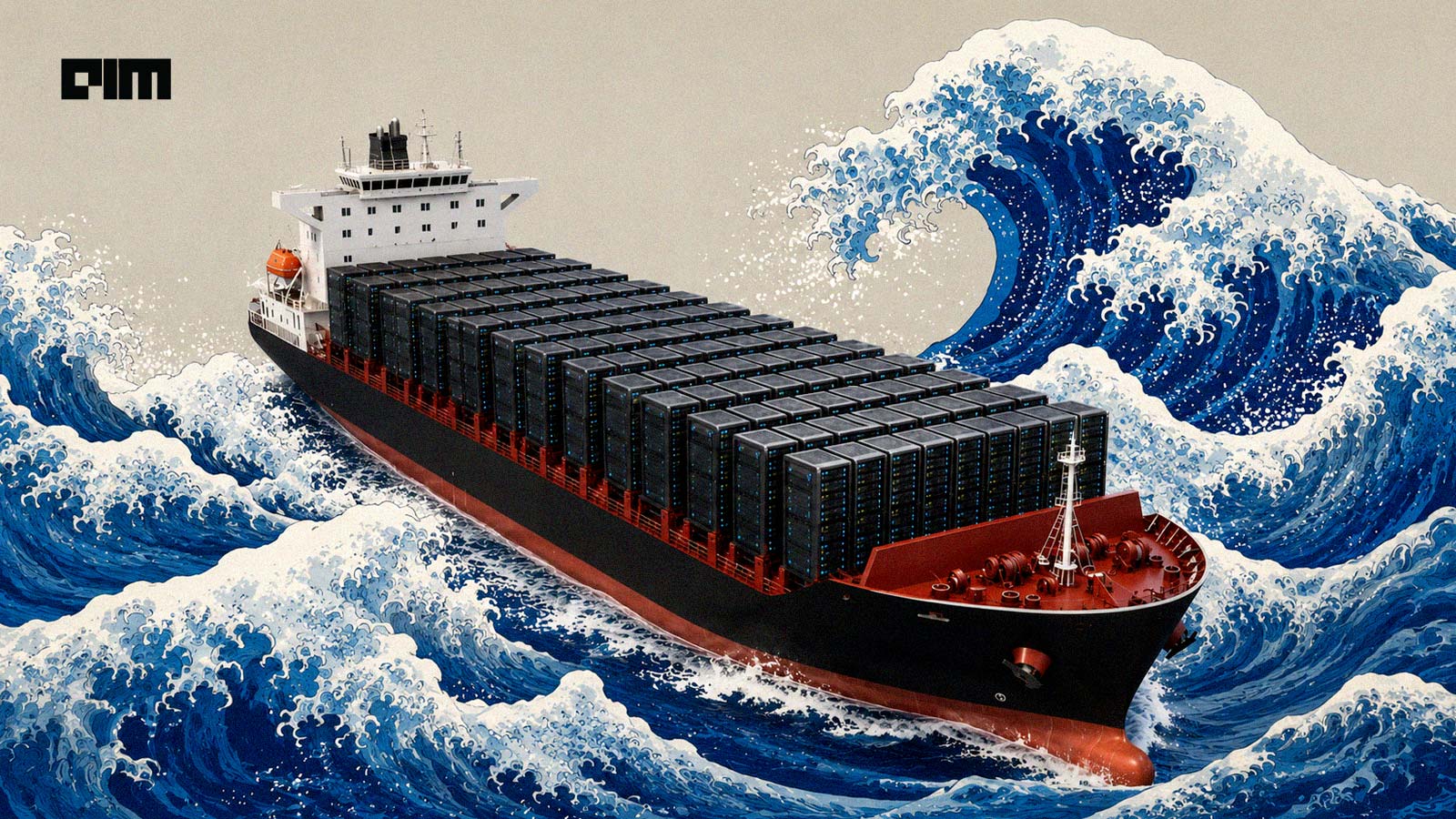
The world's data centres are running out of room. Land is scarce, power grids are strained, water for cooling is contested, and planning approvals in dense urban markets can drag on for years. Now, more engineers, shipbuilders, and investors suggest a radical solution to move infrastructure offshore.
Floating data centres, compute facilities housed on barges, purpose-built vessels, or modular marine platforms, have moved swiftly from experimental curiosity to credible infrastructure strategy.
According to the International Energy Agency's 2025 analysis, data centres consumed approximately 415 terawatt-hours (TWh) of electricity globally in 2024, roughly 1.5% of total global electricity consumption.
By 2030, that figure is projected to more than double to 945 TWh, driven almost entirely by AI workloads. Traditional land-based infrastructure is struggling to keep pace. The floating data centre market, valued at $316.7 million in 2024, is projected to reach $828.9 million by 2034, growing at a compound annual growth rate (CAGR) of 10.1%.
How Floating Infrastructure Differs from Land-Based Facilities
The engineering differences between a floating data centre and a conventional facility are significant, cascading into every dimension of cost, performance, and siting logic.
The most obvious distinction is cooling.
A standard land-based data centre relies on energy-intensive chillers, cooling towers, and evaporative systems that together can account for a substantial portion of total electricity consumption. A floating facility, by contrast, uses the surrounding water body directly. Keppel Data Centres' project in Singapore, currently under construction at 25 Loyang Crescent, uses a closed-loop seawater cooling system that requires no potable or industrial water.
Traditional data centres use a huge amount of electricity not just to run computers, but also to keep them cool. For every unit of computing power used, nearly half as much extra power is needed for cooling systems like fans and air conditioners.
Floating data centres are trying to solve that problem by using seawater or surrounding water to naturally cool the machines. As a result, they consume far less energy. Companies like Nautilus Data Technologies say their floating facilities can cut energy use by nearly 30%. China’s underwater data centre near Hainan is also far more efficient than a typical land-based facility because the ocean itself helps keep the servers cool.
Conventional data centres are permanent and take 3-4 years to build, especially in markets like India. Floating facilities, built in shipyards and not constrained by land, can cut this to about 1 year, as demonstrated by a Japanese consortium comprising Mitsui O.S.K. Lines, Kinetics, and Hitachi. They noted a car carrier's floor area of around 54,000 square metres, equivalent to Japan's largest land-based data centre.
Modular design also enables incremental scaling, allowing operators to deploy floating modules to match demand and capital requirements, thereby avoiding the need for large upfront investments.
The Cost and ROI Calculus
The financial case for floating data centres is nuanced. Construction costs for conventional land-based facilities have risen sharply. The 2025 data centre construction cost index shows a 5.5% year-on-year increase in the cost per watt of a traditional air-cooled facility, with premium markets such as Singapore reaching $14.5 per watt and Tokyo hitting $15.2 per watt. Standard non-AI data centres typically cost between $10 million and $12 million per megawatt to build; AI-optimised facilities can cost more than $20 million per megawatt.
Floating facilities sidestep land acquisition entirely and eliminate the most energy-hungry components of conventional cooling. According to Schneider Electric estimates cited in industry analyses, the total cost of ownership (TCO) for modular data centre approaches can be reduced by as much as 25%, with capital expenditure running 10 to 20% below traditional builds.
The trade-off lies in the complexity of marine engineering, ongoing vessel maintenance, and the logistical overhead of operating at sea. Subsea power cables, salt-resistant hardware specifications, and the cost of barge construction or vessel retrofitting must all be factored in. Nevertheless, for markets where land is either unavailable or prohibitively expensive, the ROI argument is increasingly compelling.
The Countries Already in the Water
Singapore is the most advanced market. Keppel Data Centres has begun construction of a 25 MW floating facility, a four-storey, 19.2 MW waterborne module paired with shoreside infrastructure, due to go live in 2028, and is already committed to a global hyperscale customer.
The country’s Green Data Centre Roadmap targets at least 300 MW of new sustainable capacity, with the city-state's land constraints making offshore solutions a structural necessity.
China has moved from concept to operational deployment the fastest.
Beijing Highlander Digital Technology launched an underwater data centre off Hainan in late 2023, with a second unit in February 2025. The cluster has about 1,200 servers, handling 7,000 AI inference queries per second for clients like China Telecom, Tencent, and SenseTime.
This concept is part of the five-year economic plans for provinces including Hainan, Shandong, Xiamen, and Shenzhen.
In the U.S., Nautilus Data Technologies' Stockton 1, a 6.5 MW floating data centre on a refurbished barge in Stockton, California, was the first commercial floating data centre. Oregon's Panthalassa, backed by Peter Thiel's VC and valued at nearly $1 billion after raising $140 million, is developing deep-ocean floating nodes powered by wave energy and connected via SpaceX Starlink.
South Korea's industry giants are involved. Samsung Heavy Industries and Dallas-based Mousterian plan to deliver floating data centres with over 1,500 MW of AI compute capacity in three years. Samsung and OpenAI also signed an MoU in October 2025 for waterborne compute infrastructure.
Why India Should Be Paying Very Close Attention
India's data centre sector has seen about USD 14.7 billion in investments since 2020, with an expected USD 20–25 billion by 2030. Google alone committed USD 6 billion to a large campus in Andhra Pradesh.
However, a key challenge is the lengthy approval process. Land-based data centres take roughly 3.5 to 4 years to secure permissions.
India's extensive 7,516 km coastline, connected to key submarine cables, offers opportunities to deploy floating data centres near ports such as Chennai, Mumbai, and Kolkata, leveraging existing infrastructure.
With tropical waters suitable for cooling and supportive government policies, India is well-positioned. To capitalise fully, the country must act swiftly to develop floating data centre infrastructure rather than just relying on others.

Your reaction