
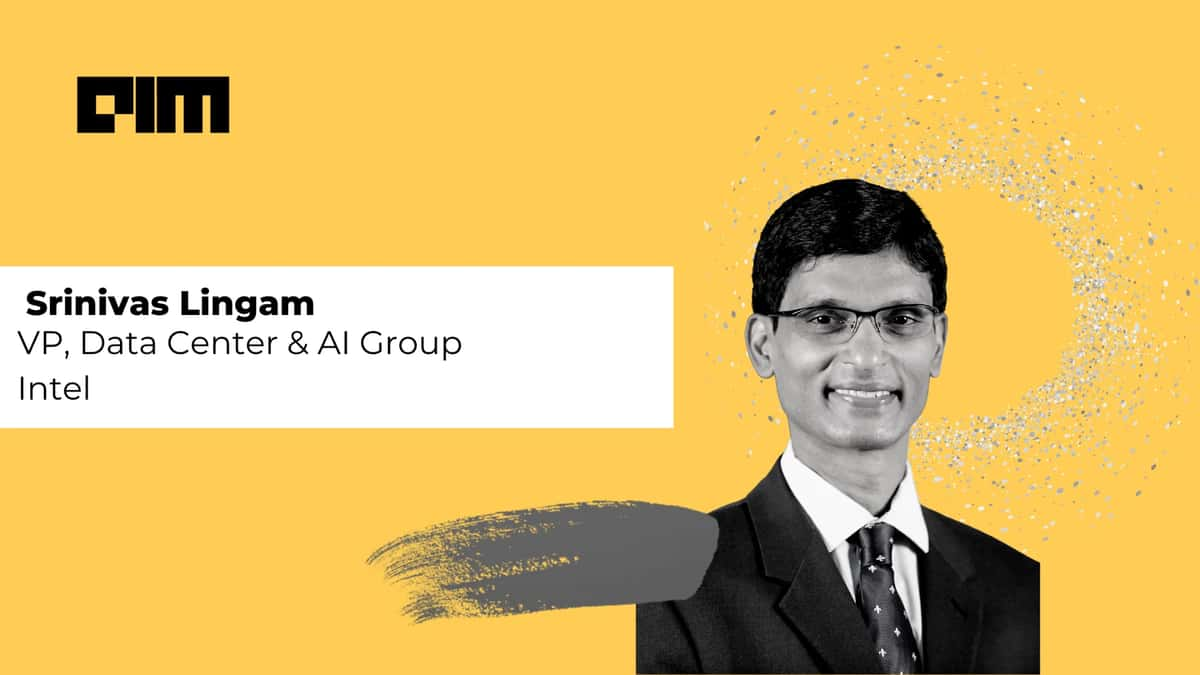
Over the 25 years that Srinivas Lingam has been at Intel, he has seen it all. Having led the team’s CPU design, SoC, chipsets, Soft IP, Hard IP and AI teams across the United States, Israel, Malaysia, India, and Costa Rica, Lingam was appointed vice-president of the data center and AI group at the company two years ago.
Lingam has seen the AI/ML industry transform and been at the forefront of these changes at Intel -- he developed the company’s deep learning training and inference products while also offering innovative data centre and cloud services products. Analytics India Magazine caught up with him to know about the lessons learnt within the industry.
AIM: As the VP of data centre and AI group at Intel, India, what exactly does your role entail?
Srinivas: I had the privilege of joining Intel right after my master’s degree about 25 years ago. The first-half of my career was in the US, where I was a part of the development of several generations of Intel CPU products – from Pentium-II to the Core family of microprocessors. After returning to India in 2010, I led the development of several differentiating IPs like low-power offloading sensing engines, mixed-signal IPs, and managed global teams across the globe.
Over the past eight years, I have built the AI products group in India and led the organisation to create a deep learning center of excellence with end-to-end hardware and software capabilities. Our team helped deliver Intel’s first data center inference accelerator – Springhill, and won Intel’s highest global achievement award.
AIM: What were some of the biggest challenges in your career, and how did you overcome them?
Srinivas: It’s been an honour to have been a part of a couple of crucial industry shifts like the CPU evolution in the 2000s and deep learning in the 2010s. If we talk about challenges vis-a-vis the process part of things, in the early 2000s, Intel and the industry drove the performance of their next-generation CPU products by running the chips at higher clock frequencies. This became unsustainable due to power and cooling challenges for these chips. To overcome this, we had to pivot to “power efficient” computing by changing the designers’ mindset, which took time as they had to unlearn old behaviours. I led the low-power design teams for several CPU generations and played a vital role in this transformation.
By the early 2010s, AI and deep learning technologies started emerging. This again required a shift in mindset while designing AI-specific accelerators with hardware-software co-optimizations. Initially, applications around vision workloads dominated the compute and architecture requirements. But later, language and recommendation workloads started to emerge at a rapid pace. Intel developed some of the industry’s first AI accelerators for data centers. This meant the team had to be very agile and constantly adapt the architecture, hardware, and software to meet the demands of the changing AI landscape.
AIM: What are some of the most important lessons you have learned in your career that you can give aspirants in the field?
Srinivas: Whenever I think about AI, I think about Arthur C. Clarke’s quote – “Any sufficiently advanced technology is indistinguishable from magic”. AI feels like magic to me as we explore new areas of learning and its newer applications. It will continue to play an integral role in the new world, so there is no better time than now to be invested and harness its true potential. But we must also remember that AI is still a dynamic field. We will witness numerous innovative technologies gain immense prominence and fall by the wayside as the field progresses. So, we need to be nimble and open to continuously learning new things. Carpe diem!
AIM: What are some of the biggest trends currently across AI/ML?
Srinivas: In the AI and ML space, the significant trends currently are large language models, multimodal learning, self-supervised learning, and last but not the least, the democratisation of AI. The prevalence of AI can be felt everywhere today – from the automated tagging of photos on social media to life-saving robotic surgery. Large Language Models (LLMs) powered by transformer architectures like BERT, GPT-3, etc., have demonstrated vast capabilities in Natural Language Understanding and Natural Language Generation.
Text and art are increasingly getting created automatically by AI – for instance, the editorial written by GPT-3 in The Guardian last year. LLMs are also powering automatic code writing assistants such as GitHub Co-Pilot. Multimodal learning has also made significant progress. Models like DALL-E 2, Imagen, and Stable Diffusion have powered the creation of realistic images from brief text prompts. Self-supervised learning has enabled the training of large foundational models from publicly available web data.
The one trend I think is critical is the democratisation of AI. We see large open-source foundational models, such as BLOOM and Stable Diffusion. This opens AI to non-AI folks like scientists, artists, gamers, etc. As AI evolves from research to the real world, this diversity and inclusion will be the key to its progress.
AIM: How have you seen data analytics and AI evolve in India?
Srinivas: AI and data analytics have grown exponentially in India over the length of my career.
About 15-20 years ago, analytics was nothing but an excel sheet tracked by a human, and AI was hardly spoken of, except in the hallways of leading academic institutes like IITs and IISc. It was mainly rule-driven or basic pattern recognition.
Srinivas Lingam, VP of Data Center and AI Group
Today, the Indian technology ecosystem is heavily invested in every aspect of AI such as developing AI-specific processors, AI infrastructure and systems, AI software and AI applications, etc. India’s e-commerce growth has fuelled multilingual chatbots, conversational agents for Indic languages, and AI-driven logistics. We currently lead the world in real-time digital payments, clocking almost 40% of the transactions, and this would not have been possible without AI and analytics infrastructure in India. To cite an example, think of our Covid vaccination program. Remember 20 years ago, how our polio vaccination tracking and infrastructure was purely manual? And now, think of the infrastructure that powered CoWIN – vaccinating a humongous 1.3 billion people and tracking the data in real-time. I think the progress has been tremendous, and this momentum will continue for a couple more decades.
AIM: In 2012, Harvard called ‘data science’ the hottest profession of the 21st century. Do you think this still holds true?
Srinivas: I feel there are several new professions in AI that have emerged and can be considered worthy of holding the title of being the hottest profession. AI is no longer just about model building in which data scientists excel, but also about deployment, monitoring, and scaling. Hence, MLOPs/AIOPs/DevOps streams in AI are increasingly witnessing a massive requirement for talent. As the integration of AI spreads to every other field, AI skills coupled with domain expertise will become the hot profession in the coming years.
AIM: How will Intel data centres move towards being more sustainable?
Srinivas: At Intel, sustainability is the backbone of everything we do. In May 2022, the company announced key investments to create more sustainable data centre technology solutions. We introduced the industry’s first open intellectual property (open IP) immersion liquid cooling solution and reference design. An integral part of the solution is embracing new principles such as heat recapture and reuse via immersion cooling, which, according to research, could reduce carbon emissions by 45% compared to traditional data centre usage. This new solution has the power to fundamentally change the way data centres are built and operated.
Intel’s programmable hardware and open software also deliver capabilities that enable greener solutions for customers. For example, by synergising Intel® Xeon® Scalable processors and Intel’s comprehensive power management and AI capabilities, we have seen a reduction in overall power consumption by data centres, as well as the ability to scale power consumption according to demand. These initiatives are in line with the company’s plans to achieve net-zero greenhouse gas emissions in its global operations by 2040, increase energy efficiency, and lower the carbon footprint of Intel products and platforms.
- India’s GCCs to Add 1.4 Million Jobs, Drive 170 Million Sq. Ft. Office Demand by 2031
- AI Can Be Cyborg or Centaur. But Can Enterprises Monetise It?
- AMD’s Server CPU Business Faces a New AI Boom
- How an Engineer Is Using AI to Bridge the Accessible Education Gap
- AI Agents are Making Human Customer Service a Specialist Job
- Why Nandan Nilekani-Backed F2A Believes India's Investment Opportunity Lies in Edge AI