
Chinese AI lab Moonshot AI released the Kimi K3 model family this month, grabbing headlines for delivering top-tier performance that outshines established models such as Claude Opus 4.8 and GPT-5.5 across numerous benchmarks.
Unlike many frontier AI models from China that split capabilities across distinct small, medium, and large model sizes, Kimi K3 has been released as a single, unified 2.8-trillion-parameter model.
The model can perform long-horizon software engineering, enterprise agent workflows, multimodal visual editing, and autonomous deep research without switching architectures.
Open-Weight Licensing and Commercial Terms
Moonshot AI released Kimi K3; its model uses a custom Kimi K3 License that blends open access with targeted commercial restrictions, setting it apart from other Chinese open-weight models.
Unlike DeepSeek, which favours fully permissive, restriction-free MIT licensing, K3 mandates that third-party model-as-a-service (MaaS) providers generating over $20 million annually enter into a separate commercial agreement with Moonshot AI.
Furthermore, where licences like Alibaba’s Qwen impose commercial paywalls once an application reaches high traffic, Kimi K3 allows consumer services with over 100 million monthly active users or $20 million in monthly revenue to use the model freely, provided they prominently display “Kimi K3” branding on their user interface.
Crucially, internal enterprise deployments remain completely free and exempt from revenue caps regardless of company size, as long as the model’s outputs are not resold as an external third-party API.
Beyond Standard Benchmarks
While standard benchmark scores offer a useful snapshot of raw performance, Kimi K3’s true capability lies in how its top-tier capabilities translate into real-world cost efficiency and autonomous execution.
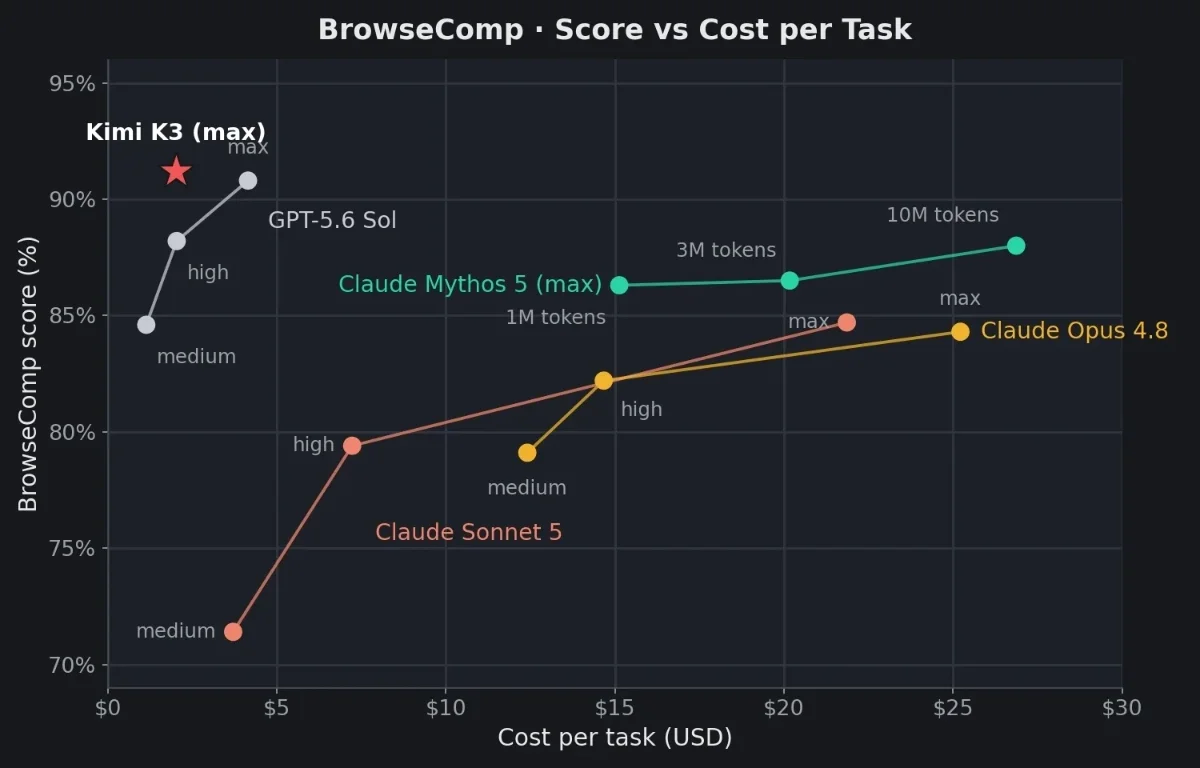
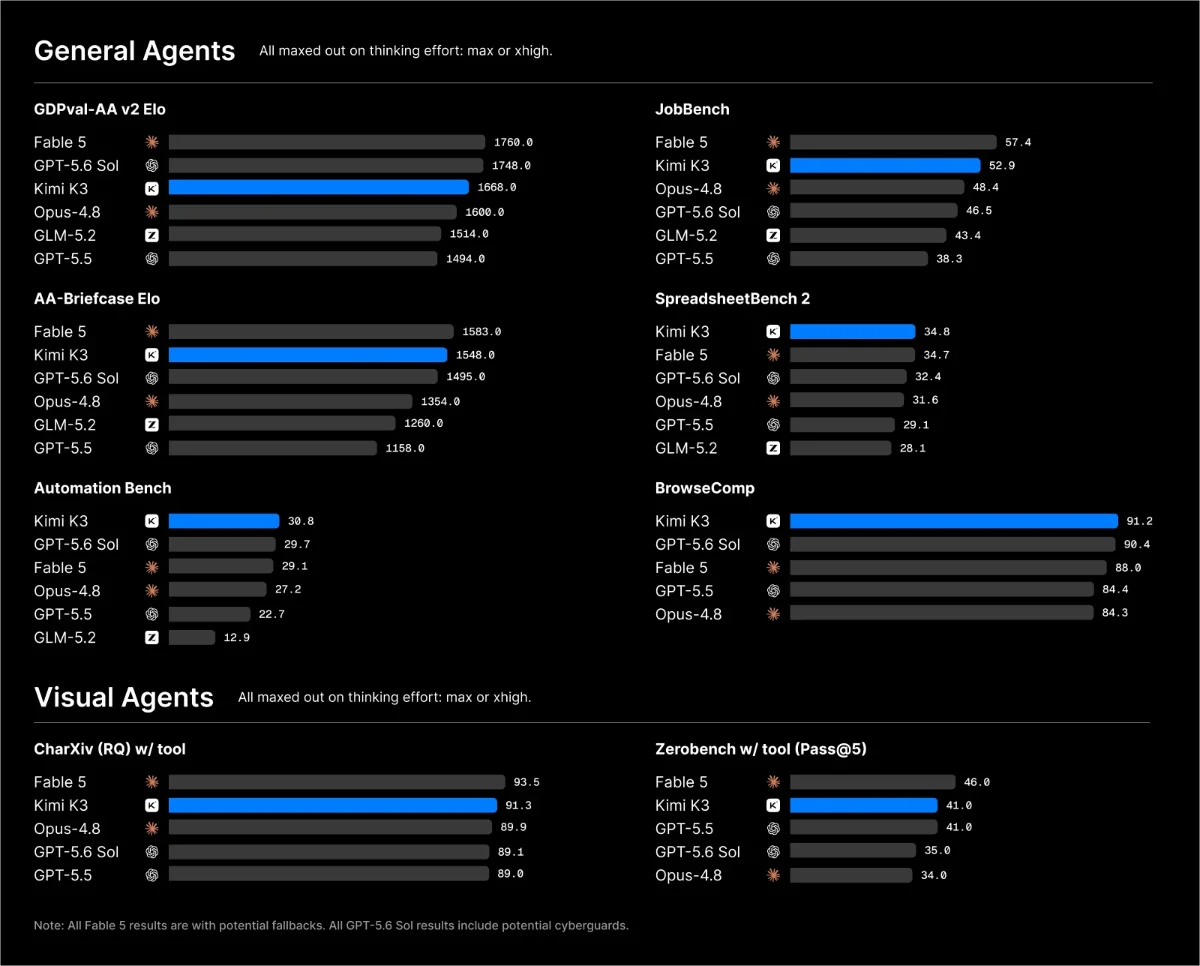
On OpenAI’s multi-step web browsing suite, BrowseComp, Kimi K3 achieves its peak 91.2% accuracy at just $2.03 per task, half the cost of GPT-5.6 Sol (90.4%), and an order of magnitude cheaper than Claude models at maximum reasoning effort.
On the economic knowledge-work benchmark GDPval-AA v2, it delivers a competitive 1,686 Elo while running 2.6x cheaper per task than Claude Fable 5 (1,747 Elo).
Beyond task metrics, K3 became the first open-weight model to top LMSYS’s human-preference WebDev Arena with a 1,678 Elo score, outranking Claude Fable 5 (1,634 Elo) driven by its ability to write code, visually inspect rendered output, and iteratively adjust web, 3D, and WebGL graphics in a single stream.
In defensive cybersecurity, it demonstrated exceptional high-precision research by uncovering hundreds of candidate bugs across OS kernels and open-source codebases, leading to 16 confirmed zero-day vulnerabilities with a 70% human-verified precision rate, while scoring 32% on ExploitBench in independent evaluations by the UK AI Security Institute and US NIST/CAISI.
Kimi K3 Became Its Own Contributor
One unusual detail in Moonshot AI's technical report is that Kimi K3 is listed as a contributor alongside the company’s human researchers.
During the model’s late-stage development, Moonshot AI used an earlier K3 checkpoint to assist with software engineering and research tasks.
The paper includes several case studies showing how Moonshot AI used K3 during development.
K3 also built MiniTriton, a lightweight GPU compiler that includes its own compiler pipeline, tensor library, distributed training support, and GPU code generation.
Separately, K3 reproduced published astrophysics research, analysed thousands of pages of semiconductor industry reports to produce an interactive research website, and created a 3Blue1Brown-style animated explainer of its own architecture using its native multimodal capabilities.
And It Built Its Own Chip
Moonshot AI pushed Kimi K3’s self-engineering capabilities beyond software by tasking it with designing its own AI inference chip.
As an early proof of concept, the company asked the model to build a processor tailored specifically for a smaller version of K3’s own architecture rather than a general-purpose accelerator.
Working autonomously for 48 hours using Kimi Code, the model designed, optimised and verified the complete chip using open-source electronic design automation (EDA) tools.
The resulting prototype, called Nano-KPU, implements K3’s hybrid attention architecture, integrates INT4 matrix multiplication hardware with fused dequantisation, and fits within a compact 4 mm² silicon area budget.
According to Moonshot AI, the design closes timing at 100 MHz and achieves a simulated inference throughput exceeding 8,700 tokens per second, while integrating 1.46 million standard cells and on-chip SRAM.
Although Nano-KPU is a research prototype rather than a production AI accelerator, it demonstrates how frontier models are beginning to contribute not only to software development but also to hardware co-design. Instead of merely generating code, Kimi K3 successfully completed an end-to-end chip design workflow, from hardware description and optimisation to verification.
The Architecture
Much of K3’s performance comes not from a single architectural breakthrough but from a tightly integrated software stack spanning model architecture, distributed training, inference, and GPU scheduling. Rather than relying on one headline innovation, Moonshot AI redesigned multiple layers of the AI stack to make a 2.8-trillion-parameter model practical to train and deploy at scale.
Kimi K3’s architecture is built around a simple goal: scaling to a million-token context while keeping inference efficient.
To achieve this, Moonshot AI replaces conventional attention with its own Kimi Delta Attention, which keeps memory usage largely flat even as prompts grow dramatically longer. Periodic global-attention layers then allow the model to reconnect distant information without paying the computational cost of full attention throughout the network.
The model also introduces ‘Attention Residuals’, allowing deeper layers to retrieve information directly from earlier parts of the network instead of relying solely on sequential information flow. Combined with a Mixture-of-Experts design featuring 896 specialised experts, this lets K3 scale to 2.8 trillion parameters while activating only a fraction of them for any given token.
To keep nearly 900 experts evenly utilised during training, Moonshot AI developed systems such as MoonEP and Quantile Balancing, preventing hardware bottlenecks that typically emerge at this scale.
Although K3 contains 2.8 trillion parameters in total, only around 104 billion participate in generating each token, allowing the model to scale without incurring the inference costs of a dense 2.8T-parameter network.
Reinforcement Learning
Rather than training a single reasoning policy, Moonshot AI trained separate reinforcement learning specialists across coding, agentic workflows, and general reasoning—each at low, high, and maximum thinking effort. These nine specialised policies were later distilled into a single model that can dynamically adjust its reasoning budget depending on the task.
Training took place inside isolated sandbox environments capable of simulating everything from GPU kernel optimisation to enterprise software workflows.
According to Moonshot AI, the infrastructure executed more than 51 million such environments, allowing K3 to learn through trial and error across long, multi-step tasks. To avoid wasting compute on slow-running jobs, the company introduced techniques such as partial rollouts and dynamic reasoning budgets that kept training efficient.
Pre-Training and Data Recipe
Before reinforcement learning, Kimi K3 was built as a native multimodal model, learning from text, images, and video within a single training pipeline from the outset.
Unlike conventional models that bolt a vision encoder onto an already trained language model, Moonshot AI jointly optimised every modality from the beginning, allowing rendered webpages, screenshots, source code, and videos to coexist within the same reasoning stream. Its dataset combined web text, code, mathematics and structured knowledge with programmatic multimodal examples linking source code directly to rendered webpages, games, CAD models, and 3D assets.
Moonshot AI also avoided introducing million-token contexts from the start.
Instead, K3 followed a progressive training curriculum, beginning with an 8,000-token context window before expanding to 64,000 tokens during pre-training and eventually reaching 1 million tokens in later stages. By delaying the most computationally expensive long-context training until the model had already learned shorter-range representations, the company kept training costs manageable while gradually adapting K3 to extremely long inputs.
Kimi’s release comes at a critical juncture when China, as per recent reports, is actively contemplating export controls and restrictions on overseas access to its premier open-weight AI models over national security and technology transfer concerns.
That said, Kimi K3, which has already logged nearly 100,000 downloads on Hugging Face, currently stands as one of the top-performing open-weight models globally, proving that open intelligence can rival proprietary frontiers.

Your reaction
Discussion
What's your take on this story?
No comments yet — be the first to share your view.