Iran War Made Gulf Data Centres Vulnerable. Now, All Eyes are on India
By Novinston Lobo ·
The modern cloud was not designed to survive missile strikes, as the war in the Gulf has made evident.
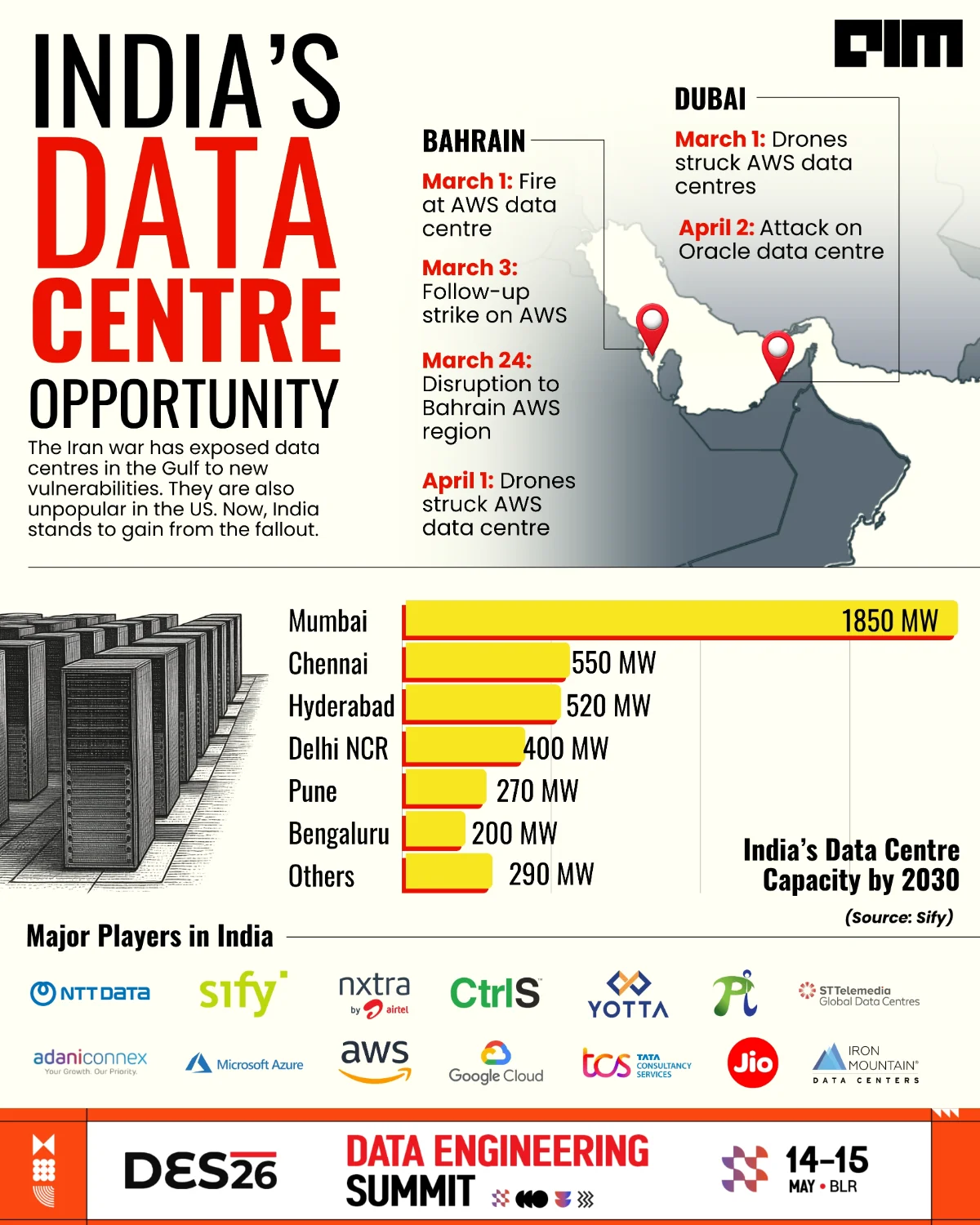
Drone strikes recently hit Oracle and Amazon Web Services data centres in the UAE and Bahrain, knocking out facilities in one of the world's fastest-growing digital hubs. The attacks on AWS caused significant damage, leading to widespread disruption of cloud services in the region. Iranian attacks also hit an Oracle data centre in Dubai.
This forced governments and companies to confront an uncomfortable question: the infrastructure powering AI, banking, and governments is no longer secure. The impetus is now on establishing data centres in regions that don’t have many internal and external disturbances, and offer a favourable tech environment and policies .
Like India.
A Crisis Becomes a Catalyst
The disruption of data centres in the Gulf forced AWS to advise customers to reroute workloads to alternate regions, including the United States, Europe, and Asia-Pacific. India has become a prime location to benefit from the fallout, as enterprises reassess disaster recovery strategies and the geographic diversification of their digital infrastructure.
The scramble that followed was swift. Prasanna Viswanathan, a data centre industry expert who has been tracking the fallout closely, believes India has already started to benefit from the crisis.
"Google Cloud, AWS, and Microsoft Azure are all actively seeking larger co-location deals with Indian data centres right now. Demand has spiked 200–500 MW in just three to four weeks. Gulf-based clients are in a particular rush, signing contracts at $60 per kilowatt. These are numbers that would have seemed optimistic six months ago," he tells AIM.
This is a sharp discount from nearly $7,000 per kilowatt, which is the data centre development cost in the country, according to a report by Kotak Mutual Fund. It’s still cheaper than the US, where the rate is nearly double, the UK at $11,000 per KW, and $10,000 in South Korea.
For Sunil Gupta, Co-founder, CEO and MD of Yotta Data Services, the shift is already underway.
"There seems to be a clear strategic shift of cloud and AI workloads from West Asia to India, triggered by regional instability and physical strikes on data centres in the region," he told Business Today. India, he added, is increasingly being seen as a "safe harbour" for critical digital infrastructure, backed by surplus capacity and connectivity advantages.
According to Yotta, India could realistically absorb 15–20% of Gulf workloads in the next three to six months, supported by available colocation capacity and GPU infrastructure.
Geography Makes Sense
For Gulf enterprises and governments migrating workloads away from damaged AWS regions, India offers the closest viable alternative with comparable latency to West Asia. The submarine cable infrastructure connecting the Gulf to Mumbai's landing stations offers a critical digital backbone.
"India is growing massively in terms of data centres right now," Carl Grivner, CEO of subsea and terrestrial network infrastructure provider FLAG, comments. "It's underserved in capacity and infrastructure. It's going to be a massive growth market."
Per Deloitte, India currently generates roughly 20% of the world's data but hosts only a fraction of global data centre capacity, a gap that investors and hyperscalers have begun tapping with urgency.
The Economics Are Compelling
Building a data centre in India is certainly lucrative. According to RackBank, building a 100 MW AI facility in India costs $5–6 million versus $12–14 million in Singapore and the APAC region.
“Double the capacity with the same amount of money if set up elsewhere. For a hyperscaler, that's essentially a second facility for free," says James Murphy, MD at data analytics firm DC Bytes for the APAC region.
GPU capacity with leading players like Yotta has already been fully contracted by US-based providers, with deals reportedly ranging from $16 million for a year to $1.3 billion for four years.
Hyperscalers have been doubling down, too. Google made a landmark commitment of approximately $15 billion over five years, establishing its first AI hub in Visakhapatnam, Andhra Pradesh. The project is being developed in partnership with AdaniConneX and Airtel.
The government has also moved to incentivise the sector aggressively. In the Union Budget 2026–27, a major tax holiday extending to 2047 was introduced for foreign companies using data centres in India.
India's data centre capacity is projected to grow around 30% year-on-year in 2026, according to CBRE, with nearly 500 MW of new supply expected this year. Investment commitments reached $56.4 billion in 2025, taking the cumulative total to $126 billion.
Headwinds From the West
India's fortunes are also being aided by a gathering political storm in the United States, where data centre expansion has run headlong into voter anger over soaring electricity bills and strained water supplies.
Lawmakers in at least 11 states have introduced legislation to temporarily ban data centres. Meanwhile, firebrand politicians Bernie Sanders and Alexandria Ocasio-Cortez have introduced a Bill to pause data centre construction nationwide. At least 36 data centres were blocked or delayed in the US between May 2024 and June 2025, disrupting $162 billion in investment, according to Data Center Watch
"If geopolitical risk continues to rise in the Gulf, companies may accelerate projects in places like Northern Europe, India, or Southeast Asia, where power supply, regulatory frameworks, and security conditions are more predictable," Patrick J Murphy, Executive Director of financial services company Hilco Global, told CNBC.
For India, the implication is clear: it is not only absorbing demand displaced by conflict in the Gulf, but also capacity being turned away or delayed in the world's largest data centre market.
Meenakshi Srivastava, Lead Analyst with ISG, says the industry is moving from "efficiency-first" to "resilience-first". “India has effectively become the primary data anchor for the region, while the Middle East faces a war risk premium that will likely redirect billions in planned investment,” she notes.
Can India Keep the Lights On?
Here is where the story becomes more complicated. The demand is real, the economics are compelling, and the geopolitical tailwinds are powerful. But the question of whether India's infrastructure can absorb this influx at speed remains genuinely open.
India's data centre capacity is projected to grow to around 10 GW by 2030, and they are expected to consume 2.5–3% of India's total electricity, per Deloitte. That would require fundamental changes in grid planning, transmission infrastructure, and regulatory standards.
Krishna V Giri and Payal Seth of Pahle India Foundation say the odds are stacked against us., "India is being asked to conjure up the equivalent of several large states' worth of additional electricity demand, for an industry that employs relatively few people, pays for land at commercial rates, and whose primary beneficiaries are global technology corporations headquartered thousands of miles away," they tell AIM.
Sunil Gupta of Yotta has also acknowledged the grid risk: "With so many data centres coming up in these regions, the load on transmission lines and substations has become extremely high."
Beyond the power grid, data centre hubs like Bengaluru and Hyderabad face intensifying water stress. A 20 MW facility can consume 1.4 million litres of water daily, increasing competition for scarce resources in shortage-prone regions.
Viswanathan, however, takes a more sanguine view. "Power infrastructure at data centre scale is a genuine ask," he concedes, "but India has been building dedicated industrial power zones and renewable capacity is expanding faster than at any point in its history."
Not a Temporary Detour
The deeper point, made by several industry voices, is that this is not simply an emergency rerouting of traffic. It is the acceleration of a structural transformation that was already underway.
"This is a permanent structural shift toward geographically distributed cloud architecture," Yotta's Gupta has argued, contending that redundancy across countries is becoming a baseline requirement for any enterprise serious about resilience.
S&P Global Commodity Insights expects India to become the second-largest market for data centre electricity demand in the Asia-Pacific within two years, surpassing Japan and Australia.
The Gulf crisis has compressed what might have been a decade-long transition into a matter of months. Now, India finds itself at the centre of a profound reordering of global digital infrastructure.