
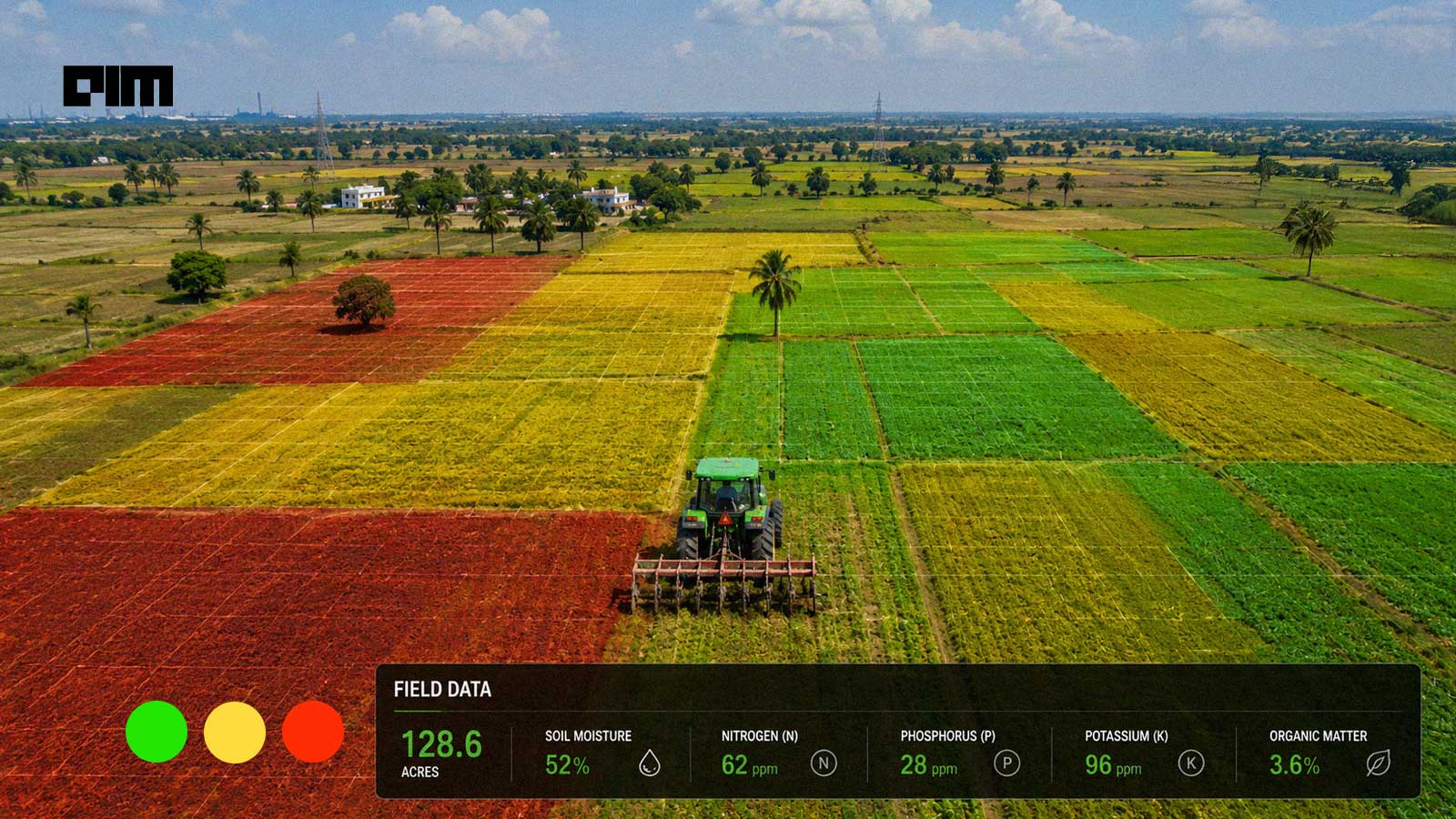
In a bid to make informed decision-making in agriculture, AI startup KissanAI recently launched the second version of Dhenu Vision with API access. According to the company, the agriculture vision model can diagnose crop pests, diseases, and other issues with 95.1% precision.
“There are hundreds of different benchmarks for agentic coding, but there was no proper benchmark for agriculture disease diagnosis,” KissanAI founder Pratik Desai says in an exclusive interview with AIM.
Unlike general-purpose vision-language models that furnish assessment based on the submitted image, Dhenu Vision tries to ensure that there is no wrong diagnosis. If the model is not confident, it can ask the farmer for another picture or additional information rather than return an uncertain answer.
The company created its own benchmark using thousands of images to compare Dhenu Vision against frontier models. Desai says the model currently has a more than 10 percentage point advantage over frontier models on the company’s agricultural diagnosis benchmark, AI AgriBench.
More Than 2 Mn Field Images
The latest iteration has been years in making. KissanAI released an early multimodal version of Dhenu Vision in 2024—Dhenu-vision-lora-0.1. It followed the text-based Dhenu 1.0 LLM in 2023.
KissanAI spent more than a year experimenting with different vision-language model architectures. It initially used supervised fine-tuning on Qwen models before building its own reinforcement learning environment for agricultural analysis and diagnosis.
The company then collected and curated more than 2 million real-world images from the field. They were annotated and segmented to identify pests, diseases, worms, caterpillars, and other problems affecting crops.
The dataset is not limited to Indian crops. KissanAI included crops and agricultural conditions from developing markets across Africa, Southeast Asia, South America, as well as the US.
The first version covers more than 80 crops and 980 agricultural issues. The company is already training a larger version covering more than 2,500 issues across about 170 crop and agricultural entities. It is also expanding into animals and aquaculture.
Desai says that KissanAI spent close to $500,000 to develop Dhenu Vision, covering the model’s training and underlying architecture.
Tech Stack
Dhenu Vision does not rely on a single vision-language model to diagnose an image.
KissanAI uses post-training reinforcement learning and supervised fine-tuning of Google Gemma models for high-level information extraction. It then combines the VLM with segmentation models and specialised models trained for individual crops, animals, and aquaculture categories.
The image first goes through segmentation. The identified segments are passed to specialist models that produce confidence levels for potential issues. Another VLM is then used to ground the results.
“The VLM is just one component to extract information,” Desai says. “We have an actual pipeline which is not using VLM at all.”
The company is targeting 98–99% precision over time. Desai says the model prioritises precision over forcing an answer in every case. He explains that if the model is not confident about an image, it can identify the issue and ask the farmer to move closer and take a sharper picture.
That approach matters in agriculture, where a wrong diagnosis can lead a farmer to apply the wrong treatment to an entire crop.
From Diagnosis to Solution
KissanAI does not want Dhenu Vision to stop at identifying a pest or disease.
Through its work with KissanGPT, the company found that giving farmers an advisory without a clear action prompt often limits continued usage. Its approach now connects diagnosis with products and retailers.
KissanAI already has more than 4 million farmers on its platform and is working with agricultural businesses to integrate its API into their applications, WhatsApp interfaces, and other products.
One of its open projects is the Syngenta Cropwise application for digital farm management, which more than 3 million farmers use.
For example, if Dhenu Vision identifies the cotton whitefly pest, an enterprise using the API can map that diagnosis to a relevant pesticide, and also enable the farmer to purchase it or find a nearby retailer.
KissanAI is also planning a farmer-facing application, but Desai said it will include actionable features rather than becoming another application where farmers can only ask questions and upload images.
API Starts at 6 Cents
Dhenu Vision is being offered primarily as an API for agricultural businesses.
KissanAI currently has three levels of API access. The basic tier costs 6 cents per call, while the advanced tier costs around 10 cents per query.
The advanced version uses a larger model, provides greater precision and coverage, and allows additional information to be supplied alongside an image.
A pro-level API provides segmentation and pipeline data, including the identified image segments and detected issues. It allows enterprises pto rocesslarge image datasets or create their own datasets.
Desai expects the cost to fall further as newer and smaller models become available. He also compares the current pricing with existing agriculture classifier APIs, which he claims can cost around 20–30 cents per request.
Built for Custom Agricultural Data
KissanAI is also offering the architecture for specialised use cases.
If an organisation has images of new crop varieties, seeds, or other entities not covered by Dhenu Vision, it can provide additional images for fine-tuning.
“If I have 986 different issues, and a company comes out and says, ‘We have 20 different seed types that we are growing,’ and they give us a set of images, we can fine-tune and create a fine-tuned version of the model,” Desai says.
The company sees the architecture eventually expanding beyond pest and disease detection to agricultural intelligence. That includes identifying water stress, dry soil, leaf curling, and nutrient deficiencies such as phosphorus deficiency.
KissanAI also plans to support satellite and drone imagery for early detection of problems across larger areas.
From Pilots to Production
KissanAI is now moving beyond pilots. Three Fortune 500 agricultural companies are taking its technology to production.
It has grown to 11 employees and plans to reach around 20 by the end of the year. The company has more than 35 large enterprise opportunities in its pipeline and two customers in the US.
Desai says KissanAI is targeting around $1 million in ARR by the year end and has only recently started generating production revenue.
The company also plans to raise capital, although Desai did not disclose details of the round.
KissanAI has not used IndiaAI compute for training so far. The training has been financed independently. However, it is now looking to access IndiaAI compute for hosting and future training.
Desai believes a government deployment could allow KissanAI to make the system available to farmers at a larger scale and at lower cost.
The company is also in discussions with the state governments of Rajasthan, Madhya Pradesh, and Jammu and Kashmir, although Desai says government deployments often happen through larger technology or consulting companies rather than directly with startups.
Dhenu Vision’s broader bet is to build an intelligence layer that agricultural companies, retailers, governments, and farmer applications can plug into.

Your reaction