
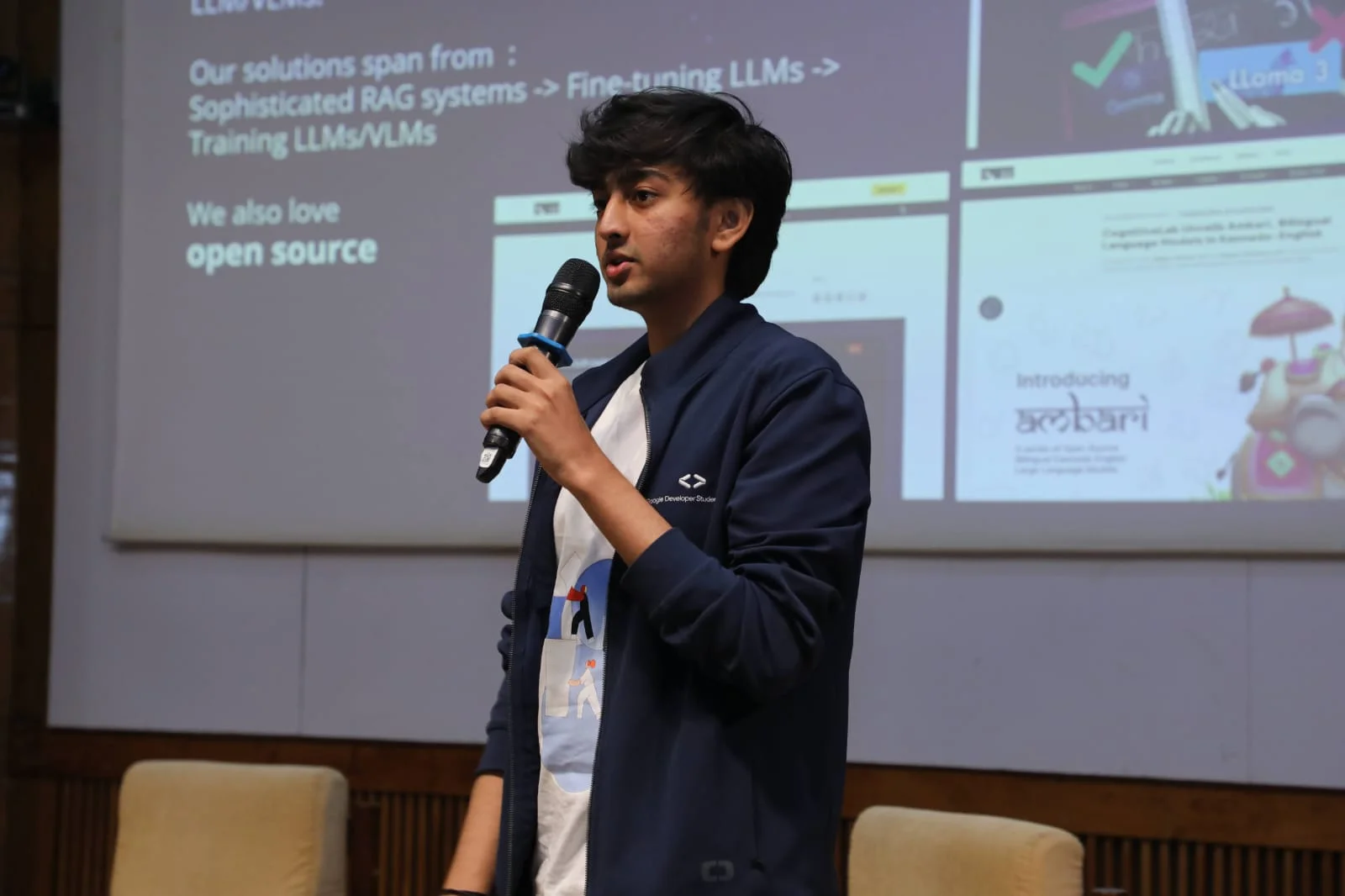
On a quiet evening in Bengaluru, when most young engineers are either scrolling through job boards or polishing interview answers, Adithya S Kolavi is usually doing something else.
He is applying. Applying to roles. To programmes. To grants. Applying without attachment to the outcome.
It sounds mundane until you realise how much of his story is built on that habit alone. He wakes up around 8 am and works from home until about 11. On many mornings, he sits at a cubicle next to his father. When both are working from home, their schedules overlap just enough for conversation to slip in between tasks.
Then comes the commute—a cab ride to the office that often doubles as a transition phase. This is when he joins the CognitiveLab standup.
The nights stretch longer. He codes till 2-3 am.
“My parents do not think this is the healthiest sleep cycle. But I usually take a one-week break after one to two months of intense work, where I step back and relax a bit.”
This is not the dramatic origin story people expect from a 22-year-old founder.
Before the Headlines
In December 2025, Kolavi’s LinkedIn profile went viral for all the internships and projects he was involved in.
“This 22-year-old techie…” read the headlines across news portals.
The outside world eventually caught up. Neighbours, relatives, and even his high school teachers.
“My family was pleasantly surprised and proud to see that kind of recognition.”
From the outside, his portfolio looked extraordinary. He has worked at Apple, collaborated with Microsoft Research, received funding from Meta, runs a research lab called CognitiveLab, publishes papers, builds open source tools, and still finds time to debate the future of AI with friends at midnight.
Now, he has joined Hugging Face as a Research Engineer.
From the inside, it looks methodical, stubborn, and often uncomfortable.
“I keep on applying to stuff,” he says, almost apologetically. “Anything that comes up as an opportunity, I just apply to it and kind of track it over time.”
Long before AI, there were machines.
Kolavi started building drones and RC planes in 8th grade. He became fascinated with aerodynamics and hardware projects using Arduino.
“I tried coding multiple times, but did not take it seriously then.” That changed after he joined PES University. A hackathon paired him with seniors. Together, they built a gym tracker application.
That is what got him to really “fall in love with the process of building.”
Kolavi started CognitiveLab while still in engineering college. At the time, it was not a lab in any formal sense. It functioned more like a consultancy. He helped startups and small businesses use AI in practical ways. The work was messy. Clients were unsure. Payments were slow.
“It was tough initially,” he says. “Then it became more of a research-centric approach, like what we are doing right now.” What did not change was the underlying intent.
“The end goal has kind of been the same,” he explains. “To create a very high impact through things we build.”
Today, CognitiveLab is deliberately small—four or five people at any given time. Mostly interns. Mostly remote.
Kolavi is not formally affiliated with the lab in a legal sense. His father is. “My dad supports most of the stuff.”
The arrangement works. Kolavi focuses on research and building. His father handles operations, finances, and compliance, especially important once grants entered the picture. There are tensions, as with any family collaboration. But the foundation of trust keeps things moving.
Opting Out of the Default Path
For Kolavi, impact does not mean valuation or press coverage. It means usefulness. Sometimes that takes the form of open source. Sometimes it takes the form of a model. Sometimes it takes the form of a paper that others can build on.
This clarity about impact shaped how he navigated college placements as well. While most of his peers were preparing for campus placements months in advance, Kolavi chose not to participate.
“I didn’t really like the notion of placements,” he says.
At the time, he was already interning at a startup called TurboML. The plan was simple: continue there or find something similar. Then, in late November, a job description arrived from Apple. It stood out immediately. One of the few ML roles on offer. Most others were standard software positions.
“I was kind of hesitant to apply,” he recalls. “I wanted something much more core ML.”
He applied anyway.
Out of roughly 20 people, he got in.
The Apple internship began in January at the Bengaluru office near Cubbon Park. For Kolavi, it was his first real exposure to corporate life. He learned how teams work. How projects move. How research ideas are shaped by product constraints. The work itself was rewarding. The team was agile. The role leaned heavily into ML and research.
Yet, something bothered him.
Apple’s culture around secrecy is well known. Employees are restricted from contributing to open source. Public sharing is limited. For someone who had been running a lab in public for nearly a year, this felt like a step back.
“As soon as I joined Apple, I had to roll back a bit,” he says. “Didn’t put anything out in public.”
It made sense from the company’s perspective. It did not align with his. Yet, he revealed that Mac mini remains his favourite daily driver.
Choosing Freedom Over Comfort
Uncertain about a full-time conversion and uneasy with the restrictions, Kolavi started applying again. Broadly. Relentlessly.
“I applied to a lot of companies,” he says. “Things work out, things don’t work out, it doesn’t really affect me.”
One of those applications led to Microsoft Research.
The shift was more than organisational. It was philosophical. Here, research was central, not a side activity. Open work was encouraged. Publishing mattered.
“When the generative AI wave started after ChatGPT launched, I began attending a lot of events and talking to founders. Many of them wanted solutions built, and while I was still learning, I could execute quickly because I had already worked on multiple projects.”
“That is when I decided to create a small initiative and build it over time. It later evolved into a research lab where we conducted open-source research and released it for the community to use and build on. Since then, we have worked on multiple impactful projects.”
This dual life of working with global labs while running his own research lab continued to define Kolavi’s path. CognitiveLab evolved in parallel. The consultancy phase faded. Research took over.
The learning curve was quite steep for him because he had to quickly understand deep learning concepts, LLMs, training pipelines, and deployment systems while also building real products.
“Most of my learning happened through hands-on experimentation, reading research papers, and shipping open-source projects under tight timelines.”
One of CognitiveLab’s most recognised contributions was the Indic LLM Leaderboard. At the time, India was seeing a surge in Indic language models, driven in part by open releases like Meta’s Llama. What was missing was a standard way to compare them.
“I can use my model very well, but how do I compare it with other Indian models?” Kolavi asked himself. “There was no uniformity.”
So he built one. The leaderboard supported multiple Indic languages and benchmarks. It was hosted publicly. It was imperfect. It was necessary. It gave researchers a common reference point. It also revealed a deeper problem.
“Most of the benchmarks are still translations,” Kolavi admits. “That’s not entirely satisfactory.” The solution, in his view, is more open work, not less. By open-sourcing the framework, he hopes others will focus on building better datasets instead of reinventing infrastructure.
Beyond Indic
For a long time, CognitiveLab was closely associated with Indic AI. That focus was deliberate. It created differentiation and aligned with a real gap in the ecosystem.
When he came for an AIM Podcast back in 2023, he was known for building Indic models and several other models on top of Meta’s Llama 2. But it has completely changed now, from the first time we met him at 19.
Over time, Kolavi began to see the limits of a purely Indic focus.
He always believed that LLMs and VLMs should be multilingual. He felt this was both an impactful and technically challenging problem to work on. “I still feel there is a lot of work that needs to be done in the open-source space to make these tools more accessible, including better evaluation models, benchmarks, and datasets,” he says.
Hindi is relatively high-resource compared to many other Indic languages. Notably, several Chinese models perform reasonably well on Hindi benchmarks. But many other Indic languages are still underrepresented and need much more focused research and data curation.
At the same time, “only having an Indic language doesn’t really make sense,” he says plainly. The lab’s newer models are multilingual. They span 22 languages—10 Indic, the rest global. This runs in parallel and is also divergent from what the IndiaAI Mission is building.
The reasoning is both practical and philosophical. On the practical side, multilingual models expand adoption beyond India. On the research side, multilingual work remains underexplored outside frontier labs.
“Chinese models are there,” Kolavi notes, “but they’re pretty focused on Chinese.”
Hindi sometimes works. Other languages do not. That gap is where he sees opportunity. For him, multilingual research is about building systems that handle complexity well.
India, Ambition, and the Long Wait
When asked about India’s broader AI ambitions, Kolavi is hopeful, but cautious.
“If you have resources, you can get things done,” he says. “It’s all about research at the end of the day.”
Compared to the US and China, he believes India is still far behind. At global conferences, the imbalance is visible. Many Indian researchers work abroad. Few labs operate at scale within the country.
Still, he sees a path forward.
India has always been resourceful. Cost efficiency matters. Paying in Indian currency matters. Local adoption matters. Over time, these factors can shift behaviour.
“I’m pretty confident it will happen,” he says. “But it will take some time. What I’m thinking is five years.”
This realism extends to the question of why Indian users still prefer tools like ElevenLabs over local alternatives. The answer, he believes, is not marketing alone. It is maturity. Trust. Performance.
Those things take time to build.
The Myth of the Coding Apocalypse
Much of Kolavi’s thinking today is shaped by how AI tools are changing software development. “The fundamentals are still required.”
He has worked with interns. He has mentored younger engineers. The pattern is clear. Tools help those who already know what they are doing. “If you don’t have your fundamentals straight, it’s not going to help you,” he says.
Servers. Python. Systems. These still matter.
AI has changed his own workflow. He writes less code now. He ships faster. Projects that once took months can now be built in a day. “The intuition only comes through building,” he says.
In the past, large IT firms absorbed a large number of engineering graduates. Even those firms are now using AI heavily.
“That is… pretty scary,” Kolavi admits, referring to the future of engineers without strong fundamentals. Tools make it easier to stand out. They also make it easier to be left behind.
Finding His People
Platforms like Lovable and v0 fascinate Kolavi. They lower the cost of experimentation. They compress timelines. They change the team size economics.
“What earlier needed 10 to 15 engineers,” he says, “can now be done by one person.” That person, however, must deeply understand systems. Without that, things break in subtle ways. Production code is unforgiving.
AI, in his view, does not replace expertise. It amplifies it.
Despite living in Bengaluru, Kolavi often feels isolated in his interests. This is what drew him to Lossfunk, a residency programme for builders and researchers.
The AI lab, founded by Paras Chopra, gave him something rare: a room full of people eager to discuss the same problems. “You don’t find like-minded people to talk tech with,” he says. “It’s always motivating to be around people who are actively building.”
The six-week-long residency format suited him. He shipped more with an intense focus and met people he still speaks to regularly.
Grants, Meta, and Focused research
A major boost to CognitiveLab came from a Meta grant. The funding supported a project called Niner. It allowed the lab to deepen its research without immediate commercial pressure.
Most of their current work aligns with this project. The team size fluctuates. Interns come and go. The work continues. This fluid structure reflects Kolavi’s own career. He moves between institutions, roles, and projects. The common thread is research quality.
When asked if he wants to be India’s Sam Altman or Dario Amodei, Kolavi laughs. He respects both. He uses both companies’ tools. At this moment, he prefers Anthropic over OpenAI.
“Anthropic is a cooler company,” he says. “Hyper-focused, proper research.” But he does not aspire to be either.
Outside coding, Kolavi’s use of AI is minimal. Emails. Drafts. Logistics. What truly keeps him awake is research automation.
“I think within the next six, seven months, research papers end-to-end will be written from the app,” he says. This possibility excites and unsettles him. Either one builds such systems, or they figure out where they add value after they exist.
Kolavi plays FIFA. He thinks about AI in games, imagines prompt-based game generation and marketplaces for user-created games. “That would be a pretty fascinating space,” he says.
“I am still figuring [my future] out. One path is to build a scalable AI company, more in the SaaS or agent space. Another option is to work at high-impact AI companies like OpenAI, Anthropic, Hugging Face, Cohere, or AI2, where I can optimise for large-scale impact.”
For all his achievements, Kolavi does not sound nearly finished. He seems restless, curious, and slightly impatient. And somewhere between the next application and the next system he builds, his story continues.

Your reaction
Discussion
What's your take on this story?
No comments yet — be the first to share your view.