
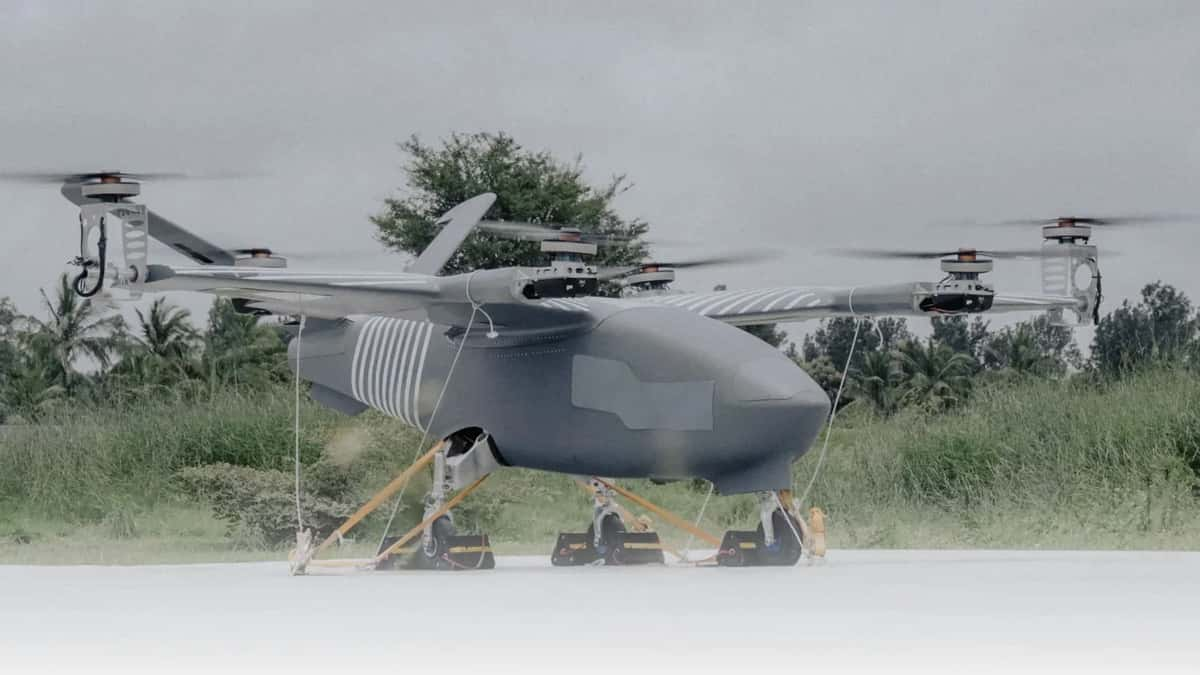

When Bengaluru-based urban air mobility startup Sarla Aviation set out to build its electric vertical take-off and landing (eVTOL) aircraft, it faced a challenge common to most deeptech startups: how do you innovate at the pace of a startup without the budgets of aerospace giants?
The answer, according to the startup, lay in digital engineering.
Using Siemens’ Xcelerator portfolio of software, Sarla says it was able to dramatically cut development time, reduce costs, and accelerate learning cycles while building its next-generation air taxi platform.
Siemens Xcelerator is an open digital business platform that brings together software, hardware, and services from Siemens and its certified partners in a single marketplace. It allows businesses to quickly access and deploy technologies that help streamline operations, accelerate innovation, and solve industrial challenges.
By adopting Siemens’ integrated digital thread, the company is connecting product design, simulation and lifecycle management in a unified environment to improve engineering efficiency, streamline certification readiness, and support faster product development.
Sarla Aviation has tapped into Siemens solutions, including Designcenter for mechanical design and CAD framework, Simcenter for engineering simulation and 3D modelling, Capital for electrical engineering, Polarion for application lifecycle management, and Teamcenter for product lifecycle management and data unification. The startup says these software products have helped reduce design iterations through early-stage simulation, enhancing collaboration across engineering teams and strengthening the traceability, verification, and validation processes required for certification.
"The fundamental shift here is economics of innovation," observes Rakesh Gaonkar, Co-founder and CTO of Sarla Aviation, in a conversation with AIM on the sidelines of Siemens’ Realize LIVE Asia-Pacific 2026.
"Being a startup, we don't have a billion dollars to spend like other companies. We have to make sure we do it at a certain cost."
The startup plans to launch electric air taxi services in Bengaluru by 2028.
Sarla and other Indian startups are turning to digital twins, AI-powered engineering, and simulation tools to speed up product development.
From Virtual Prototypes to Flying Aircraft
Before building physical prototypes, Sarla relied heavily on virtual engineering tools.
"Money is scarce," Gaonkar says. "So what we did is we did a lot of virtual prototyping from an architecture point of view, from space allocation, from aerodynamic lofting and others."
Using Siemens' simulation tools, Sarla could evaluate aircraft performance long before constructing hardware. "We got lift-to-drag ratios around 13, which is quite good for an eVTOL," Gaonkar adds.
The next challenge was determining whether the aircraft could actually be manufactured and withstand real-world stresses. Traditionally, aerospace companies build multiple prototypes, test them extensively, and learn through failures. Startups, however, rarely have that luxury.
"Usually, conventional companies build a couple of airframes, and they drop them, and then they learn and iterate. But we don't have that kind of money. We have to get it right in the first instance," Gaonkar states.
According to Gaonkar, Siemens' simulation technologies enabled Sarla to move much closer to real-world performance before committing resources. "Simulation tools these days are 90% closer to what reality could be," he states.
The company then used Siemens NX and Simcenter platforms to bridge the gap between design and manufacturing. "Simcenter NX is something that glued it together in terms of design for manufacturing."
More importantly, the software helped create a collaborative engineering environment where teams could work simultaneously instead of sequentially.
"What kept everything glued together under one umbrella was Simcenter," he explains. "It helped us streamline our company, our specialists, their flow of information, the release of data, and the different iterations that we have."
The results, according to Sarla, were significant. "We were able to get the weight down by close to 80%," he states.
The company also reduced manufacturing timelines substantially. "We got that time down by 70%—from 10 days to three days," Gaonkar shares. "In fact, we are even pushing to do it in one day itself."
Cost savings were equally dramatic, with expenditure dropping by 74%.
"All this together means that we are learning faster—3x faster,” he states. "And that's game-changing."
Siemens Bets Big on India's Startup Ecosystem
Sarla Aviation is not an isolated case.
Mathew Thomas, CEO and MD, Siemens Digital Industries Software India, highlights that startups across electric vehicles, aerospace, defence, and advanced manufacturing are increasingly adopting digital engineering technologies at much earlier stages.
"To answer your question on demand—it’s massive," he notes.
According to him, startups no longer view engineering software as a luxury.
"Today, startups see technology as a differentiator," Thomas mentions. "They are adopting technology much earlier because they understand it gives them a competitive advantage."
The company structures its offerings to allow startups to begin with smaller deployments and expand as they grow.
While Siemens declined to share the exact number of startups using its platforms, the executive notes that the company adds hundreds of new startups across industries.
Another example is Skyroot Aerospace, a pioneering space tech company that recently put Vikram-1 into orbit, making it the first private Indian player to do so. Siemens has worked with Skyroot since its early years, helping the startup build its engineering stack.
"They started with Product Lifecycle Management, then moved to Designcenter and Simcenter," Thomas reveals. "We've been working with them for years and have grown with them as they scaled."
He also sees startups as critical to India's ambitions in strategic sectors. From electric aircraft and space rockets to next-generation manufacturing, Siemens believes startups will increasingly drive India's innovation economy—and faster, thanks to digital engineering tools, that will enable them to compete with far larger rivals.
- The AI Slowdown Narrative Doesn’t Reflect Enterprise Reality
- India’s Enterprises are Scaling AI. Is the Infrastructure Ready?
- Industry Wants Faster Approvals and Cheaper Power in India’s Data Centre Policy
- Inside Jio Platforms: Its Tech Bets, Loss-Making Subsidiaries and Hidden Risks
- India’s GCCs to Add 1.4 Million Jobs, Drive 170 Million Sq. Ft. Office Demand by 2031
- AI Can Be Cyborg or Centaur. But Can Enterprises Monetise It?