
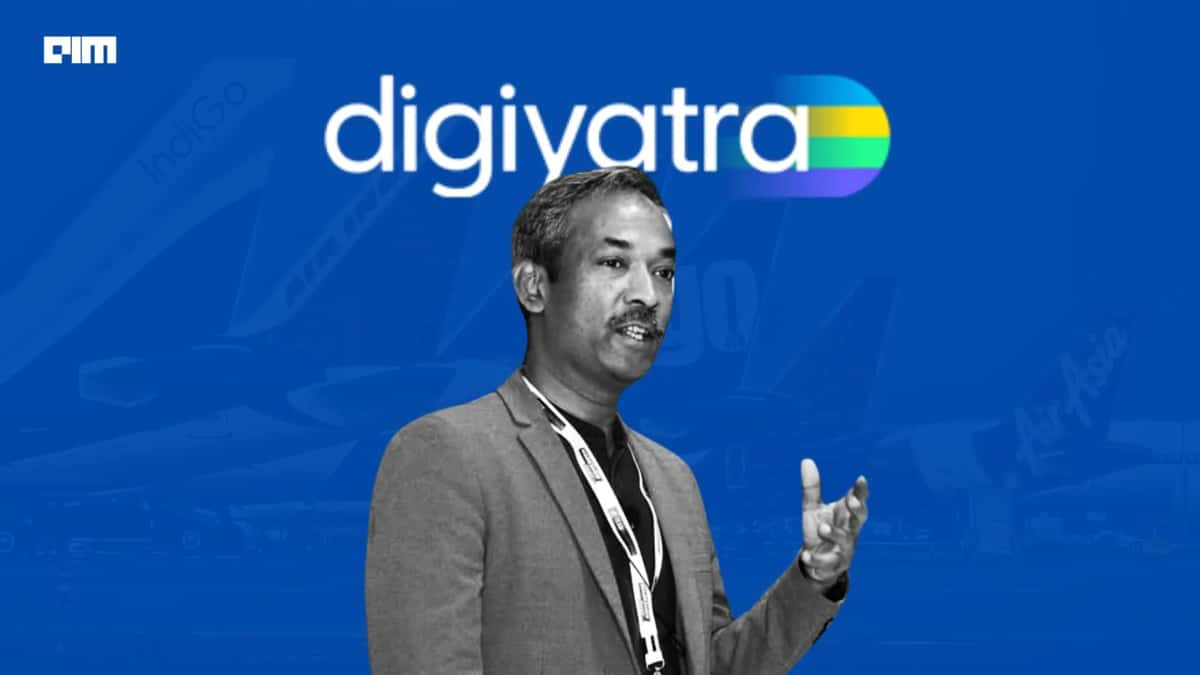

Suresh Khadakbhavi, CEO of Digi Yatra Foundation, spent decades trying to solve one of India’s oldest problems. The airport just happened to be where he started.
There are very few CEOs who can pinpoint the exact moment their life’s work began. For Khadakbhavi, it wasn’t inside an airport. It wasn’t in a boardroom discussing biometrics. It wasn’t even when Digi Yatra officially launched in 2022.
It began in a ration queue.
“As a kid, my mother would tell me to go and stand in line because ration supplies had arrived,” he recalls. “Then there were queues for college application forms. Queues to submit them. Electricity bill queues. Then airport queues.”
What started as childhood annoyance gradually became an obsession. Decades later, that obsession has quietly changed the way more than 25 million Indians travel.
“I think for citizens of India, we should have seamless everything.” That belief eventually found its way into Digi Yatra. Despite the endless conversations around facial tracking and recognition, Khadakbhavi insists the technology isn’t really the story. It is simply the elimination of waiting.
Ironically, the idea wasn’t born out of thinking about technology at all.
Back in 2015, Bengaluru Airport was designing Terminal 2. During a three-day innovation workshop, participants were asked to write a fictional story describing the perfect passenger experience.
Khadakbhavi’s story was remarkably simple.
“The passenger walks through all the touchpoints right from the airport entry gate, crosses security and boards the flight without being stopped by anyone.”
No identity checks. No boarding pass verification. No repeated document inspections. “My face is my boarding pass.” At the time, it sounded almost unrealistic. Today, it feels routine.
That may well be Digi Yatra’s biggest achievement. The journey to get there, however, was anything but straightforward.
Initially, Aadhaar was expected to serve as the primary identity layer. The architecture later evolved into a more privacy-centric model—a one-time Aadhaar verification, followed by a selfie-based system stored securely on the user’s own device. At the time, Pramod Verma described it as one of Aadhaar’s strongest use cases.
With Nandan Nilekani’s backing, the Digi Yatra Foundation officially came into being in August 2019. Then the COVID-19 pandemic arrived, bringing aviation—and much of the world—to a halt.
Eventually, when momentum returned, discussions around IATA’s One ID initiative pushed the team to embrace decentralisation more seriously.
Once Aadhaar was on board with this new approach, Nilekani advised that the team needed its own dedicated vehicle to build, operate, and maintain the platform. He pointed to the Indian Highways Management Company Ltd (IHMCL), the not-for-profit company that manages toll collection for the National Highways Authority of India, as the model worth emulating.
Digi Yatra’s shareholders—Airports Authority of India (26%) and the remaining 74% equally shared by five major PPP airports—told Khadakbhavi there was no traffic and their cash flows were impacted. Under those circumstances, investing in a new platform wasn’t exactly a priority.
Eventually, several Indian startups came together to build the platform on top of open-source solutions like Hyperledger. On December 1, the service went live at the Delhi, Bangalore, and Varanasi airports. There were murmurs online questioning whether the software itself was glitchy. Khadakbhavi dismissed the criticism quickly, saying Digi Yatra only uses top-shelf, NIST-approved algorithms from companies like NEC, Neurotech, Thales Group, and Idemia.
“All that data is stored in SQLite database in your phone, which eventually gets purged within 24 hours after the travel,” Khadakbhavi says, allaying the privacy concerns that have followed Digi Yatra almost since its inception.
The Difficulty
Few public places are as operationally complicated as an airport.
“It’s like a city in itself,” Khadakbhavi says. A single passenger journey involves airlines, airport operators, CISF, immigration, security agencies and government departments.
Passengers, however, don’t experience that complexity. They experience friction. They remember standing in line. They remember pulling out their ID again. They remember fumbling for a boarding pass at every checkpoint.
Technology, in Khadakbhavi’s view, should disappear into the background.
Passengers shouldn’t notice facial recognition. They should simply notice they reached their gate without constantly being asked to prove who they are.
Digi Yatra’s numbers suggest that India has been willing to embrace the idea faster than many expected. National adoption has already crossed 30-35%, while some airport terminals have reached more than 60% usage in under four years.
“We are expecting that we’ll scale it up to 80% by 2028.”
Yet, even while building a platform handling millions of identities, Khadakbhavi never considered monetising that scale. “The intent is to enable the passenger’s journey. Beyond that, there is no other intent.”
Digi Yatra operates as a not-for-profit. The reason, he says, is perception as much as technology. “We don’t want to monetise personally identifiable information.”
Running as a not-for-profit, he believes, removes suspicion before it even has a chance to take root. Of course, no conversation around Digi Yatra lasts very long before privacy enters the room.
Khadakbhavi knows this. He has answered the same question hundreds of times. Yet, he never seems particularly frustrated by it. Instead, he believes people simply haven’t fully understood the underlying technology.
“The whole concept itself of self-sovereign identity is very, very new.”
Unlike conventional identity systems, Digi Yatra does not maintain a massive central database containing passengers’ information.
Instead, credentials remain inside an encrypted wallet on the passenger’s own phone. “We only process the data. We put a signature on the credential.”
After Aadhaar e-KYC validates the identity and facial verification succeeds, the credential is created. It stays with the passenger, not Digi Yatra.
That architecture, he argues, actually makes the platform significantly harder to attack than conventional systems.
“Imagine a central repository with a huge database.” One successful cyberattack could expose millions of records. “But imagine Digi Yatra. No central repository… If someone wants to hack it, they’ll have to hack 25 million users individually.”
Borderless World
One criticism Khadakbhavi finds particularly interesting is that people willingly hand over personal information to banks, telecom companies and countless mobile apps. Yet, many hesitate when airports ask for facial verification.
“I find it difficult to believe.” His argument isn’t that privacy shouldn’t matter. It absolutely should.
“The only concern everyone should have is where this data is being used.” That, he says, is precisely why Digi Yatra was designed differently.
The next phase, however, is significantly more ambitious than simply walking through Indian airports faster. Khadakbhavi wants international travel to become just as seamless.
Digi Yatra has already begun working with electronic passport-based enrolment built around ICAO standards.
Instead of relying on Aadhaar alone, travellers will increasingly be able to create digital credentials directly from e-passports using NFC-enabled smartphones.
The vision starts to sound almost like science fiction.
Imagine flying from Bengaluru to London.
Before boarding, you securely share your passport credential and travel details with both airports. By the time you land at Heathrow, your identity has already been verified. Instead of joining long immigration queues, you simply walk through automated border control.
“The future is a borderless world.” He quickly clarifies that borders themselves won’t disappear. Only the waiting might.
Interestingly, Khadakbhavi compares Digi Yatra less with airports than with UPI. “In terms of volume and scale, you cannot find an equivalent of Digi Yatra anywhere in the world.”
That is a bold statement.
Yet, India’s ability to deploy identity infrastructure at population scale has increasingly become something other countries are studying rather than leading.
Ironically, one challenge Digi Yatra now faces is almost psychological. Passengers often assume manual queues are moving faster simply because they can see people standing there.
Digi Yatra lanes frequently appear empty. Which, according to Khadakbhavi, is exactly the point.
“You won’t find people at the Digi Yatra gates because passengers have already gone through.”
Make India Healthy Again
As the conversation drifts beyond airports, Khadakbhavi talks about his love for walking. He reveals a personal campaign he calls ‘Make India Healthy Again’, simply by getting Indians to walk, run and cycle again.
“When I was a kid, I used to walk 40 minutes to school.”
Today, he says, neither parents nor children feel safe enough to do the same. Footpaths have disappeared, cycling has disappeared, walking has become optional, and cars have replaced movement.
For someone who has spent years eliminating queues, the next bottleneck appears to be urban life itself. Perhaps that’s what makes Digi Yatra feel different from most government-backed technology projects.
Underneath the facial recognition, encrypted credentials and airport automation lies a surprisingly simple philosophy.
Khadakbhavi isn’t really obsessed with airports. Airports just happened to be where India’s most visible queues existed. His real obsession has always been removing friction, wherever it exists.
- The AI Slowdown Narrative Doesn’t Reflect Enterprise Reality
- India’s Enterprises are Scaling AI. Is the Infrastructure Ready?
- Industry Wants Faster Approvals and Cheaper Power in India’s Data Centre Policy
- Inside Jio Platforms: Its Tech Bets, Loss-Making Subsidiaries and Hidden Risks
- India’s GCCs to Add 1.4 Million Jobs, Drive 170 Million Sq. Ft. Office Demand by 2031
- AI Can Be Cyborg or Centaur. But Can Enterprises Monetise It?