
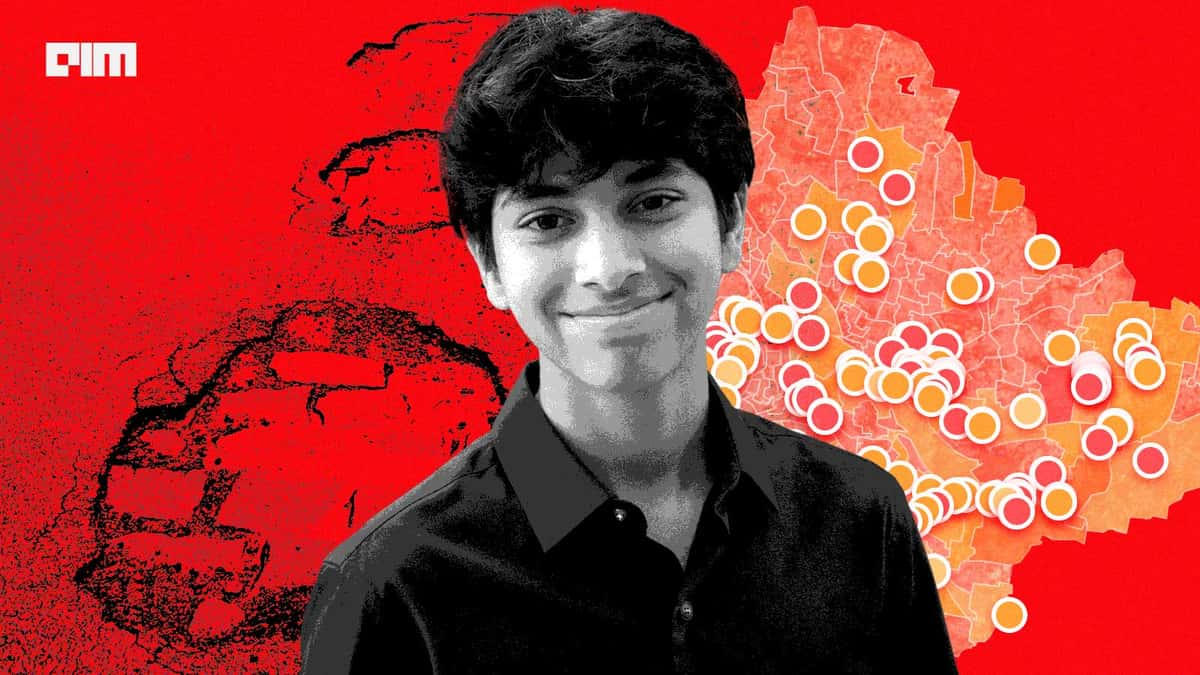

Instead of complaining about Bengaluru’s crumbling footpaths, 14-year-old Surya Uthkarsha decided to build a solution. His app, RASTHE, uses AI-assisted development and crowdsourced reporting to help citizens document unsafe sidewalks and encourage civic authorities to take action.
Bengaluru’s roads are often criticised for potholes, traffic congestion and broken footpaths that force pedestrians to walk alongside speeding vehicles. While civic complaint platforms already exist, many residents feel pedestrian issues rarely receive the attention they deserve.
For Uthkarsha, that frustration became the motivation to build RASTHE, a crowdsourced platform dedicated entirely to reporting damaged, blocked and unsafe footpaths.
Dubbed the ‘Tinder for Footpaths’, the platform lets users upload photographs and precise locations of damaged sidewalks while also allowing the community to swipe and rank footpaths as “better” or “worse”. The goal is to create a city-wide map of walkability that helps identify the areas needing the most urgent attention.
AI Built the Prototype, But Not the Product
Surya says the first version of RASTHE was created in around 30 minutes using an AI-powered development platform, 10x Apps. However, he believes AI only accelerated development—it didn’t build the product itself.
“The very basic version of RASTHE was generated using 10x Apps. AI helped create the initial UI and brainstorming,” he tells AIM.
“I keep AI to a minimum because I personally face this problem and wanted to take a human approach. AI made development dramatically faster, but understanding the problem and building the right solution was still a very human process,” he adds.
Beyond generating the initial interface, he says he still had to define the product vision, design the user experience, integrate external services, test the application, fix bugs, deploy updates and continuously improve the platform using user feedback.
Why Another Civic App?
Bengaluru already has civic complaint portals, including BBMP’s Sahaaya platform. However, Surya believes pedestrian infrastructure often gets lost among hundreds of complaint categories.
]“Most civic complaint platforms are designed to handle every kind of civic issue, but none were specifically focused on footpaths,” he said.
He noted that pedestrian infrastructure often gets buried under hundreds of complaint categories. RASTHE changes that by being purpose-built for footpaths while also creating a city-wide dataset of pedestrian infrastructure.
Instead of simply collecting complaints, the platform analyses reporting patterns to identify unsafe areas and wards requiring urgent intervention.
“We want to make walkability something that can actually be measured and improved,” he affirms.
Community Verification Over Complaint Dumping
To prevent duplicate or misleading submissions, RASTHE combines location data, photographs and community verification.
Each report contains GPS coordinates and supporting images, making verification easier. If multiple users report the same damaged footpath, the system identifies duplicates instead of flooding authorities with repeated complaints.
Surya explains that users can also confirm whether an issue has already been resolved.
“As the platform grows, we’ll continue strengthening moderation and reputation systems to ensure the data remains reliable,” he adds.
Early Results Show Promise
The platform has reportedly crossed 10,000 users and received more than 1,000 reports from across Bengaluru.
While official city-wide repair data is still unavailable, Surya says he has personally witnessed visible improvements. “We’ve personally seen around 20 to 25 reported locations in my locality being cleaned or cleared, sometimes on the very same day,” he highlights.
To improve transparency, RASTHE recently introduced an “after” photo feature that allows users to upload images once repairs are completed.
“For us, success isn’t measured by the number of reports submitted. It’s measured by the number of safer footpaths created,” he asserts.
One example Surya shared on X showed a damaged footpath uploaded on June 5 being cleaned by BBMP the following day.
Building With BBMP in Mind
Although BBMP has acknowledged RASTHE on social media, formal discussions around integrating the platform into the city’s civic workflow have yet to begin.
“We’ve tagged BBMP publicly, reached out through social media and even tried meeting Krishna Byre Gowda to demonstrate what we’re building. I genuinely believe RASTHE can complement the government’s existing systems rather than replace them,” Surya notes.
According to him, features such as ward-wise heatmaps, public verification after repairs, and real-time pedestrian infrastructure data could help civic authorities prioritise maintenance more effectively.
He believes AI coding tools will make it easier for ordinary citizens to build technology solving local governance problems.
“Someone who understands a local problem no longer needs years of programming experience to create a solution,” he explains.
However, he cautions that AI cannot replace responsible product thinking. “The biggest risk is quality. AI can generate software, but it can’t replace a deep understanding of the people you’re building for,” he adds.
He reveals he has already received acquisition interest from private companies but chose not to sell the platform.
“When I built RASTHE, I wasn’t thinking about monetisation or building a business. I built it because I genuinely wanted to solve a problem I saw every day. If RASTHE is going to create lasting impact, I believe it should work alongside the government and serve the public,” he opines.
His long-term vision is to transform RASTHE into a civic infrastructure platform that enables governments and citizens to collaborate using crowdsourced data.
- The AI Slowdown Narrative Doesn’t Reflect Enterprise Reality
- India’s Enterprises are Scaling AI. Is the Infrastructure Ready?
- Industry Wants Faster Approvals and Cheaper Power in India’s Data Centre Policy
- Inside Jio Platforms: Its Tech Bets, Loss-Making Subsidiaries and Hidden Risks
- India’s GCCs to Add 1.4 Million Jobs, Drive 170 Million Sq. Ft. Office Demand by 2031
- AI Can Be Cyborg or Centaur. But Can Enterprises Monetise It?