
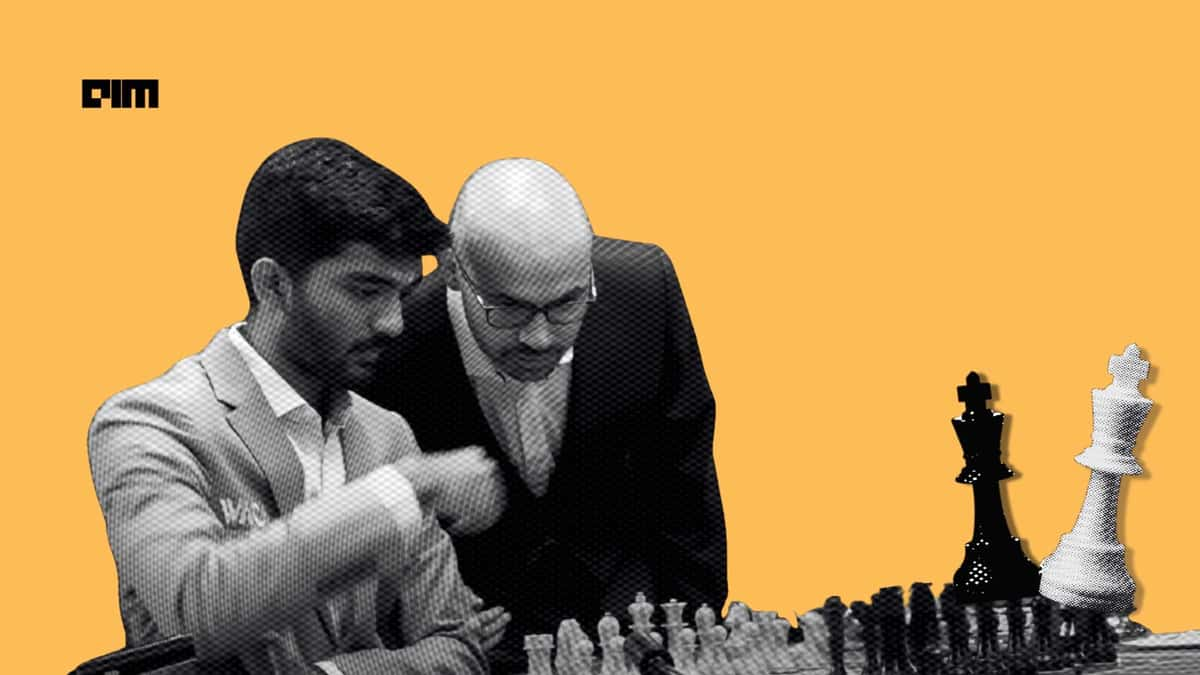
At the age of just 18, Gukesh Dommaraju made history by becoming the youngest World Chess Champion after defeating China’s Ding Liren at the World Chess Championship 2024 in Singapore.
The entire world is celebrating this win, especially the Google community, including CEO Sundar Pichai and DeepMind CEO Demis Hassabis, who have played a central role in integrating AI into the world of chess. Hassabis lauded former world chess champion Viswanathan Anand for inspiring a generation of Indian chess prodigies.
Google’s official sponsorship for the championship legacy adds to the company’s weight, given its contributions to AI in chess through models like AlphaZero. This exemplifies state-of-the-art capabilities in strategy and learning for games like chess.
This championship was more than just a contest of skill; it reflected how technology is at the heart of chess. Interestingly, for the first time, AI cameras tracked players’ focus and emotions by monitoring their eye movements and seating positions in real time. This championship also used the most number of cameras ever.
The Story of 2 ‘DeepMinds’
Coincidently, two weeks ago, Hassabis made the historic inaugural move at the start of the championship. He and Dommaraju share more than just their passion for chess; they are making history in their respective fields.
A FIDE candidate master and former second-highest-ranked under-14 chess player globally, Hassabis has played a pivotal role in advancing AI through innovations like AlphaFold in particular.
Interestingly, AlphaFold is one of the youngest innovations to make it to the Nobel Prize. “AlphaFold is four years old, very young to win the Nobel Prize,” said the presenter at the award ceremony in Stockholm while introducing Hassabis.
Notably, Dommaraju is also the youngest champion yet. In a previous interview, Dommaraju shared that becoming the youngest chess champion was his dream, and he went on to make it a reality.
“Huge congratulations, Gukesh, my friend! The new and youngest ever world chess champion at 18 – absolutely incredible,” congratulated Hassabis on X.
Inside Google’s Chess Legacy
During the FIDE World Championship 2024 press conference, both Gukesh and Ding emphasised the profound influence of the book on AlphaZero's playing style on their own approach.
Google Gemini has introduced the Chess Champ experiment – a feature allowing users to play chess in a text-based format. This feature uses Gemini's knowledge base to generate accurate visual responses, enhancing the interactive experience.
Google’s AlphaZero defeated open-source chess program Stockfish 8 in a 100-game match, winning 28 games and drawing 72. AlphaZero also mastered Go and shogi within hours, using reinforcement learning to focus on move quality rather than brute-force calculations. Unlike traditional engines, it relied on self-reinforcement to achieve advanced performance, marking a shift in AI design towards generalised, self-learning systems.
Interestingly, chess AI techniques, like AlphaZero, have enabled real-world applications such as AlphaFold for protein structure prediction, AlphaProof for mathematical research, and AlphaDev for algorithm discovery, showcasing AI's impact across fields.
Google DeepMind is blending scaling with architectural innovation, betting on multimodal and neuro-symbolic AI to propel it towards AGI. Google DeepMind is also investing in RL agents and exploring real-world simulations to improve understanding of complex systems.
In the end, AI is just a Tool, Not a Player
Gukesh’s victory also reflects the growing influence of AI in chess, as players use it to prepare for matches and study their opponents.
Earlier this year, Anand shared his insights on AI’s role in chess at AIM’s MLDS event. He talked about using AI tools to create training exercises and explain moves, describing it as "statistics applied to language" and a reflection of how players learn.
Despite these advances, audiences prefer the thrill of human competition, valuing emotions, risks, and creativity over AI players. Anand also said that AI can never replace humans.
OpenAI chief Sam Altman shared a similar view at the Davos World Economic Forum, pointing out that while chess is more popular than ever, audiences remain uninterested in watching two AIs play, preferring human competition.
Moving forward, for Gukesh and the entire chess community, this is just the beginning of a future where tradition and innovation go hand-in-hand.
- AMD’s Server CPU Business Faces a New AI Boom
- How an Engineer Is Using AI to Bridge the Accessible Education Gap
- AI Agents are Making Human Customer Service a Specialist Job
- Why Nandan Nilekani-Backed F2A Believes India's Investment Opportunity Lies in Edge AI
- India Needs to Build the AI 'Brain' for Robotics, Not Just Import Hardware
- Why Enterprise AI Prototypes Break in Production