

When Salesforce completed its $8 billion acquisition of Informatica in November 2025, it was more than a headline-making deal—the culmination of decades of effort to address one of the most enduring challenges in enterprise technology: ensuring data accuracy so that AI can function reliably.
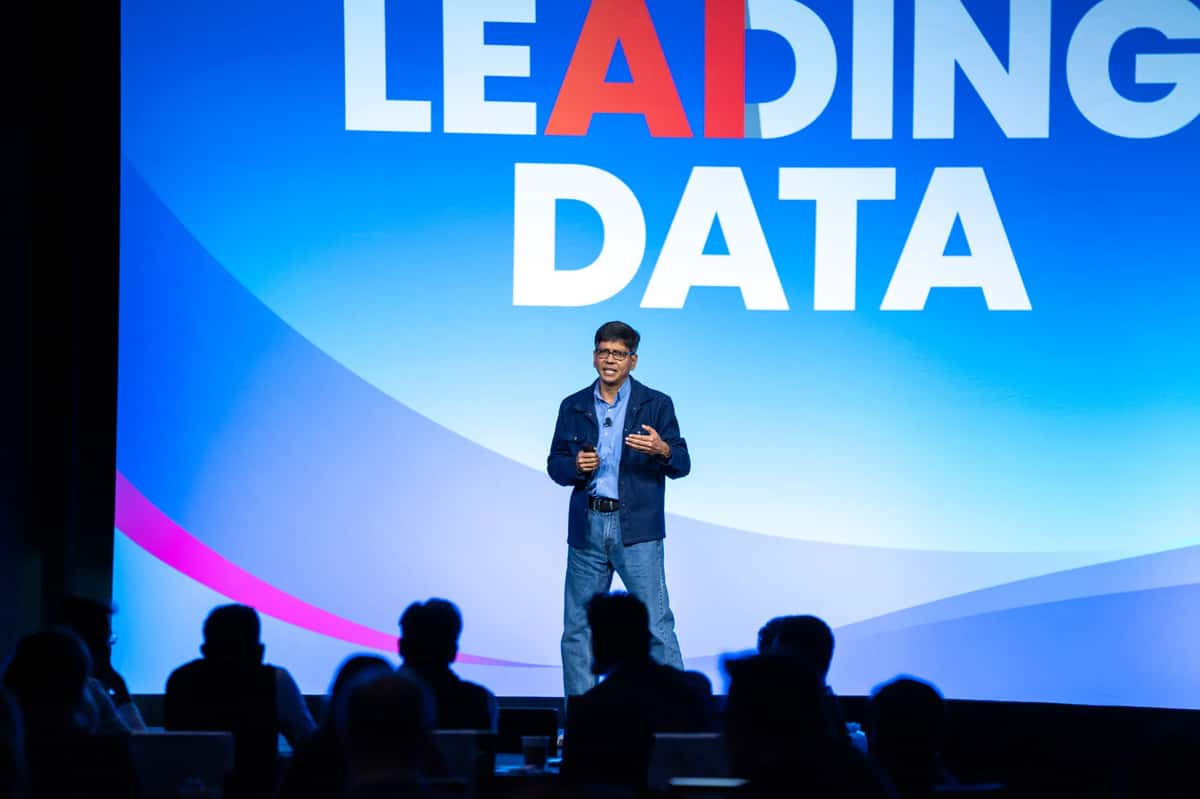
At the center of that story is Gaurav Pathak, Senior Vice President of Product Management at Salesforce, who spent over a decade at Informatica steering its metadata and AI product strategy. In a recent conversation with AIM, Pathak reflects on how far the industry has come and how much further it needs to go.
Three Decades, Three Eras of Enterprise Data
Pathak's vantage point on enterprise data stretches back to the 1990s, when Informatica was founded with a singular mission: to help companies move transactional data from applications like SAP into warehouses like Teradata, so that financial reporting—profit and loss statements, balance sheets, regulatory filings—could be done accurately.
"Transactional data was the most important data enterprises needed to capture," he says. "Getting it from applications into data warehouses, and making it available for reporting, was one of the most important things enterprises used to do."
That world gave way to a second era defined by interaction data, the steady stream of signals generated by devices, apps, and users that companies needed to understand customer behaviour. Cloud data warehouses such as Snowflake, Amazon Redshift, and Microsoft Azure have emerged as new repositories. Volume, variety, and velocity of data all rose sharply. Informatica adapted alongside these shifts, extending its integration capabilities to this new landscape.
Now, Pathak says, the industry is "in the middle of the agentic era," a third wave in which the emphasis is not just about moving data but making it legible and trustworthy for AI agents. Unstructured data, long ignored in the enterprise, has become a critical asset. And the capabilities that matter most have expanded from integration to include data quality, governance, and master data management.
Why Context Is the New Differentiator
A central theme in Pathak's thinking is the concept of context, and how profoundly different the requirements are for AI agents compared to human users. He explained that when humans were given information about the number of customers or products, that was sufficient. He stated that humans relied on their intuition and social knowledge to interpret what those numbers signified, whereas agents could not do so without a substantial amount of explicit context.
Pathak illustrates that if a CEO asks an AI agent about last quarter's new customers, the agent lacks understanding of terms like "quarter" or "customer" without explicit context, which humans typically take for granted.
This is where Pathak sees Informatica's, and now Salesforce's, competitive advantage. He describes three pillars: being the "Switzerland of data and AI," a neutral platform collecting metadata from partners like Microsoft, AWS, Google, Snowflake, and Databricks; offering top products across data integration, quality, MDM, cataloging, and governance; and creating a unified metadata foundation as a map for AI agents navigating an organisation's data landscape.
"Metadata provides the map to the agent of where the right data sets are," he says. "It's like the table of contents for the encyclopedia that is the organisational memory."
The Acquisition: A Logical Convergence
Salesforce completed the acquisition of Informatica on November 18, 2025, bringing Informatica's data catalogue, integration, governance, quality and privacy, metadata management, and Master Data Management services into the Salesforce platform, with the stated goal of establishing a unified data foundation for agentic AI. The deal was valued at approximately $8 billion in equity value, with Informatica shareholders receiving $25 per share in cash.
The acquisition was completed early after Salesforce signed a definitive agreement in May 2025, following earlier discussions and a failed attempt. For Pathak, the deal represents a natural convergence.
AI labs and CRM platforms are increasingly moving into vertical-specific enterprise areas, but he argues that years of deep specialisation in data management and the proprietary metadata gathered from thousands of enterprise deployments create a durable competitive moat that is difficult for general-purpose AI providers to replicate quickly.
The Bottlenecks Holding AI Back
Despite the excitement around agentic AI, Pathak is cautious about timelines and honest about friction points. He highlights three key requirements for AI to reach enterprise-scale deployment: a strong data foundation, human skills focused on AI-first thinking, and suitable technology partnerships. He notes that the second is often overlooked. For instance, deploying a support agent demands teams to design and conduct evaluations with human-annotated tests to confirm correct answers before deployment. "I don't think many IT teams are there yet," he says.
He also raises a concern backed by Informatica's own research: in a CDO survey, 76% of respondents said their organisation's governance systems were not ready for AI, and 75% expressed worry that employees would uncritically trust AI outputs. Pathak frames this as a "garbage in, gospel out" problem, in which persuasive models confidently produce wrong answers, and users believe them.
Building for What's Coming
Pathak is also watching the longer arc of AI capability with sober attention. He notes that AI models have moved from what he describes as intern-level knowledge to PhD-level knowledge in a short span, and that if scaling laws continue to hold, enterprises need to be building their data foundations now, not once the intelligence arrives. "The only way to differentiate in this world will be to get your data foundation in the right shape as quickly as possible," he says.
With Informatica now embedded in Salesforce's platform and the agentic era accelerating, the question for enterprises is less about whether to invest in data infrastructure and more about whether they can move fast enough.
- The AI Slowdown Narrative Doesn’t Reflect Enterprise Reality
- India’s Enterprises are Scaling AI. Is the Infrastructure Ready?
- Industry Wants Faster Approvals and Cheaper Power in India’s Data Centre Policy
- Inside Jio Platforms: Its Tech Bets, Loss-Making Subsidiaries and Hidden Risks
- India’s GCCs to Add 1.4 Million Jobs, Drive 170 Million Sq. Ft. Office Demand by 2031
- AI Can Be Cyborg or Centaur. But Can Enterprises Monetise It?