
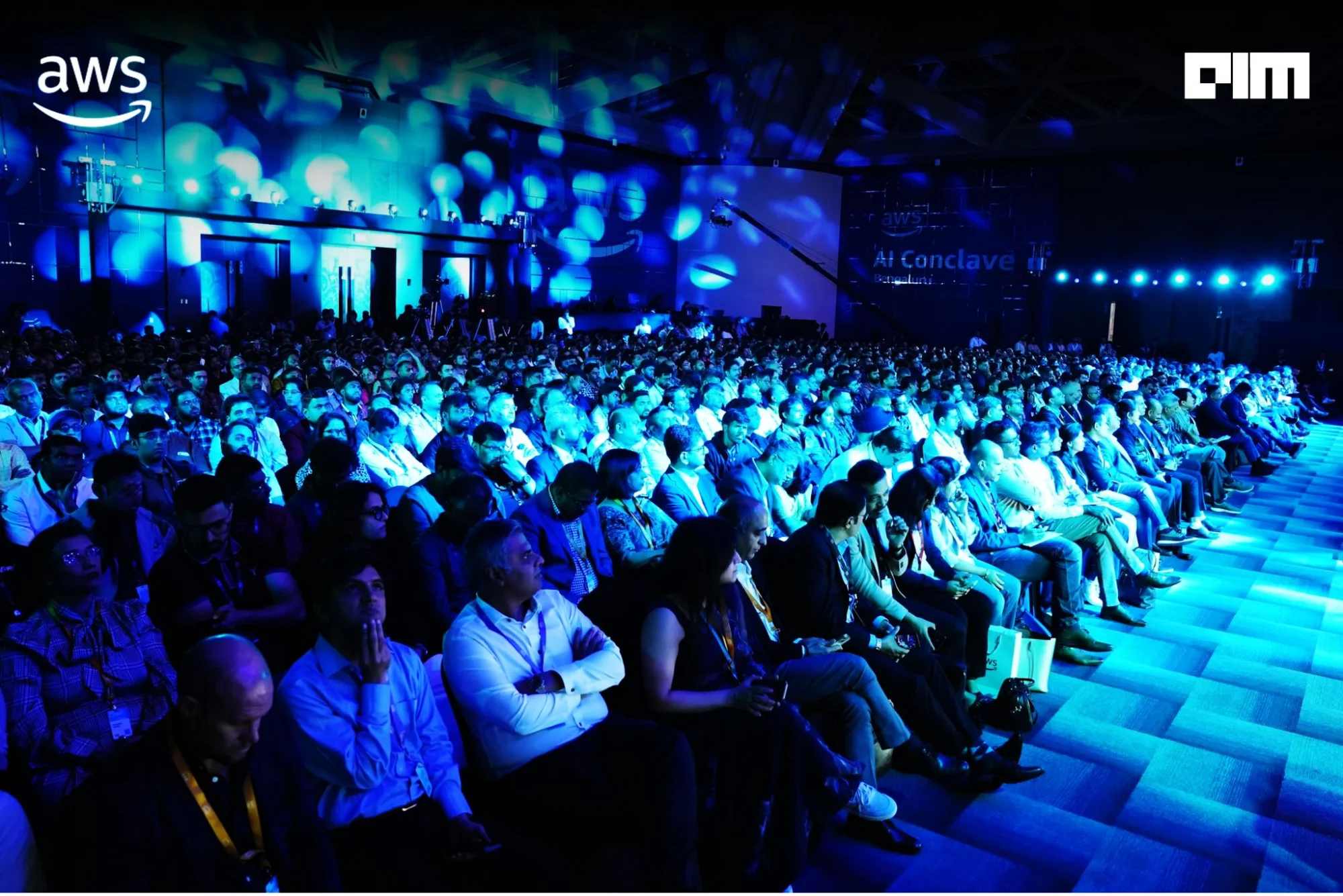
The AWS AI Conclave 2026, held in Bengaluru on January 22, showcased how AI in India is rapidly moving beyond experimentation into real-world, population-scale impact.
Senior AWS leaders outline a future where AI agents, digital public infrastructure (DPI), and cost-efficient cloud compute converge to democratise innovation across industries and society.
AI’s Shift From Strategy to Everyday Reality
Opening the conclave, Sandeep Dutta, president of India and South Asia at AWS, highlights how AI has transitioned from a boardroom discussion to an embedded part of everyday life.
“The fascinating thing is that AI has moved from being a boardroom conversation to now being a part of our everyday life,” Dutta says.
He further adds that India’s success with AI will depend on democratisation in both creation and consumption, enabled by the country’s unmatched digital public infrastructure.
Dutta highlights the nation’s scale, with over 1.3 billion digital identities and nearly 18 billion monthly UPI transactions settling instantaneously, calling it unprecedented and unparalleled anywhere in the world.
Among the most impactful use cases highlighted was the women and child development ministry’s Poshan Tracker platform, which leverages AI, Aadhaar-based eKYC, and visual recognition to fight undernutrition.
“Today, more than 1.4 million Anganwadi centres support over 90 million beneficiaries—80 million of them children under six,” Dutta says.
According to him, the platform ensures welfare funds reach the right beneficiaries.
From India to the World
The conclave also showcased how Indian partners are exporting innovation globally. Dutta highlighted Infosys’ collaboration with the Australian Open in 2025.
Using Amazon Bedrock, Infosys delivered real-time, AI-powered tennis commentary processing over 100 live feeds with millisecond precision.
“This content was consumed by more than a million users,” Dutta says. “Infosys ended up creating a new global standard in sports broadcasting.”
Agents Take Centre Stage
Taking the stage next, Ganapathy Krishnamoorthy, vice president of Database Services at AWS, focuses on what he describes as the next major shift in AI, agents.
“We foresee a future where agents are capable of tasks that today need human hands and brains,” he says.
Unlike chatbots that merely advise, Krishnamoorthy explains that agents act autonomously—querying dashboards, scanning logs, analysing CI/CD pipelines, and even generating code fixes. He describes agents as transformative in two ways: expanding who can build technology and drastically reducing build times.
“What used to take years is now possible in weeks,” he says. “Agents are enabling building at the speed of an idea.”
AI as a Modernisation Tool
AWS positioned agentic AI as a cloud-native workload and argued that modernisation is a prerequisite.
The company has launched Amazon Bedrock AgentCore and Amazon Bedrock Agents to build and run secure AI agents at scale. It has also introduced Frontier agents for long-running autonomous tasks, AWS Transform to modernise applications and code using AI agents, and Kiro to help developers build and manage agent-driven workflows.
Databases as the Backbone of Agentic AI
As more organisations deploy AI agents into live workloads, AWS argues that a trusted, AI-ready data foundation is no longer optional. “Agents can only be as smart as the data you feed them,” Krishnamoorthy says, emphasising the need for secure, low-latency access to operational data.
AWS positions its database portfolio as central to this shift. Enterprise-critical systems such as ERP, supply chain, contract lifecycle management, and other operational workloads continue to run on databases, making them a key enabler for agentic AI.
“Some of your most critical data lives in operational databases,” Krishnamoorthy says, pointing to AWS’ support for relational, key-value, document, and purpose-built databases.
AWS traces its database strategy back more than 15 years, starting with fully managed services and expanding with products such as DynamoDB, Aurora, and Elasticsearch.
The company points to database savings plans that can deliver up to 25% cost reductions and highlights easier migrations from legacy systems such as Oracle and SQL Server.
AWS also underscores the growing demand for zero-ETL integrations, which allow organisations to use operational data directly in analytics and AI systems without complex data pipelines.
Customer’s Perspective
Several AWS customers, including Kotak Mahindra Bank, Eternal, and Axis Group, share examples of how they are using AI services at scale.
Gyanendra Kumar, VP of technology at Zomato, describes how Eternal uses AI across large consumer-facing systems. On New Year’s Eve alone, its AI agent handled 35% of inbound support requests—over one lakh interactions—reducing the load on human agents.
Kumar also says Eternal has built an internal coding assistant that has shipped more than three lakh lines of code and reviewed hundreds of pull requests, allowing engineers to focus on problem-solving rather than repetitive tasks. Eternal’s AI-powered CRM platform, Nugget, handles voice and chat interactions at scale across multiple Indian languages.
Srikanth Ramasubramanian, head of enterprise AI at Axis Group, says enterprises should focus on building shared AI capabilities instead of isolated applications. These capabilities can be reused across channels while remaining consistent. He adds that while experimentation is important, production AI systems must be secure, observable, and explainable, especially in regulated industries like finance.
The AI conclave concluded with an engaging fireside chat featuring former Indian cricketer, Dinesh Karthik; mathemetician and inventor of Hawk-eye sports technology, Dr Paul Hawkins; and sports producer and analyst, Joy Bhattacharjya, where the conversation brought together sport, science, and storytelling to show how data and technology are reshaping performance on the field and redefining decision-making, innovation, and competitive advantage in the modern era.

Your reaction
Discussion
What's your take on this story?
No comments yet — be the first to share your view.