
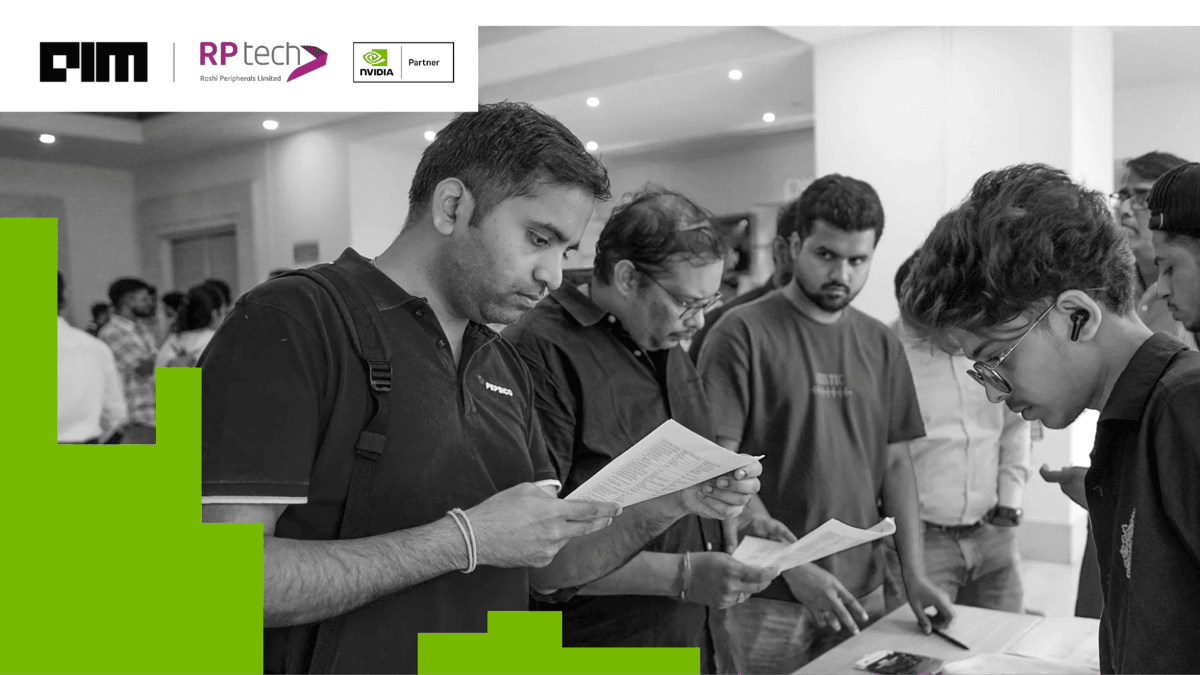
At the recent GenAI: From Build to Impact meetup in Hyderabad, the conversation moved beyond hype cycles and model benchmarks to how developers actually take generative AI systems from experimentation to production.
Since these systems need to be scaled efficiently and securely, the session focused on a growing shift in the AI ecosystem. How do we move away from purely cloud-dependent workflows towards local, self-contained AI development environments?
From APIs to Ownership
At the event, a quick pulse check of the room revealed a familiar pattern. Many developers are already using generative AI through APIs, but very few are downloading models, and even fewer are fine-tuning them.
That gap, between usage and ownership, framed the rest of the session.
The discussion emphasised that while APIs from major providers have democratised access, they also come with trade-offs: limited control, recurring costs, and data privacy concerns. For teams building domain-specific or enterprise-grade applications, relying entirely on external APIs may not be viable.
Instead, the focus is shifting towards running models locally where developers can experiment, customise, and deploy without external dependencies.
Check out the upcoming meetup in Mumbai on May 9, 2026 | Click here
The Rise of ‘AI Computer’
At the cusp of this shift is a new class of hardware designed specifically for AI workloads. These are not traditional laptops, nor are they full-scale data centre systems.
The session showcased a compact, desktop-sized system positioned as a “personal AI supercomputer.” Unlike conventional setups, it combines CPU and GPU memory into a unified pool, enabling developers to run significantly larger models locally.
This architecture addresses one of the biggest constraints in AI development—memory.
Large language models (LLMs) are inherently memory-intensive. Running even mid-sized models typically requires high-end GPUs, often out of reach for individual developers or small teams. By enabling unified memory access and optimised compute, such systems enable running LLMs locally and even fine-tuning them on proprietary datasets. It will also let the models perform inference without cloud latency, while maintaining full control over the data.
The takeaway wasn’t that local machines will replace the cloud, but that they can meaningfully complement it, especially during development and early-stage deployment.
Why Local AI, Open Models Matter Now
The session explored the push towards local AI—towards convenience and control.
Running models locally allows teams to keep sensitive data within their own environments and avoid dependency on external APIs. It would also help reduce latency for real-time applications and enable faster development and testing.
This is particularly relevant in sectors such as healthcare, finance, and enterprise software, where data privacy and compliance are critical. The session also highlighted how local systems can later scale to larger infrastructure, creating a smoother path from prototype to production.
Another key theme was the importance of open, reproducible AI.
Instead of just releasing model weights, the ecosystem is increasingly moving towards sharing full “model recipes”, which include training data, code, and configurations. This reduces friction for developers building on top of existing models.
The emphasis was that access alone is not enough, and that usability and reproducibility enable real innovation.
Alongside models, the session also focused on the role of the software stack. From frameworks for training and fine-tuning to tools for inference and scaling, the stack is becoming just as important as the models themselves.
Click here to register for the upcoming meetup in Mumbai on May 9, 2026
Agents are Changing the Game
The session primarily explored the rise of agent-based systems.
Unlike traditional applications that rely on a single model, agent systems involve multiple models working together, planning, reasoning, executing tasks, and interacting with tools.
This shift introduces new challenges, such as managing multiple model calls, handling memory across agents, ensuring system stability, and controlling behaviour in production environments.
While powerful, these systems can also be unpredictable. The session highlighted how unchecked agents, especially those capable of executing commands, can lead to unintended outcomes if not properly governed.
One of the most practical insights from the session was the distinction between what works in a demo and what works in production.
Agent frameworks and autonomous systems may perform well in controlled environments, but deploying them in real-world scenarios requires accounting for new factors. Guardrails to restrict actions, sandboxing to isolate operations, memory management for stability, and even observability to track performance.
The discussion introduced the idea of structured runtime environments that can make agent systems safer and more predictable, turning experimental setups into deployable solutions.
The underlying takeaway was that AI development is entering a more mature phase. The focus is now on building usable systems, not just bigger models.
This will mean moving from cloud-only to hybrid or local-first approaches and treating infrastructure as a core part of development. The users will also have to design for production from day one, prioritising control, efficiency, and reliability.
For developers, this signals a shift in skill sets from prompt engineering to system design.
- Meet the Winners of AIM Chess League 2026
- Cypher 2026: AIM’s Best Firm Awards Spotlight 22 Companies Shaping India’s AI Workforce
- 2026 Minsky Awards for Excellence in AI Winners
- What Enterprise Vendors Need to Rethink About AI Agents
- The Industrialisation of Enterprise Intelligence
- The Knowledge Enterprise is Becoming the New Moat