Key takeaways
- AMD and Johns Hopkins University launch Agent Laboratory to enhance research efficiency and quality.
- Framework processes research ideas through literature review, experimentation, and report writing stages.
- OpenAI’s o1 preview produces the best research outcomes, emphasizing AI's role in scientific discovery.
- Human involvement is crucial, significantly improving research quality and outcomes.
- Agent Laboratory reduces research costs by 84% compared to previous autonomous models.
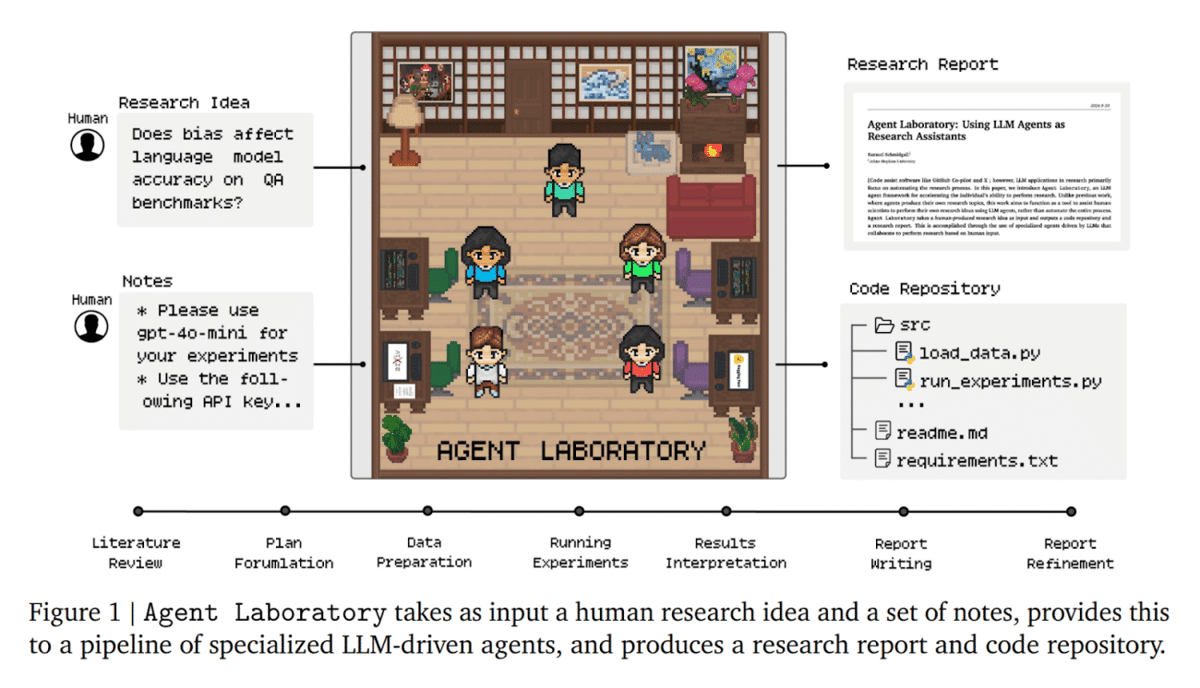
American chipmaking giant AMD collaborated with Johns Hopkins University to introduce a new research study titled ‘Agent Laboratory: Using LLM Agents as Research Assistants’. The study focuses on frameworks to accelerate scientific discovery, reduce research costs, and improve research quality.
The framework will accept a human-provided research idea. It will process the same across three stages, namely literature review, experimentation, and report writing, which includes a code repository and a research report.
The researchers used this framework with various AI models, and it found that OpenAI’s o1 preview generates the best research outcomes. Furthermore, AMD also reiterated the importance of human involvement in the research process.
“Human involvement, providing feedback at each stage, significantly improves the overall quality of research,” read the report.
Moreover, Agent Laboratory also ‘significantly reduced’ research expenses, achieving an 84% decrease compared to previous autonomous research models.
“By integrating specialised autonomous agents guided by human oversight, our approach can help researchers spend less time on repetitive tasks and more time on the creative, conceptual aspects of their work,” said AMD researchers.
Check out the GitHub repository here: https://agentlaboratory.github.io/
A New Era of Scientific Breakthroughs
Indeed, AI has often been used to make scientific discoveries. For instance, David Baker, Demis Hassabis, and John Jumper were awarded the 2024 Nobel Prize in Chemistry for predicting and designing protein structures using AI.
Moreover, Google DeepMind’s Graph Networks for Materials Exploration (GNoME), an AI tool for discovering new materials, is said to have discovered over 2.2 million new materials, including 380,000 stable materials. This is equivalent to nearly 800 years’ worth of knowledge.
Recently, several researchers observed significant gains in efficiency using OpenAI’s o1 models for scientific tasks. “I just had o1 write a major cancer treatment project based on a very specific immunological approach. It created the full framework of the project in under a minute, with highly creative aims, approaches, and even considerations for potential pitfalls and alternative strategies,” said Derya Unutmaz, a biomedical scientist in a post on X.
The integration of an agentic workflow to enhance scientific research works like these can certainly have a positive impact on science. Moreover, several leaders in the AI industry are betting big on AI agents' potential.
“We believe that, in 2025, we may see the first AI agents join the workforce and materially change the output of companies,” Sam Altman, the CEO of OpenAI, wrote in a recent blog post.
On the other hand, NVIDIA launched the Llama Nemotron LLMs and Cosmos Nemotron vision language models (VLMs), to improve agentic AI workflows.
“Agentic AI is the next frontier of AI development, and delivering on this opportunity requires full-stack optimisation across a system of LLMs to deliver efficient, accurate AI agents,” said Ahmad Al-Dahle, vice president and head of GenAI at Meta, the company behind the Llama models.
Spotted an error? Tell our editors. Read our editorial standards and corrections.