
Key takeaways
- AWS launches Multi-Agent Orchestrator for efficient management of multiple AI agents.
- Framework integrates seamlessly with AWS Lambda and other cloud environments for enhanced deployment.
- Supports Python and TypeScript, allowing flexible implementation for developers.
- Includes pre-built scripts for rapid development of chatbots and e-commerce support systems.
- Facilitates complex conversations with intelligent context management and intent classification.
Amazon Web Services(AWS) has introduced Multi-Agent Orchestrator, a framework, that offers a solution for managing multiple AI agents and handling complex conversations.
The framework routes queries to the most suitable agent, maintains conversational context, and integrates with various environments, including AWS Lambda, local setups, and other cloud platforms.
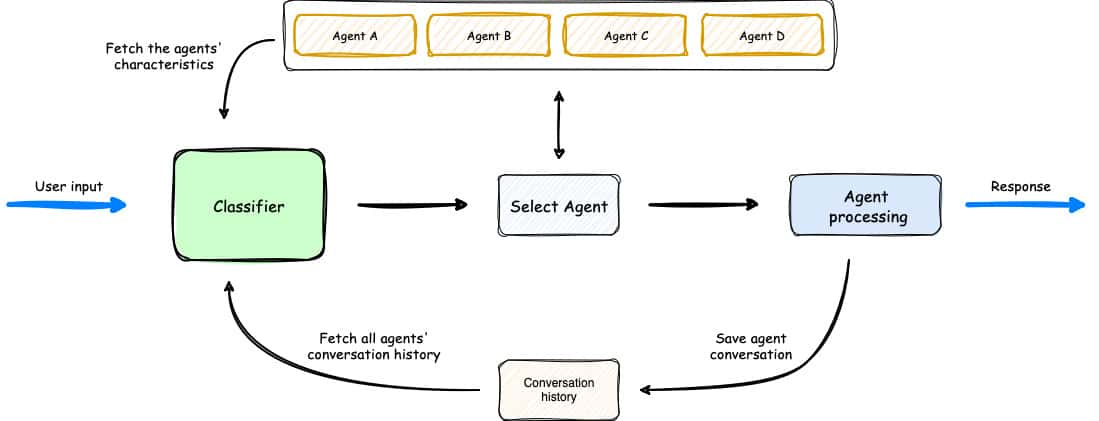
The orchestrator supports Python and TypeScript, enabling dual-language implementation. It allows for both streaming and non-streaming responses from agents and includes pre-built options for rapid deployment. Additionally, it provides extensive features like intelligent intent classification, context management, and scalable integration of new agents.
AWS also published a demo on the GitHub repository highlighting its capabilities with six specialised agents, including ones for travel, weather, math, and health. The orchestrator switches between agents to manage multi-turn conversations and diverse tasks while preserving context.
Moreover, developers can also use pre-built scripts and demo applications, such as a chatbot for specialised queries or an AI-powered e-commerce support system. Sample projects include a multilingual chatbot for flight reservations and an AI customer support system balancing automated responses with human oversight.
The framework also supports voice-based interactions using Amazon Connect and Lex, showcasing its versatility in addressing a variety of use cases. With the ability to integrate with tools like Bedrock LLMs and Lex Bots, the orchestrator is positioned as a flexible choice for enterprises managing complex AI deployments.
As AI moves towards an agentic future, several multi-agent frameworks have been introduced recently.
Microsoft Research unveiled Magentic-One, a generalist multi-agent system capable of solving open-ended tasks across diverse domains. Available as an open-source tool on Microsoft AutoGen, Magentic-One helps developers and researchers create agentic applications for managing complex, multi-step tasks autonomously.
OpenAI introduced Swarm, a framework for building, orchestrating, and deploying multi-agent systems.
Similarly, IBM launched the Bee Agent Framework, an open-source toolkit for creating and deploying agent-based workflows at scale. Currently, in its alpha stage, Bee Agent supports various AI models and offers compatibility with IBM Granite and Llama 3.2 models.
The framework enables developers to build efficient agents with minimal modifications to existing implementations while optimising for other widely used LLMs.