
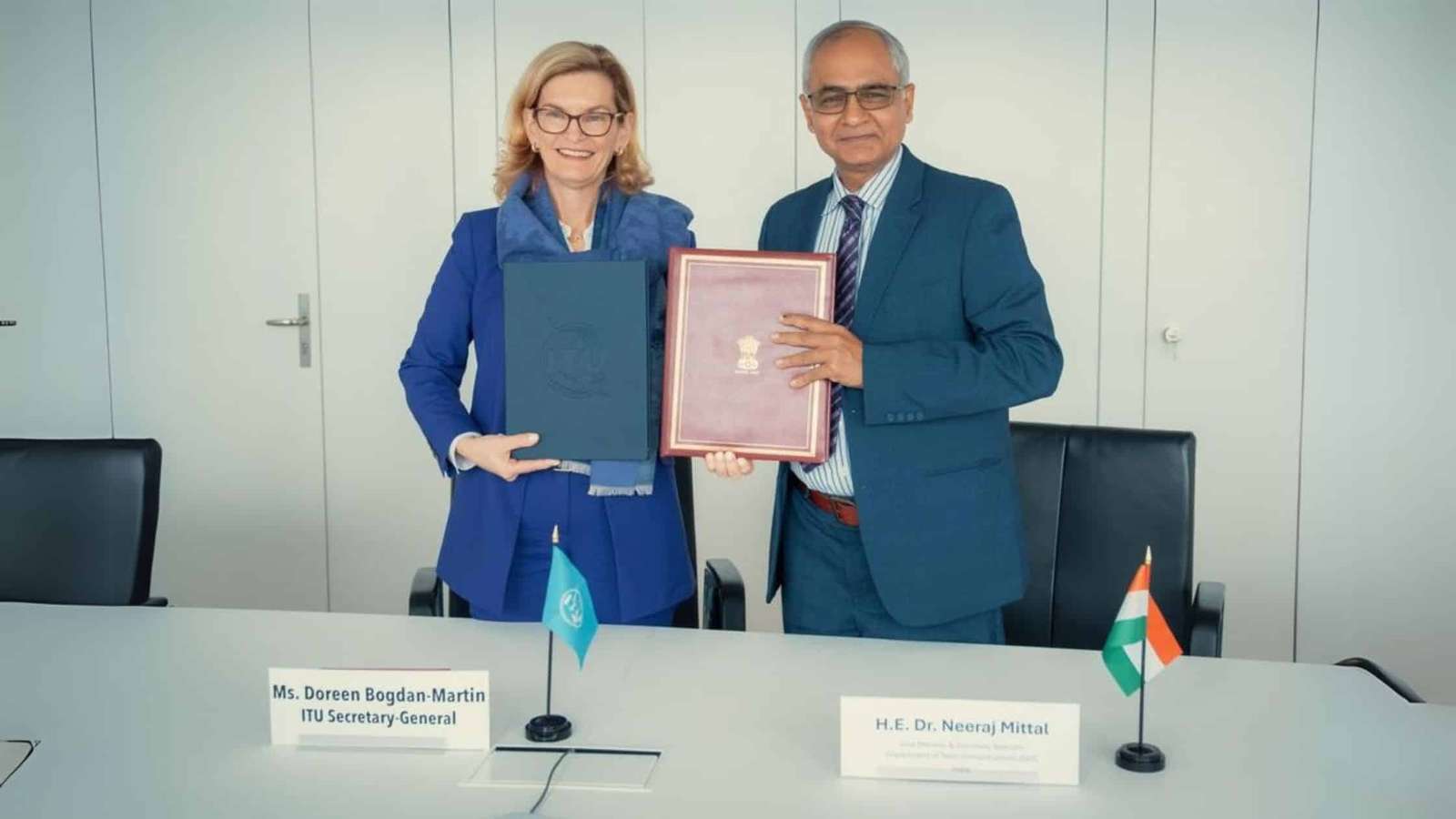
The Department of Telecommunications (DoT) of India signed a Letter of Intent (LoI) with the International Telecommunication Union (ITU) on Monday to enhance infrastructure planning through AI-driven digital twin technologies.
The agreement was finalised during DoT secretary Neeraj Mittal’s official visit to Geneva, which was aimed at reinforcing India’s role in global digital connectivity.
DoT expressed on X that the LoI also intends to support PhD students in carrying out research in telecom technologies, ultimately empowering Indian researchers to drive global innovation.
The collaboration will focus on several key areas, including the integration of AI solutions and digital twins into infrastructure frameworks, the development of global standards for interoperability, and the promotion of sustainable urban planning practices.
In the official statement, Mittal said, “This partnership marks a significant shift in the telecom sector’s role, evolving from providing connectivity to delivering data-driven insights for infrastructure planning.”
Meetings held between Mittal and ITU secretary-general Doreen Bogdan-Martin emphasised India’s commitment to advancing 5G and 6G technologies and addressing the global digital divide through ITU’s Partner2Connect initiative.

India also proposed to host the ITU Plenipotentiary Conference in 2030, a proposal that received positive feedback and will be further discussed at the upcoming ITU Council Meeting.
The LoI outlines initiatives for knowledge sharing and capacity building between DoT’s Sangam project and ITU’s Citiverse program.
Additionally, it aims to create sandbox environments for testing new technologies and engaging citizens in urban planning through AI platforms.
This partnership is expected to foster innovative business models and scalable solutions across critical sectors such as transportation, urban development, and healthcare.
In December last year, American telecommunications company Verizon also announced a collaboration with NVIDIA to deliver a solution enabling AI applications to operate on Verizon’s 5G private network with mobile edge computing (MEC).
In this partnership, Verizon’s secure 5G infrastructure and private MEC will be integrated with NVIDIA AI Enterprise software and NVIDIA NIM microservices. According to the company, demonstrations of this solution are scheduled to begin early next year.
This stressed how generative AI is becoming a cornerstone of digital transformation and business growth.
- AI Productivity to Add $28 Billion to $84 Billion to India's GDP: Cognizant Study
- OpenAI's Codex Helps in Aerodynamic Engineering for Mazda
- Bengaluru Accounts for 34% of India's FDE Talent: Report
- 84% See AI Productivity Gains, but Only 10% Allow Agent Autonomy: TCS Study
- Snowflake Introduces Business Ontology, Cortex AI Gateway to Bring AI Agents Into Enterprise Workflows
- Three Members Behind Claude Code Leave Anthropic Within 10 Days