
Key takeaways
- Google Chrome introduces AI to detect and block tech support scams in real-time with Gemini Nano.
- The AI model analyzes suspicious pages locally, enhancing detection speed against rapidly changing scam tactics.
- Chrome aims to outpace scammers by evaluating user-experienced threats directly on their devices.
- Users receive warnings from Chrome when harmful pages are identified through AI analysis.
- Tech support scams often employ fear tactics and can exist for less than 10 minutes on average.
Google Chrome is taking an AI-driven defence approach to help users protect against tech support scams. With the release of Chrome 137 this week (as a beta version), the browser will begin using Gemini Nano, Google’s on-device large language model, to detect and block scam sites in real time.
Tech support scams have long relied on fear tactics such as full-screen takeovers, fake virus alerts, and even disabling input controls or giving up remote access. According to Google, these pages often change rapidly and avoid detection by evading security crawlers. “We’ve found that the average malicious site exists for less than 10 minutes,” the company noted in its announcement.
The new AI-powered feature aims to outpace scammers by analysing suspicious pages locally on the user’s device.
“We believe we can leverage LLMs to help detect scams at scale and adapt to new tactics more quickly. But why on-device? Leveraging LLMs on-device allows us to see threats when users see them.”, the company stated in the blog post.
If Chrome detects behaviour typically associated with scams, like abuse of keyboard lock APIs, it will trigger Gemini Nano to evaluate the page.
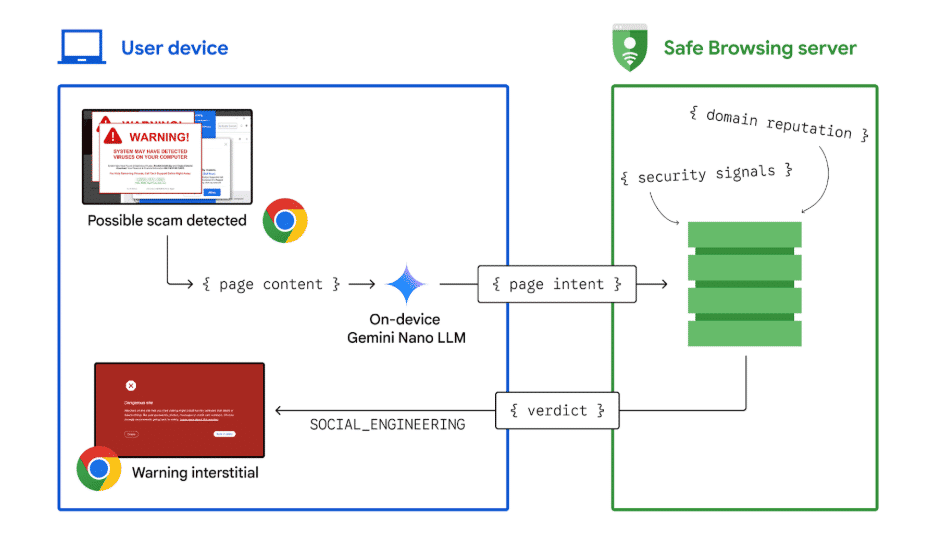
“Chrome provides the LLM with the contents of the page that the user is on and queries it to extract security signals, such as the intent of the page.”, mentioned the announcement.
The LLM summarises signals such as intent and page content, which are then sent to Google Safe Browsing for a final verdict. If deemed harmful, Chrome will display a warning.
Because the evaluation happens locally, threats can be identified as users experience them—an approach that offers both privacy and speed. Only users who opt-in to Chrome’s Enhanced Safe Browsing will send these AI-generated signals to Google, though standard users will still benefit through improved blocklists.
Looking ahead, Google plans to expand this AI layer to catch other scam types, including package tracking fraud and unpaid toll schemes. Android support is expected later this year, and ongoing research is being conducted into improving resilience against prompt injection and other emerging threats.
Spotted an error? Tell our editors. Read our editorial standards and corrections.