

Google today announced a new multi-agent AI system called ‘AI co-Scientist’ – a tool built with its Gemini 2.0 model. The system is designed to function as a ‘virtual scientific collaborator’ to help scientists generate novel research and hypotheses.
While most big AI firms, such as OpenAI, xAI, and Perplexity, are betting big on a deep research agent, Google seems to have gone further.
“Beyond standard literature review, summarisation and ‘deep research’ tools, the AI co-scientist system is intended to uncover new, original knowledge and to formulate demonstrably novel research hypotheses and proposals,” said Google in a blog post.
Google also says the tool uses a multi-agent system focusing on various research steps to automatically iterate, generate, evaluate, and refine hypotheses. Further, the tool uses web search, and ‘specialised AI models’ to enhance the quality of the generated hypotheses.
“The AI co-scientist parses the assigned goal into a research plan configuration, managed by a Supervisor agent. The Supervisor agent assigns the specialised agents to the worker queue and allocates resources,” read the blog post from Google.
More importantly, the tool is also said to utilise test time computation to improve its outputs.
Google also revealed that the tool outperforms several state of the art reasoning models.
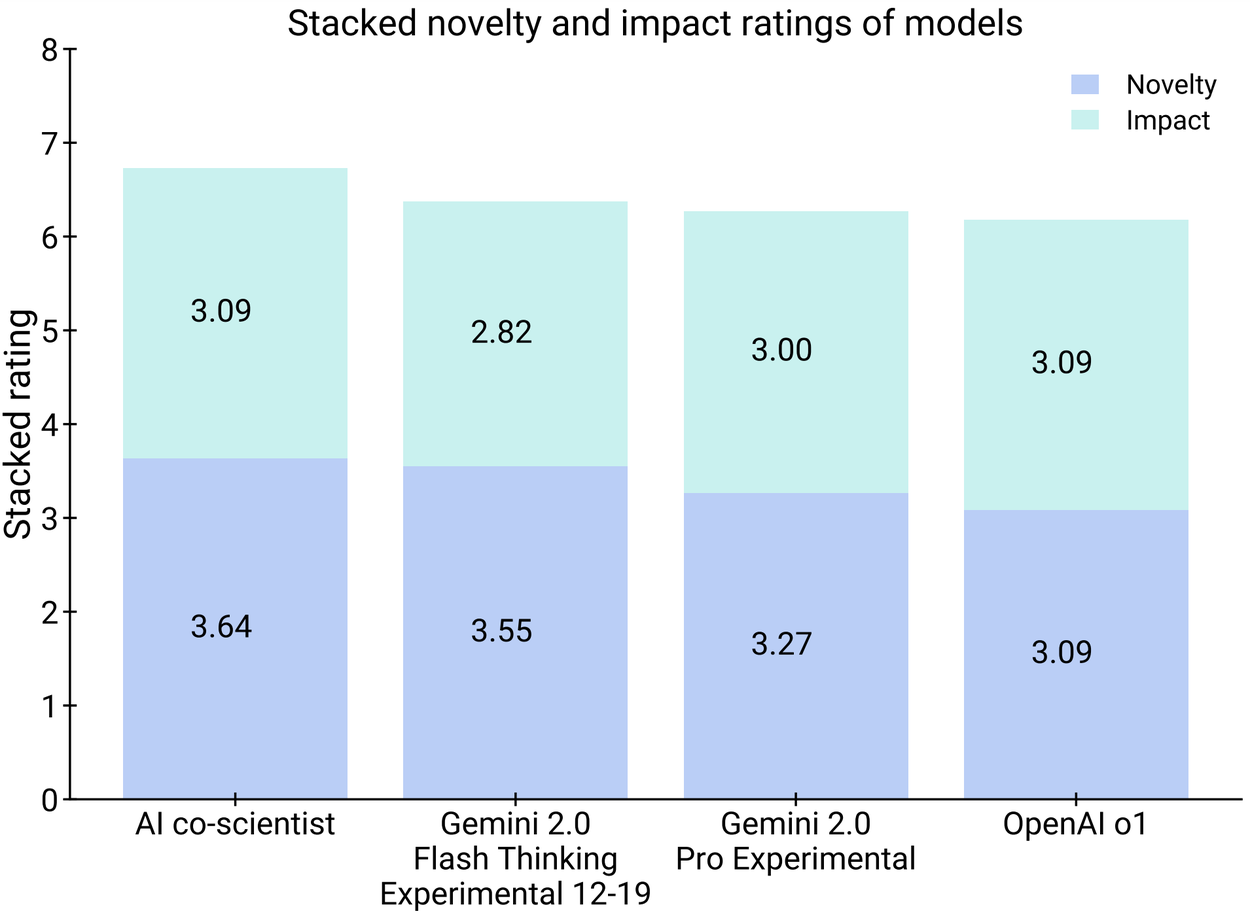
The tool was also tested through validation of the hypotheses it generated by laboratory experiments in drug repurposing, target discovery, and antimicrobial resistance.
The AI co-scientist's successful validations include novel drug candidates for leukemia, potential anti-fibrotic targets for liver fibrosis, and insights into antimicrobial resistance mechanisms.
Google has published a detailed technical paper outlining the AI co-scientist's capabilities, benchmark results, and real world performance.
The tool can be accessed through Google's Trusted Tester Program. Interested research organisations can apply here.
Similarly, American chipmaking giant AMD collaborated with Johns Hopkins University last month and introduced a new research study titled ‘Agent Laboratory: and Using LLM Agents as Research Assistants’.
The framework accepts a human-provided research idea. It will process the same across three stages, namely literature review, experimentation, and report writing, which includes a code repository and a research report.
“By integrating specialised autonomous agents guided by human oversight, our approach can help researchers spend less time on repetitive tasks and more time on the creative, conceptual aspects of their work,” said AMD researchers.
- Amazon Warns Engineers Against AI Productivity Traps in Latest Memo
- Gnani AI Launches Prisma v3.0 Speech Recognition Model for 10 Languages
- Venttup Raises $3 Million To Expand Precision Manufacturing
- Articul8 Launches Bivia To Help Enterprise AI Agents Make Decisions
- NVIDIA Launches Open-Weight Transcription Model for 40 Languages
- Sarvam AI Rolls Out Indus Cowork to 2,500 Maharashtra Govt Officials