
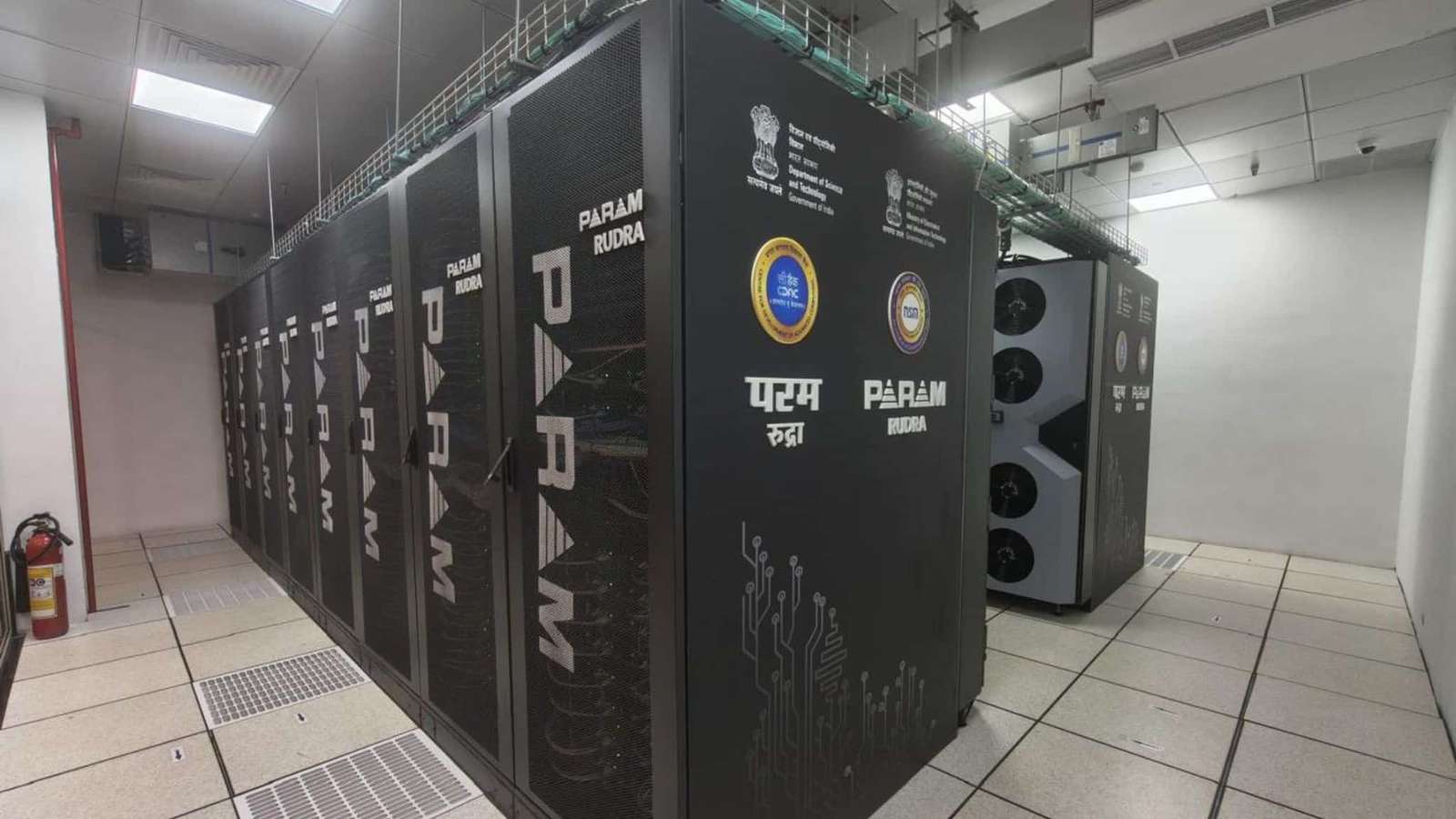
The Ministry of Electronics and IT (MeitY) has launched Param Shakti, an indigenous 3.1 petaflop supercomputing facility at IIT Madras. This is aimed at strengthening India’s research capacity in high-performance computing. The facility was launched in Chennai by the MeitY Secretary, S Krishnan, under the National Supercomputing Mission.
Param Shakti hosts the PARAM Rudra supercomputing system, designed and implemented by the Centre for Development of Advanced Computing (CDAC).
The system has been funded through the National Supercomputing Mission, jointly led by MeitY and the science and technology department, and will support advanced research across aerospace, materials science, climate modelling, drug discovery and manufacturing.
The 3.1 petaflop system can perform over 3.1 quadrillion calculations per second, placing it among the most powerful computing systems in Indian academia. According to MeitY, the facility will help researchers reduce experimental timelines and handle complex simulations at scale.
IIT Madras director V Kamakoti highlighted the role of government-led computing initiatives such as the National Knowledge Network, which connects centrally funded academic institutions. He urged students to focus on energy-efficient programming and effective sharing of GPU resources.
Addressing students and faculty, Krishnan said the institute’s growing interdisciplinary research culture would benefit from the new system. “It is encouraging to see faculty and researchers from diverse departments coming together to use this facility and contribute meaningfully in their respective domains,” he said.
He added that India’s supercomputing footprint was expanding steadily. “With 37 supercomputers already installed across institutions nationwide and more in the pipeline, including the largest system planned for Bengaluru, these efforts are strengthening India’s research and innovation ecosystem,” Krishnan said.
Built Entirely in India
The PARAM Rudra system has been built entirely in India using C-DAC’s Rudra series servers and runs on open-source software, including AlmaLinux and an indigenous system software stack. MeitY said this aligns with India’s push for self-reliance in critical computing infrastructure.
Krishnan also linked the facility to the broader IndiaAI Mission, noting that the government is avoiding dependence on a single technology platform. “By enabling access to multiple GPU architectures, we want our innovators, scientists and researchers to gain broad exposure and develop the capability to master diverse platforms,” he said.
C-DAC director general, E Magesh, traced the development of the Rudra platform and encouraged researchers to adopt indigenous high-performance computing systems. He said wider adoption would be critical to building long-term capability in advanced computing.
Operational since May 2025, the Param Shakti facility has already recorded over 80% utilisation, indicating strong demand from researchers. The data centre operates at a power usage effectiveness of 1.2-1.4, reflecting a focus on energy efficiency.
MeitY said the facility marks an important step as the National Supercomputing Mission moves towards its next phase, with India’s total computing capacity expected to approach exascale levels in the coming years.
- Amazon Warns Engineers Against AI Productivity Traps in Latest Memo
- Gnani AI Launches Prisma v3.0 Speech Recognition Model for 10 Languages
- Venttup Raises $3 Million To Expand Precision Manufacturing
- Articul8 Launches Bivia To Help Enterprise AI Agents Make Decisions
- NVIDIA Launches Open-Weight Transcription Model for 40 Languages
- Sarvam AI Rolls Out Indus Cowork to 2,500 Maharashtra Govt Officials