
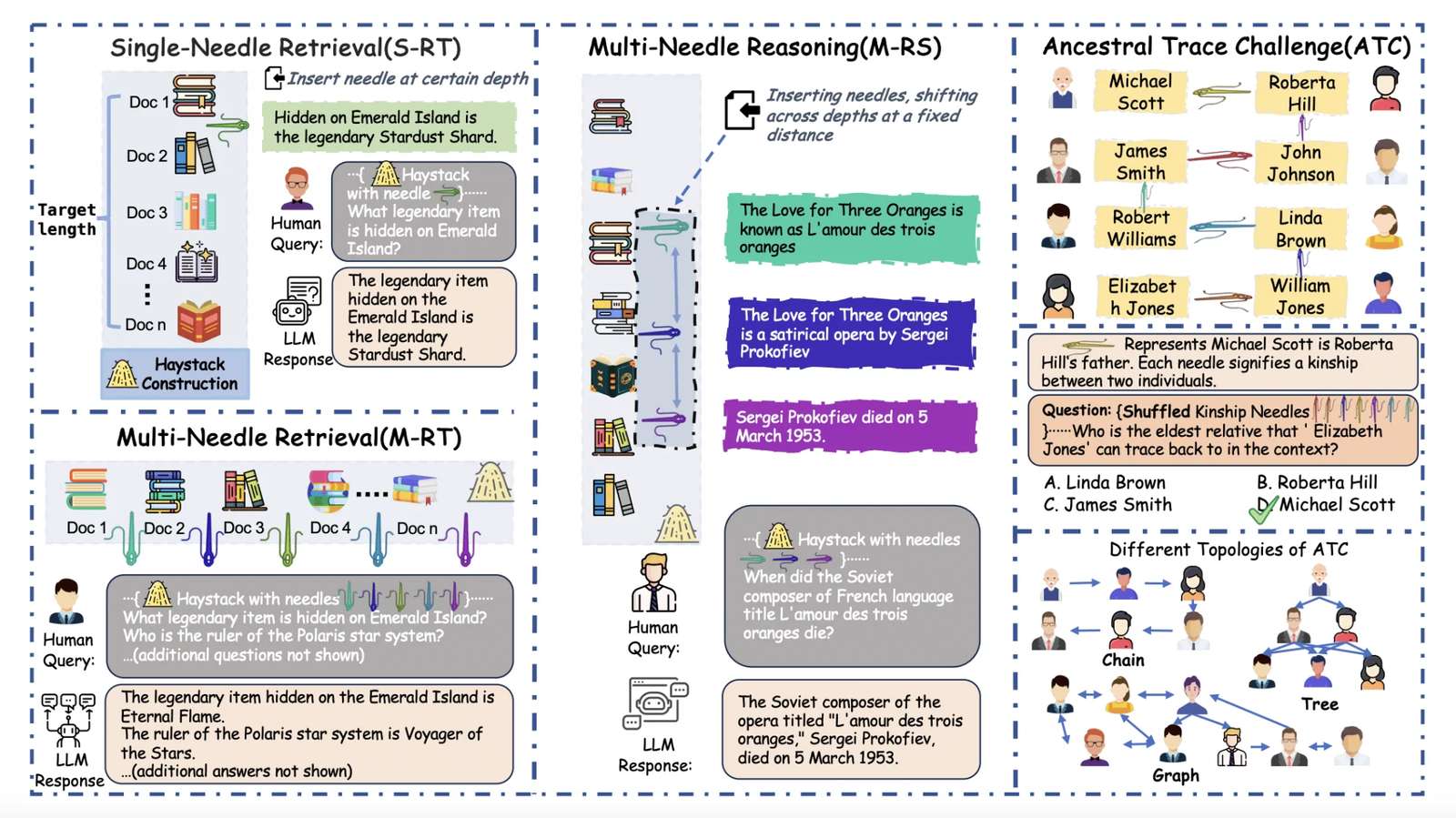
A team of researchers from Shanghai AI Laboratory and Tsinghua University, introduced NeedleBench, a new framework for evaluating the long-context capabilities of large language models (LLMs). The research aims to assess how well LLMs can identify and reason with relevant information in extensive texts.
Read the full paper here.
NeedleBench consists of progressively challenging tasks designed to test bilingual long-context capabilities across multiple length intervals, ranging from 4,000 to over 1 million tokens. The framework strategically inserts critical data points at various depths within texts to rigorously evaluate both retrieval and reasoning abilities of models in diverse contexts.
The researchers also proposed the Ancestral Trace Challenge (ATC), a method to simulate the complexity of logical reasoning challenges likely present in real-world long-context tasks. This provides a simple way to evaluate LLMs in handling complex long-context situations.
Results from the study suggest that current LLMs have significant room for improvement in practical long-context applications. Even leading models like GPT-4 Turbo and Claude-3-Opus struggled with the complexity of logical reasoning challenges in the ATC test, even with relatively short contexts of around 2,000 tokens.
Additionally, the study evaluated a wide range of open-source and proprietary LLMs, including models from OpenAI, Anthropic, and various research institutions. Performance varied widely, with some models excelling in certain tasks while faltering in others.
As China continually experiments with new models and frameworks, Chinese tech giant SenseTime recently unveiled SenseNova 5.5 at the World Artificial Intelligence Conference in Shanghai, boasting a 30% performance boost over its predecessor and claiming to outperform GPT-4 in several areas.
Additionally, last month, Shanghai AI Laboratory and Tsinghua University introduced the MotionBooth AI model, capable of generating diverse and realistic human-object interactions, and the new ChatGLM language model, which matches or exceeds GPT-4's capabilities across various benchmarks and tasks.
- Shield AI Opens Bengaluru Engineering Office to Build Defence Autonomy Software
- Adobe, Google Expand AI Partnership Across Creative and Productivity Tools
- Google Launches Gemini 4 Hydrogen for Faster Coding and AI Workflows
- Kalshi to Develop Trading Platform for Compute Futures: Report
- Microsoft Outage: Fix Fails to Restore Outlook, Teams, Copilot Across 74 Countries
- In a Stunning Fall, Jensen Huang Resigns as NVIDIA Chief After 33 Years