
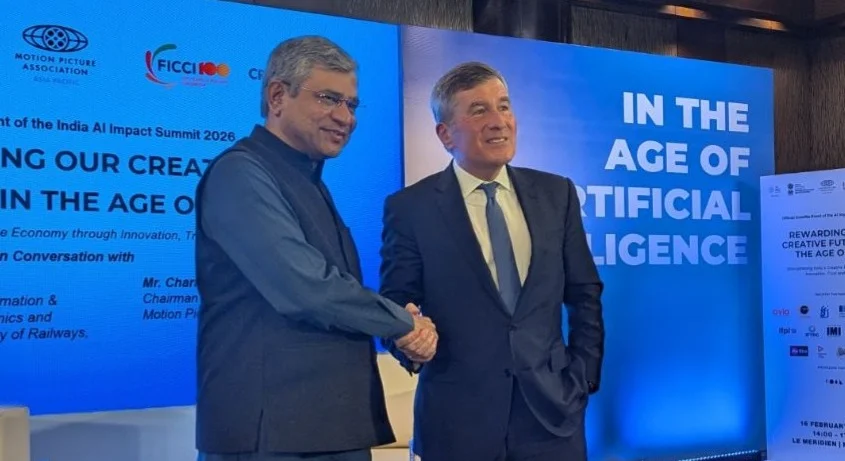
Underscoring that while AI is transformative, human creativity must remain at the core, Ashwini Vaishnaw, Minister of Electronics and Information Technology, spoke about the impact of the India AI Impact Summit.
At a fireside chat titled ‘Merging Cultural Heritage with Frontier Technology’, organised by FICCI, in association with the Ministry of Electronics and Information Technology (Meity), Vaishnaw answered an array of questions about the role and impact of artificial intelligence on the creator economy. Hosted by Charles Rivkin, Chairman and CEO of the Motion Picture Association (MPA), the conversation centred on AI and copyright.https://analyticsindiamag.com/ai-news/india-gears-up-for-global-ai-moment-as-impact-jobs-and-governance-dominate-day-1
Defending intellectual property rights, the minister said, “We as a country believe in IP rights. We believe in the creators, the value that the creators have brought.”
However, he also acknowledged the complexity of training foundational AI models on vast swathes of publicly available and copyrighted material. “The challenges between AI and copyright are very, very complex…We have to have techno-legal solutions,” he added.
Rather than viewing AI and copyright as adversaries, the panellists agreed that both were coexisting pillars of a sustainable creative economy. “AI doesn’t become a competitor to human creativity,” the minister said. “Human creativity is the most important thing that we have in our entire civilisation. We must protect it.”
The discussion highlighted the deep cultural and economic ties between Bollywood and Hollywood, as well as the expanding collaboration between Indian institutions and the MPA studios. The message was clear: technology and entertainment are no longer separate domains. “There’s increasingly little difference between technology and entertainment. They are now one,” Rikvin noted, pointing to AI’s growing role in filmmaking, from colour correction and de-ageing to visual effects and post-production efficiencies.
For India, however, the focus goes beyond technological experimentation to large-scale diffusion. “It’s diffusion which is going to really make a very big difference,” Vaishnaw emphasised. “The use cases, the applications, the way AI will bring the productivity—that is where the real ROI will come from.”
India’s strategy rests on scale, skills and infrastructure. With 5G coverage reaching nearly 90% of the country and a digitally native population, the government is aggressively pursuing re-skilling, up-skilling and new-skilling initiatives.
The minister added that after last year’s WAVES India summit in Mumbai, the government launched the Indian Institute of Creative Technologies, with advanced laboratories that industry participants describe as globally competitive.“Content creator labs are being introduced in 15,000 schools and colleges to widen the creative talent pipeline,” he said.
Speaking about the summit’s broader theme—impact—which reflects a shift from earlier global AI conversations centred on safety toward measurable societal outcomes, Vaishnaw said, “We are basically measuring and looking at what the impact on human society is going to be.” He pointed to AI’s potential in agriculture, climate forecasting, materials discovery and productivity gains, while acknowledging potential harms.
The conversation also addressed rising concerns around misinformation, deepfakes and child safety. The minister described disinformation as “attacking the foundation of our society” and called for both strict legal and technical guardrails. Protection of children, he insisted, “should be non-negotiable for the entire human society.”
Vaishnaw also announced plans to launch the Create in India mission. “Like the semiconductor mission, the Create in India mission will also be industry-oriented, employment-oriented, and future-oriented. It will look at strengthening what we already have and help in making us become the most preferred platform for the world for creating.”
If executed thoughtfully, the minister suggested, AI may not disrupt storytelling but may usher in its next golden age.

Your reaction
Discussion
What's your take on this story?
No comments yet — be the first to share your view.