
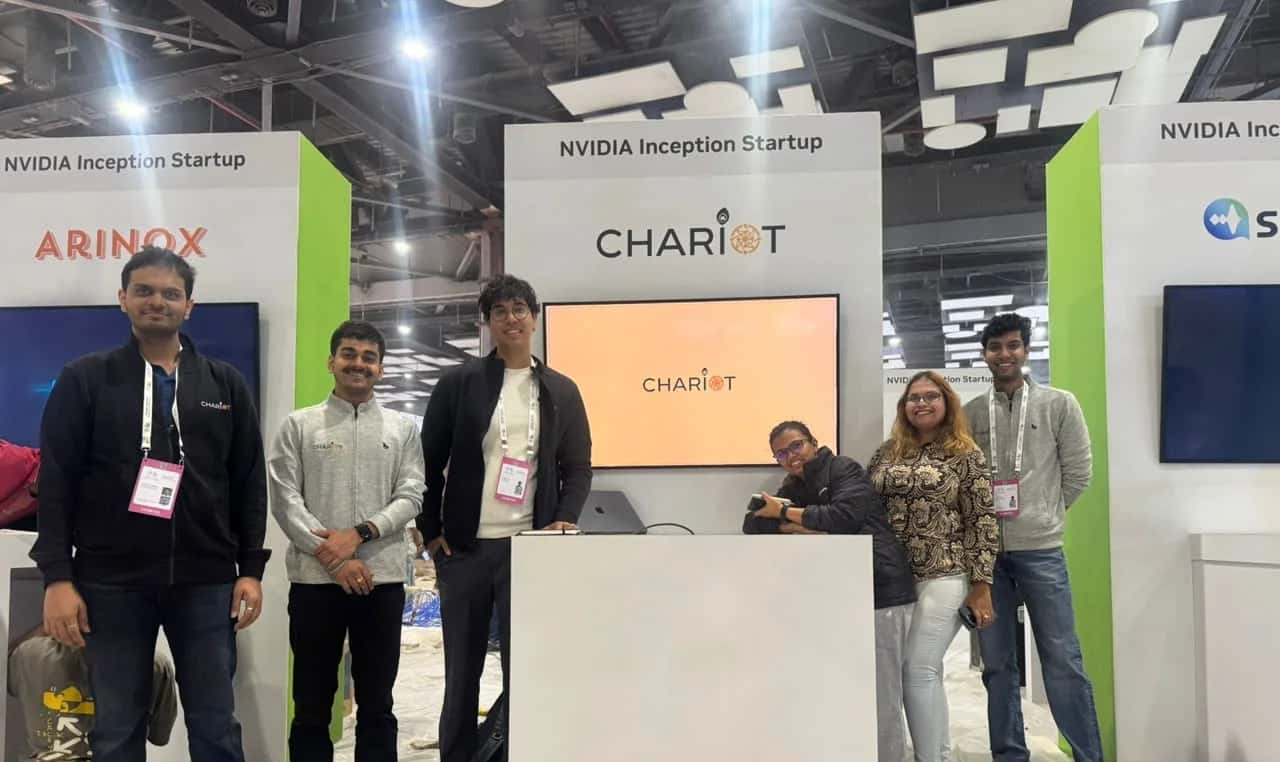
Chariot, an Indian AI research lab founded by former researchers from Google DeepMind and Meta's Fundamental AI Research (FAIR) lab, has launched Chariot-1-TTS-Multilingual, a text-to-speech (TTS) model supporting 11 Indian languages and English.
The model supports more than 50 voices, code-mixing between any two supported languages within a sentence, and voice cloning using a few seconds of reference audio. It can generate speech from up to 1,000 characters in a single request.
Unlike conventional TTS systems that rely on text normalisation rules to determine pronunciation, Chariot's model uses contextual reasoning to decide how written expressions should be spoken.
For instance, it can distinguish between 'B+' referring to a blood group and the same expression referring to a grade.
It also handles contextual pronunciation of currency amounts, dates, abbreviations, and technical expressions.
Chariot claims its model ranks first across several measures in its comparisons with selected models from ElevenLabs, Cartesia, Microsoft, OpenAI, AWS, and Sarvam.
It reported a character error rate of 7.60% for Hindi and 6.47% across nine other Indic languages. On an English verbalisation benchmark covering more than 1,000 sentences across 40 categories, the model recorded 93.78% accuracy.
The company also reported the highest plain-English NISQA score, an automated measure of predicted speech quality, among the configurations it evaluated. These are company-reported results, with benchmark coverage varying across competing models.
"People use numbers, symbols, and abbreviations, and move between languages in the same sentence," Parth Sarthi, Co-founder of Chariot, said in a statement.
The model will be deployed for applications including voice agents, customer service, educational platforms, and multilingual public helplines. Developers can access its voice catalogue or create custom voices using reference recordings.
Recently, the company launched Chariot-1-ASR Realtime a speech recognition model. The company said the model outperformed every streaming and batch transcription system it tested across 10 Indian languages.
The model supports Hindi, Marathi, Bengali, Tamil, Telugu, Kannada, Malayalam, Gujarati, Punjabi, and Odia. It also supports Indian English.
Chariot, previously Gan.ai, is a Delhi-headquartered frontier AI research lab founded by Parth Sarthi and Suvrat Bhooshan, with experience at Google DeepMind and Meta's Fundamental AI Research (FAIR) lab.
On its website, Chariot showcases projects involving brands such as Zomato, Doordarshan, Coca-Cola, Cadbury, and HDFC Bank.
The examples include using the voices of actors Hrithik Roshan and Ranveer Singh to name local restaurants for Zomato; delivering the Prime Minister's Mann Ki Baat address in his voice across languages for Doordarshan; enabling Shah Rukh Khan to answer cricket questions live for Coca-Cola; and generating 600,000 personalised birthday songs, each sung to a different name, for Cadbury.
The IndiaAI Mission, launched in March 2024 with an allocation of ₹10,372 crore, supports the development of indigenous AI infrastructure, datasets, applications, and foundation models.
Under its Foundation Models pillar, the government selected 12 organisations and consortia to develop indigenous models.
These include Sarvam AI, which is developing multilingual large language and multimodal models; Soket AI, focused on Indian-language foundation models; Gnani AI, which works on speech-to-speech and voice AI; and Chariot.
Other selected organisations include BharatGen, Avataar AI, GenLoop, Zenteiq, Intellihealth, Shodh AI, Fractal Analytics, and Tech Mahindra's Maker's Lab.
- Lenovo Unveils New AI, HPC Servers With AMD’s 6th Gen EPYC Processors
- Only 35% Indian Enterprises are Prepared for AI Cyberattacks: Kyndryl Study
- OpenAI Launches API Inference Residency in India
- HCLTech, PTC Launch Pre-Configured PLM Solution for Semiconductor Firms
- IBM, Microsoft Launch Agentic AI Platform With Over 6,000 AI Agents
- NHA Selects EkaCare for AI Voice Scribe in Public Health Facilities