
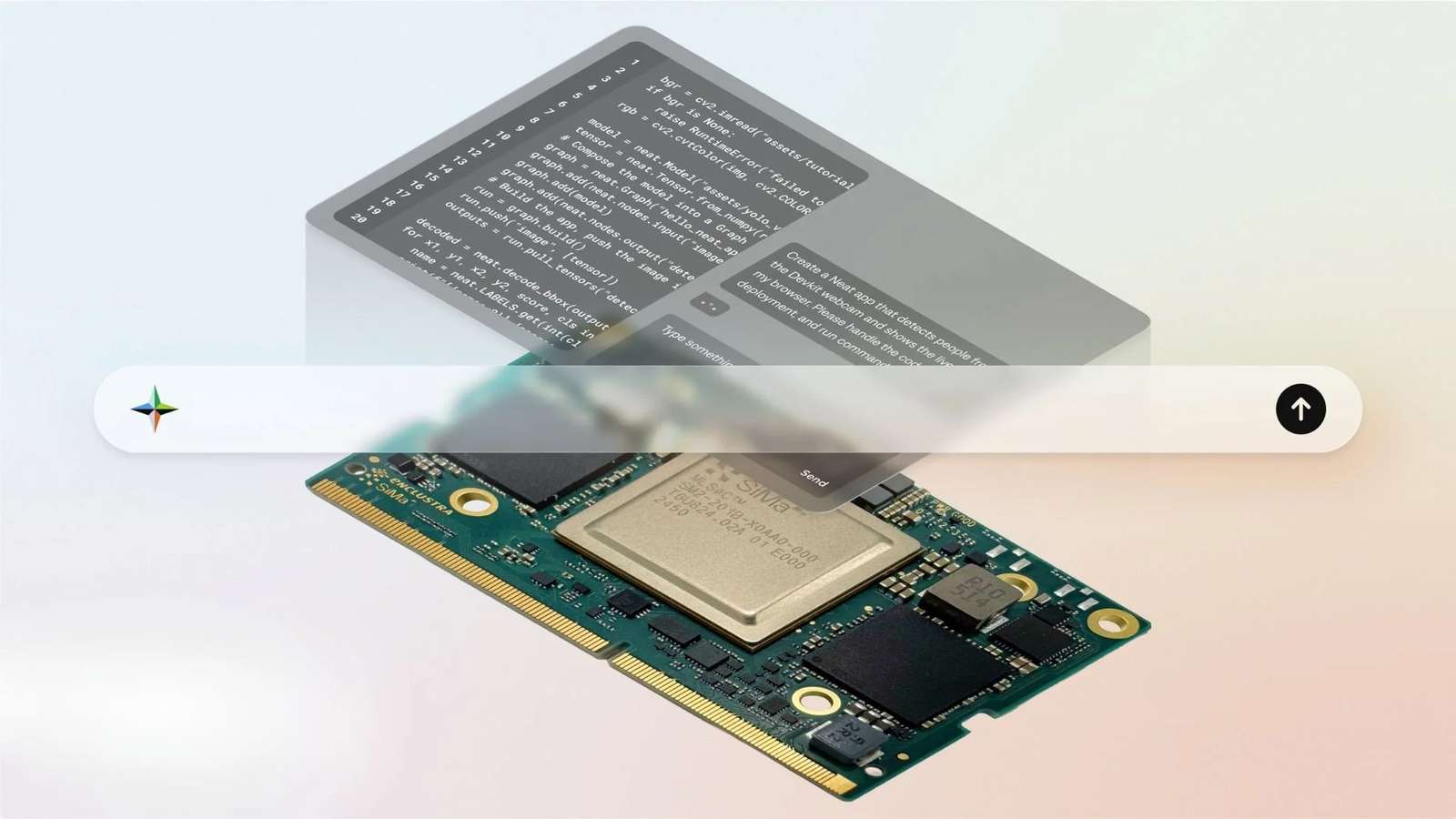
Edge AI startup SiMa.ai has launched Palette Neat, an agentic software environment for physical AI, alongside a production-ready version of its Modalix system-on-module (SoM), as the startup seeks to reduce developers’ reliance on NVIDIA’s GPU ecosystem.
The company said the platform aims to shorten deployment timelines for robotics, drones, industrial systems, and autonomous machines.
Palette Neat aims to help developers move physical AI workloads to its hardware with minimal software rewriting. SiMa.ai also introduced a pin-compatible Modalix SoM that works with NVIDIA Orin carrier boards, allowing customers to switch hardware without redesigning systems. The company plans to make Palette Neat generally available after testing it with more than 20 customers globally.
“So we did an alpha and a beta, and then we engaged with 20-plus customers globally,” Krishna Rangasayee, Founder and CEO of SiMa.ai, told AIM. “What we’re announcing now is general access.”
https://youtu.be/pVblHQ5Lxoc?si=JzXy8_voWWpUv1Gw
SiMa.ai believes the challenge in physical AI lies less in hardware and more in software migration. Developers often spend weeks or months adapting applications built around NVIDIA’s CUDA ecosystem when shifting to new hardware.
Palette Neat uses an agentic workflow that allows developers to describe applications using natural language. The company says the software then maps workloads to its silicon, reducing manual integration work.
“Our secret sauce is not that you can instruct in English, but that you can take English and make it build a complex system,” Rangasayee said.
He said developers can define systems using prompts instead of writing large amounts of code. “You can just describe ‘build me a robot, it has 16 cameras, radar, LiDAR. Here’s my data set. Here’s my accuracy criteria. Here’s my performance, here’s my power. Build it on SiMa,’” Rangasayee explained in the interview.
The launch also includes SiMa.ai’s Modalix SoM, which the company designed as a pin-compatible replacement for the NVIDIA Orin module. Krishna said the hardware removes a major barrier for developers who want to change platforms without redesigning carrier boards.
The launch comes as chipmakers and startups push alternatives for AI inference, particularly at the edge. While NVIDIA remains dominant in model training, companies increasingly focus on systems that process AI workloads inside robots, vehicles, and industrial machines.
Krishna argued that physical AI workloads require specialised architectures that balance power consumption, latency, and sensor processing.
“They will rule the training world for a long time. I have no doubts,” he said, referring to NVIDIA. “But inference is a very different ballgame.”
SiMa.ai’s software-first approach aims to reduce the effort required to move applications away from GPU-based systems. “Everybody will have to pick a specialised architecture.”
- Anthropic Posts $17 Bn in Q3 Revenue, Swings to Operating Loss
- OpenAI Signs Four Agreements With Abu Dhabi Across Government, Energy And Investment
- Deep-Tech and Green Finance to Drive India’s Climate Investments in 2027
- Google’s Project Suncatcher Satellite Generates First AI Response in Orbit
- DeepSeek Proposes Super-Agent Architecture to Automate AI Coding Workflows
- Arrowhead AI Launches Fletch Voice Model for Multilingual Customer Calls