

GitHub has added more than 3 million CPU cores, 120 petabytes of high-speed storage, and significant network capacity as part of a capacity expansion programme that began in recent months.
Monthly commits have more than doubled from 1.4 billion in April to 2.9 billion in August, while GitHub has accelerated its migration to Microsoft Azure, which now handles roughly 58% of the platform’s load, up from 12% in May.
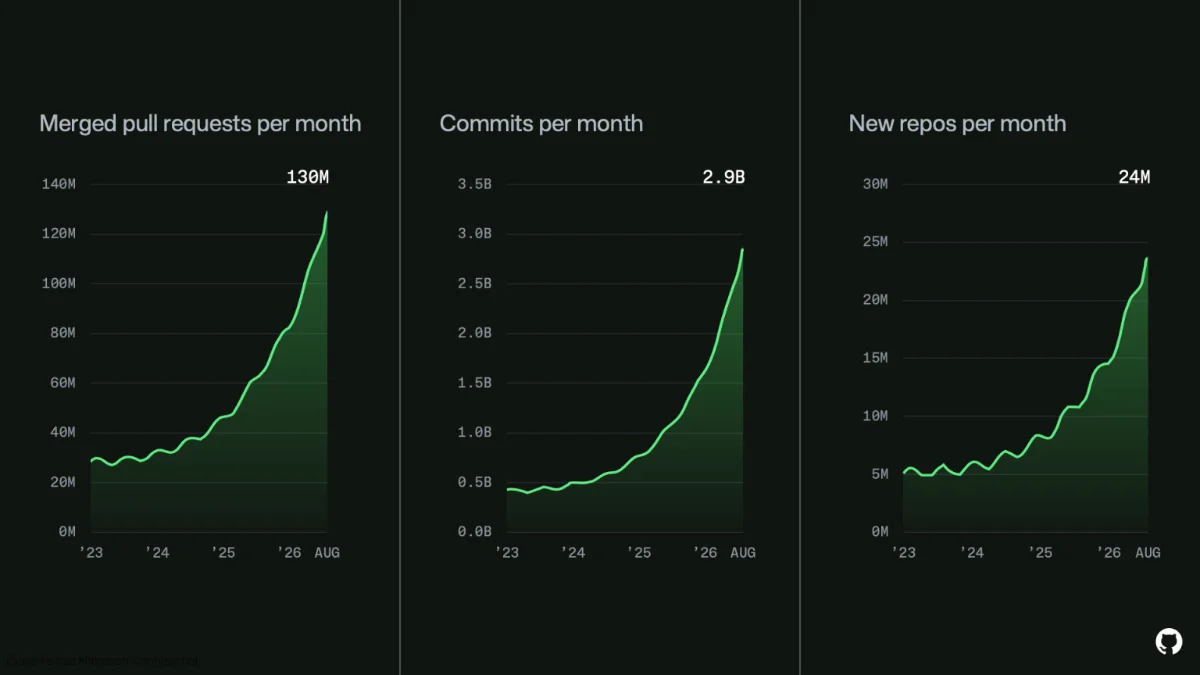
The infrastructure expansion follows a series of reliability incidents, including an outage on August 17 lasting 7 hours, 47 minutes that disrupted GitHub.com, authentication, APIs, GitHub Actions, pull requests, issues, and Copilot.“Our investigation found that the outage began when traffic reached a new peak, and a critical infrastructure component in our Central US data center failed to scale with it,” GitHub CTO Vlad Fedorov said in a blog post. “The resulting capacity pressure spread through our systems, causing authentication failures and disrupting multiple GitHub services.”
During recovery, some Copilot services also encountered a client-side retry loop that increased traffic. GitHub said engineers had to mitigate the behaviour before safely restoring traffic.
The company said the August 17 outage was not caused by a code or configuration change, but by a failure to scale critical infrastructure before demand exceeded available capacity.
The incident came less than two weeks after a separate GitHub Actions outage on August 6. During that incident, workflow runs failed or remained queued for extended periods, affecting both GitHub-hosted and self-hosted runners.
At its peak, 71% of workflow runs experienced infrastructure failures, while 75% of the remaining runs were delayed by more than five minutes.
GitHub said the August 6 outage was triggered by a routine deployment to an internal Actions service that exposed an existing capacity and concurrency weakness.
As pods were replaced, the remaining capacity became saturated, causing services to crash and creating a cascading impact across multiple clusters and downstream services. A backlog then accumulated, while a latent bug caused some runners to repeatedly attempt to acquire invalid jobs.
The two incidents followed reliability work GitHub had announced in March and April.
GitHub has since focused on three priorities: adding capacity, improving efficiency and removing architectural bottlenecks.
“First, we are applying consistent retry limits, retry budgets, and variable timeouts across service-to-service interactions to prevent retry storms and cascading load,” said Federov. “Second, we are reviewing lower-priority CPU and memory alerts to identify components that could fail during sudden traffic spikes.
He added that GitHub is also isolating critical systems and removing shared dependencies between them. “This work is designed to reduce the likelihood of an outage and limit its impact when one occurs.”

Your reaction
Discussion
What's your take on this story?
No comments yet — be the first to share your view.