
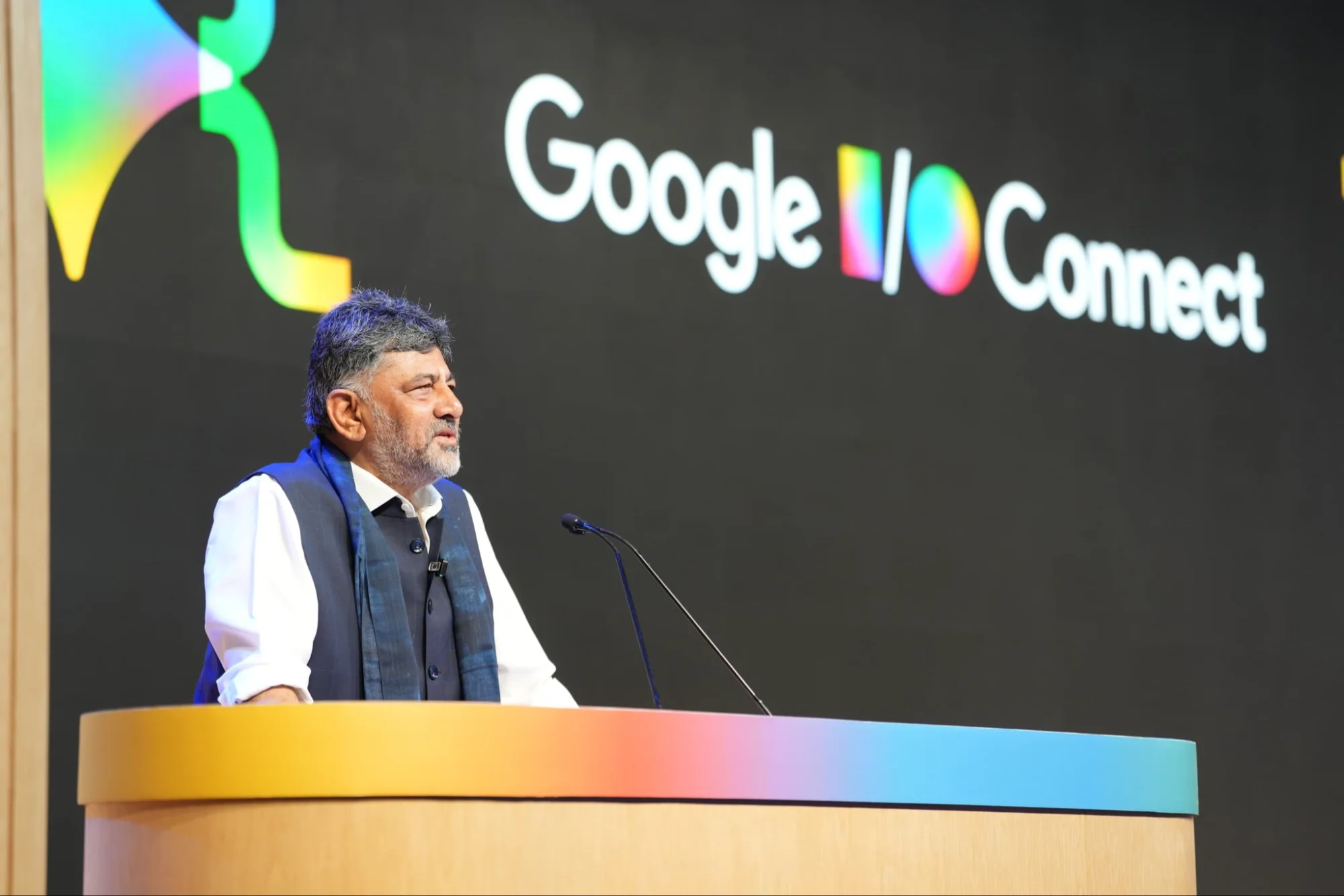
Karnataka Chief Minister DK Shivakumar announced plans to establish a government-backed AI university, an AI innovation hub, and a next-generation green data centre at Google I/O Connect 2026 in Bengaluru.
Addressing developers, researchers, policymakers and industry leaders, Shivakumar said Karnataka wants to become “one of the world’s leading centres of responsible artificial intelligence”.
“We want to build one of the world’s leading centres of responsible artificial intelligence,” he said.
The chief minister said Karnataka already contributes nearly 40% of India’s software exports and is home to more than 17,000 startups, adding that thousands of global capability centres have chosen the state to build products and engineering talent for the world.
“Our first ambition is to make Karnataka an AI-native state,” Shivakumar said. “By AI-native, I do not mean using AI as a slogan.”
He said the state government plans to establish “the first and the largest university by the government” focused on AI while creating a world-class ecosystem for research and talent development.
Karnataka also plans to build an AI innovation hub that will bring together startups, researchers, academia and industry, while introducing AI education from the school level.
Shivakumar also said the state is working on a next-generation green data centre in Karnataka’s coastal region alongside infrastructure development around Bengaluru.
Shivakumar said Google had chosen Bengaluru not merely as an office location but as one of its most important global centres for engineering, research and innovation.
He said millions of Indians first experienced the internet through Google’s products, including Search, Android, YouTube, Maps, Chrome and Google Pay, arguing that these services have become part of everyday life.
Citing figures shared with him, Shivakumar said Google employs more than 18,000 people in India, with around 12,000 based in Bengaluru.
“I was told that Google employs more than 18,000 people in India and in Bangalore, it is 12,000,” he said.
The CM invited Google to deepen its partnership with Karnataka, saying the government was prepared to support the company as it expanded its AI efforts.
“I am ready to give you any support you want,” Shivakumar said. “Let us build AI for education. Let us build AI for healthcare, agriculture, climate resilience and urban mobility.”
Acknowledging Bengaluru’s infrastructure challenges as the city’s population has grown rapidly, he said the government would work with industry to address them.
Google unveiled a series of AI initiatives for India at Google I/O Connect India, including on-premises access to its Gemini models, new AI education programmes, cybersecurity tools, and support for 25 Indian languages in Gemini Live, as it seeks to expand enterprise and public sector adoption of AI.
The company also said the Google Play and Android ecosystem generated ₹5.3 lakh crore ($60 billion) in revenue for app publishers and the wider digital economy in India in 2025, up 28% from the previous year, based on third-party research.
A key announcement was the availability of Gemini on Google Distributed Cloud, allowing enterprises and government organisations to deploy Google’s frontier AI models entirely within Indian data centres. Google said the offering is intended for regulated sectors that require data localisation and disconnected environments.
Google also said Gemini 3.5 Flash will now be available to Indian enterprises and startups with in-country machine learning processing commitments through its Gemini Enterprise platform.
“As we drive the shift into the agentic era, where AI moves from answering queries to securely executing tasks, our focus is on providing the underlying infrastructure and guardrails the ecosystem needs to scale safely,” said Preeti Lobana, Country Manager, Google India.
“Today, we are delivering just that across the board, from flexible on-premise cloud environments for highly regulated sectors, to open security protocols for developers, to localised tools for healthcare and classrooms.”
The company also expanded its AI education efforts.
Google DeepMind is bringing its AI Research Foundations curriculum, a free 56-hour programme on building and fine-tuning large language models, to India. The programme will be available through Google’s Skills platform and will be rolled out with NASSCOM, IISc Bengaluru, and AVPN.
Google DeepMind also introduced ATL Saathi, a Gemini-powered assistant for teachers in the Atal Tinkering Labs network. The web application will initially be deployed in 100 schools this year, with plans to eventually reach 10,000 schools.
In healthcare, researchers at AIIMS Delhi are using Google’s MedGemma open models to develop India-specific AI models for leprosy and sexual and reproductive health. Google said the resulting models will be made available to Indian developers.
The company also expanded Gemini Live to support more than 25 Indian languages and dialects, including Sanskrit, Bhojpuri and Maithili.
On the security front, Google announced that Sec-Gemini V3, its cybersecurity AI agent, will be made available to trusted government and enterprise testers, including Flipkart. The tool is designed to help security teams analyse incidents using AI.
Google is also open-sourcing Capabilities Security for Agents (CAPSEM), a runtime environment that isolates AI agents inside virtual machines to reduce the impact of compromised agents or malicious prompts.
The company introduced additional security standards for the agentic AI ecosystem, including Device Bound Session Credentials (DBSC) to prevent session cookie theft, and an Agents-to-Payments framework for low-value AI-led financial transactions, and the open Agent2Agent (A2A) protocol.
Google said it has partnered with IIT Delhi and IIT Madras on research into agentic AI safety, including early threat detection and AI systems designed to mitigate institutional risks.
The company also announced that it will bring its Google Play Academy curriculum to 10,000 developers in partnership with the governments of Rajasthan, Odisha, and Madhya Pradesh. The programme will focus on helping developers build and scale AI-powered applications.
Around 1,500 developers attended Google I/O Connect India 2026, where startups including Adya.AI, VideoSDK, Sivi, Superjoin, Knit, PolicyBazaar, Emergent, and RedBus showcased AI applications built using Google’s models.

Your reaction
Discussion
What's your take on this story?
No comments yet — be the first to share your view.