
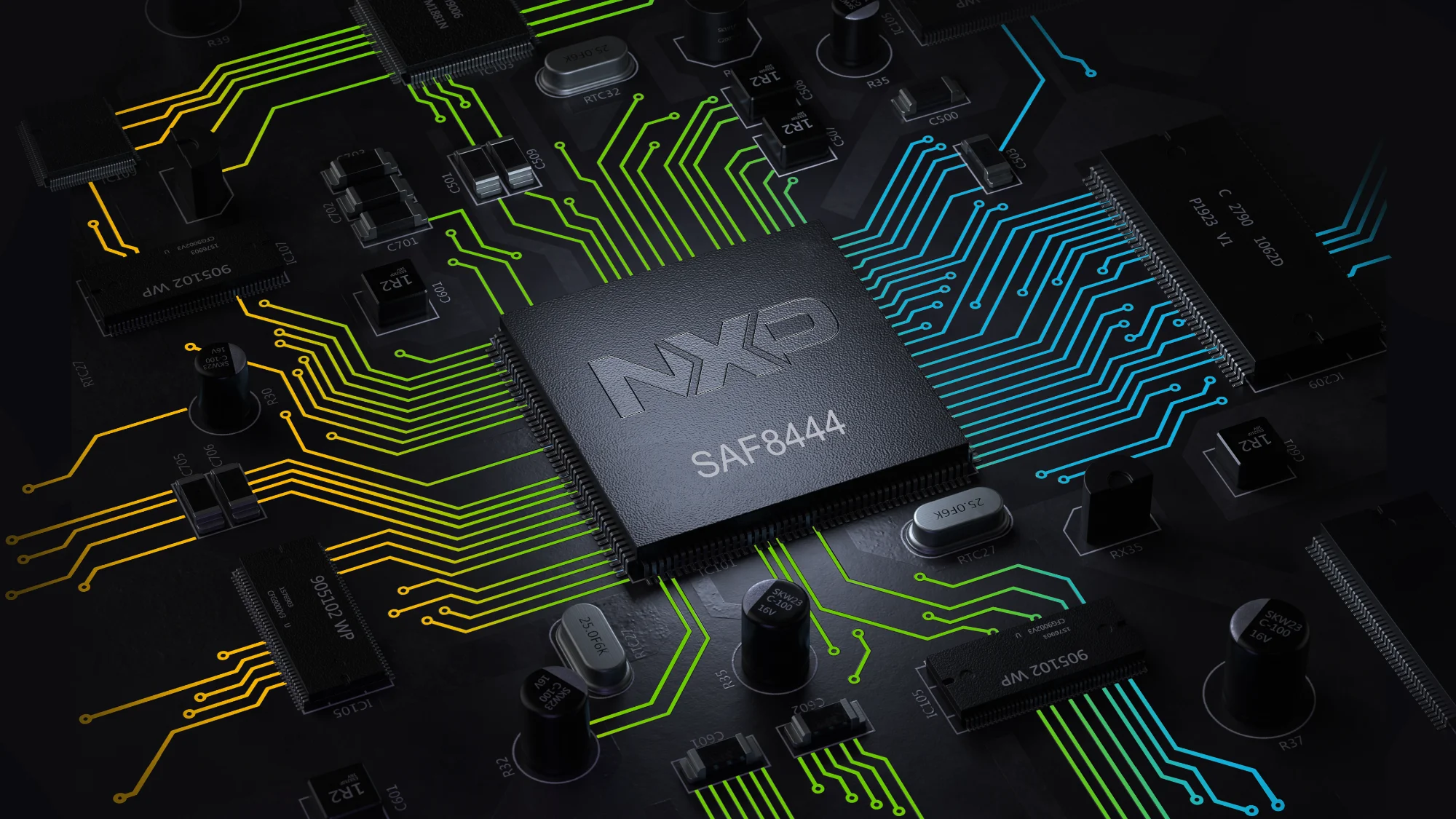
NXP Semiconductors has launched a new automotive radar system-on-chip (SoC) designed to bring advanced driver assistance systems (ADAS) to mainstream vehicle platforms, including economy and entry-level models.
The SAF8444 chip enables on-sensor processing for Level 2 and Level 2+ ADAS functions while reducing system costs and design complexity. The company said the chip could support wider adoption, particularly in EV platforms.
NXP said the SAF8444 is currently in pre-production and targets next-generation front- and corner-radar systems. Development support for lead customers is already available.
“SAF8444 strengthens our one-chip radar portfolio with a solution that balances performance, power efficiency, and cost,” said Meindert van den Beld, Senior Vice President and General Manager, Radar and ADAS at NXP Semiconductors, in a statement.
“It allows customers to meet tightening safety requirements while reducing system cost, an essential step toward democratising ADAS adoption,” he added.
The chip also combines radar and camera data processing directly on the sensor, reducing dependence on central computing systems inside vehicles. NXP said the technology can help automakers and tier-1 suppliers meet safety demands, including future Euro NCAP 2030 requirements, while managing performance, compliance and cost.
The announcement comes as vehicle manufacturers face growing pressure to improve safety systems across price segments. Euro NCAP 2030 standards will require features such as detecting obstructed pedestrians in low-light conditions and maintaining performance in difficult weather environments.
NXP said the SAF8444 chip addresses these challenges by supporting perception-level processing directly at the radar sensor. The company added that this approach can reduce power consumption, simplify vehicle architecture and lower the overall bill of materials.
Built on NXP’s 28nm RFCMOS technology, the SAF8444 operates across the 76–81 GHz automotive radar band. It supports short-, medium-, and long-range sensing for functions such as adaptive cruise control, autonomous emergency braking, blind-spot detection, and park assist.
The chip also integrates embedded radar processing through an Arm Cortex-A53 application processor, an Arm Cortex-M7 real-time core, and NXP’s radar accelerator technology. The company said the system supports anti-jamming functions to improve radar reliability in congested radio frequency environments.

Your reaction
Discussion
What's your take on this story?
No comments yet — be the first to share your view.