

OpenAI’s first custom AI inference chip, Jalapeño, delivered up to 1.9x more performance per watt than NVIDIA’s Blackwell systems in benchmark tests, while also reducing response latency, according to results published by OpenAI.
The chip, developed with Broadcom and Celestica, is designed specifically for inference and is expected to begin deployment inside OpenAI’s compute infrastructure by the end of 2026.
OpenAI tested Jalapeño against commercially available AI systems using InferenceX, a public benchmark developed by SemiAnalysis, across GPT-OSS 120B, DeepSeek R1 670B, and Kimi K2.5 1T. Across the models, Jalapeño delivered 1.5–1.9 times more AI work per watt at peak throughput and 1.7–3.6x lower end-to-end latency than the comparison systems.
The DeepSeek R1 comparison illustrates the gap. Jalapeño delivered 19,641 mixed tokens per second per kilowatt at peak throughput, versus 11,781 for NVIDIA’s GB300, giving OpenAI’s chip a 1.7x advantage.
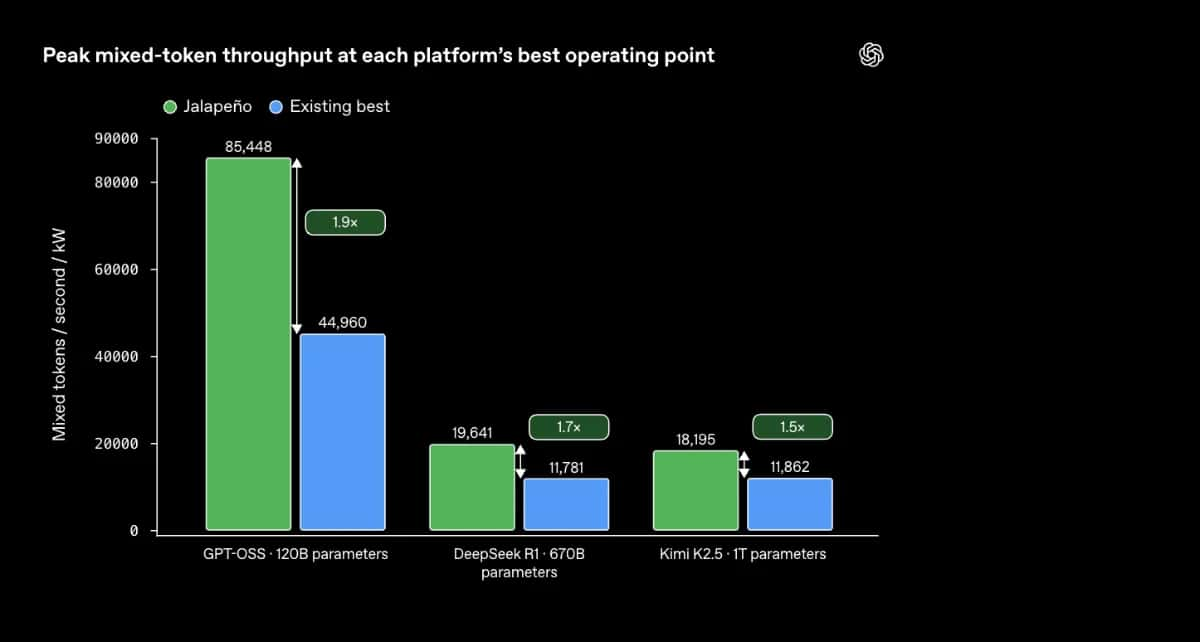
End-to-end latency was 1.65 seconds on Jalapeño compared to 5.99 seconds on the GB300. OpenAI reported similar advantages over NVIDIA systems on GPT-OSS and Kimi K2.5, with the full results shown in the accompanying benchmark data.
OpenAI rated Jalapeño at 700 watts, although its measured sustained power remained at or below 550 watts on the tested workloads.
The company said it evaluates inference hardware based on useful AI work delivered per unit of power while maintaining the latency required for interactive applications.
“Jalapeño is also evidence of a broader full-stack advantage,” OpenAI said in the blog post. “OpenAI can design models, products, serving software, chips, memory, networking, and systems together, using what we learn from real workloads to improve every layer of the stack. “
At the Hot Chips 2026 conference, OpenAI, just after publishing these results, also outlined how quickly it expects the platform to evolve.
The company said Jalapeño is only the first generation of a broader roadmap, with Gen 2 already in development and approaching tape-out within months. He also said Gen 3 is already operational.
Hot Chips '26: OpenAI says its Gen 1 chip is only step one with Gen 2 nearing tape-out in a number of months and Gen 3 already operational, afterwards bringing out the Broadcom and Celestica teams to share the stage
"One more thing -- this is step one of a multi-generational… https://t.co/alAB43w1ME pic.twitter.com/Q8eddAWNoU
— Fireside Alpha (@firesidealpha) August 26, 2026
OpenAI originally announced Jalapeño in June as part of a multi-generation platform it is developing with Broadcom and Celestica.
OpenAI designed the accelerator, while Broadcom provided chip implementation, networking, and connectivity technologies, and Celestica contributed board, rack, and system integration and production expertise.
The company said AI models also accelerated the chip’s development, helping take Jalapeño from initial design to tapeout in nine months.
Using Codex with GPT-Astra, engineers brought three open-weight models to high performance within two months, while selected AI-generated implementations for GPT-OSS components ran 1.5–1.8x faster than existing human-written implementations.
OpenAI said it will continue deploying NVIDIA and other third-party accelerators for training and inference. Jalapeño is the first generation of a planned multi-generation platform, with Gen 2 already in development and Gen 3 taking shape.
- AI Productivity to Add $28 Billion to $84 Billion to India's GDP: Cognizant Study
- OpenAI's Codex Helps in Aerodynamic Engineering for Mazda
- Bengaluru Accounts for 34% of India's FDE Talent: Report
- 84% See AI Productivity Gains, but Only 10% Allow Agent Autonomy: TCS Study
- Snowflake Introduces Business Ontology, Cortex AI Gateway to Bring AI Agents Into Enterprise Workflows
- Three Members Behind Claude Code Leave Anthropic Within 10 Days