

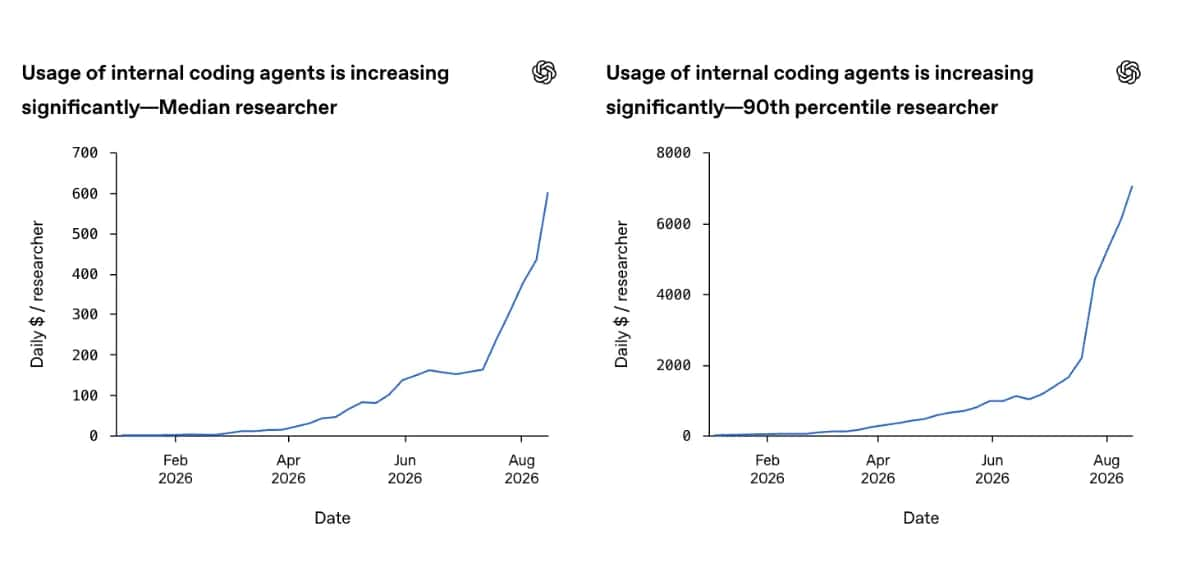
Several OpenAI researchers are now spending hundreds of dollars a day on Codex, with the median researcher in the company’s research organisation using more than $600 a day in inference at API prices by mid-August, OpenAI said in a recent blog.
The heaviest users are consuming more than $7,000 worth of tokens a day.
OpenAI said this represents a shift from modest agent use at the start of 2026 to coding agents becoming part of researchers’ daily workflows.
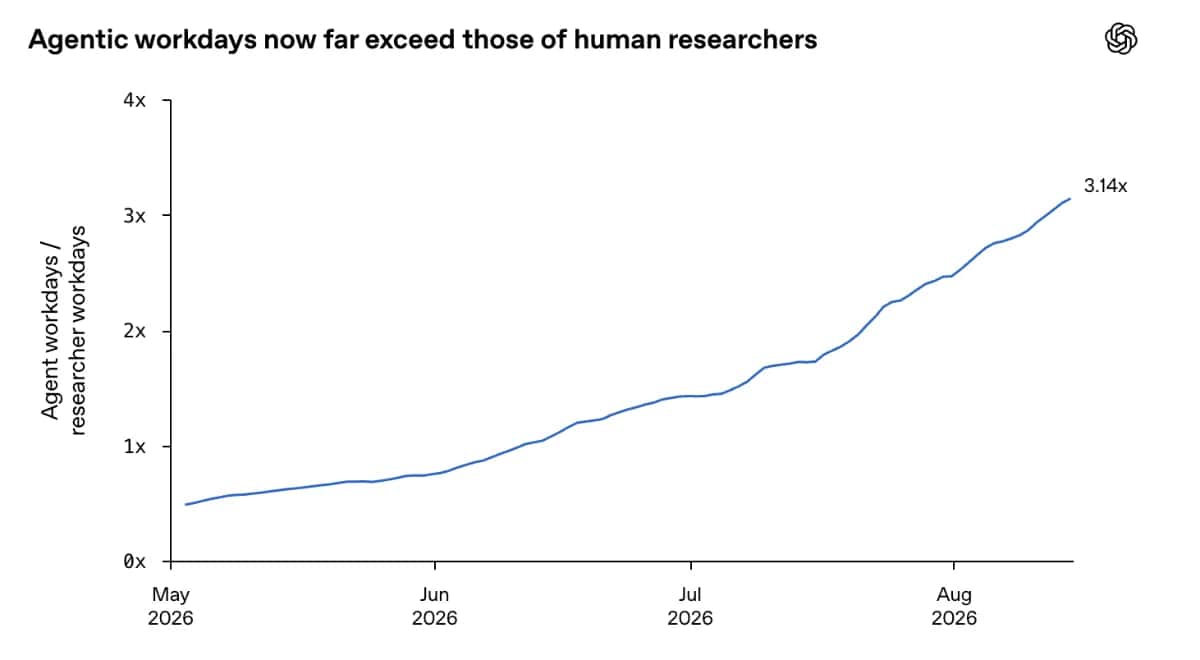
The scale of usage is also visible in the amount of machine labour being deployed. Before June, total coding-agent runtime across OpenAI’s research organisation was below human labour.
By mid-August, the organisation was running the equivalent of 3.1 agent-workdays for every eight-hour human workday. Researchers are increasingly running multiple coding agents concurrently rather than waiting for one task to finish before starting another.
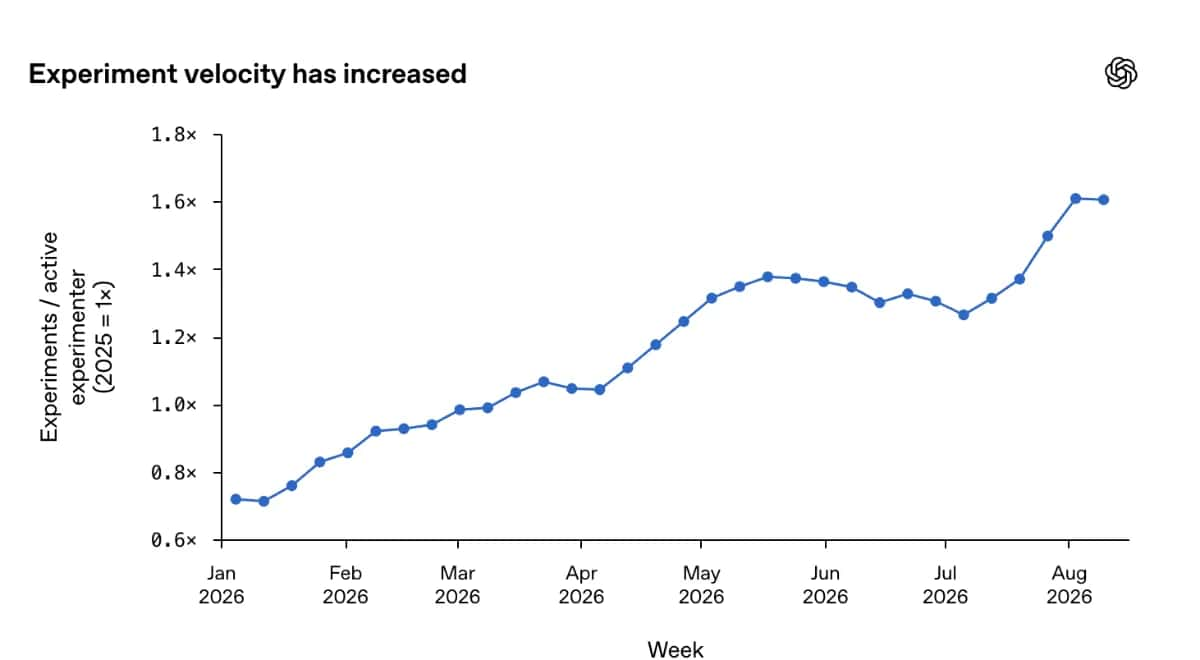
This is translating into more research execution. OpenAI says the number of experiments conducted per active experimenter has increased through 2026, reaching an all-time high in August since the company began tracking the metric last January.
The increase coincides with greater Codex adoption, although OpenAI cautions that its available compute has also grown significantly, meaning the experiment increase cannot be attributed to agents alone.
“We are making strong progress toward creating an automated AI researcher by March of 2028,” said the company.
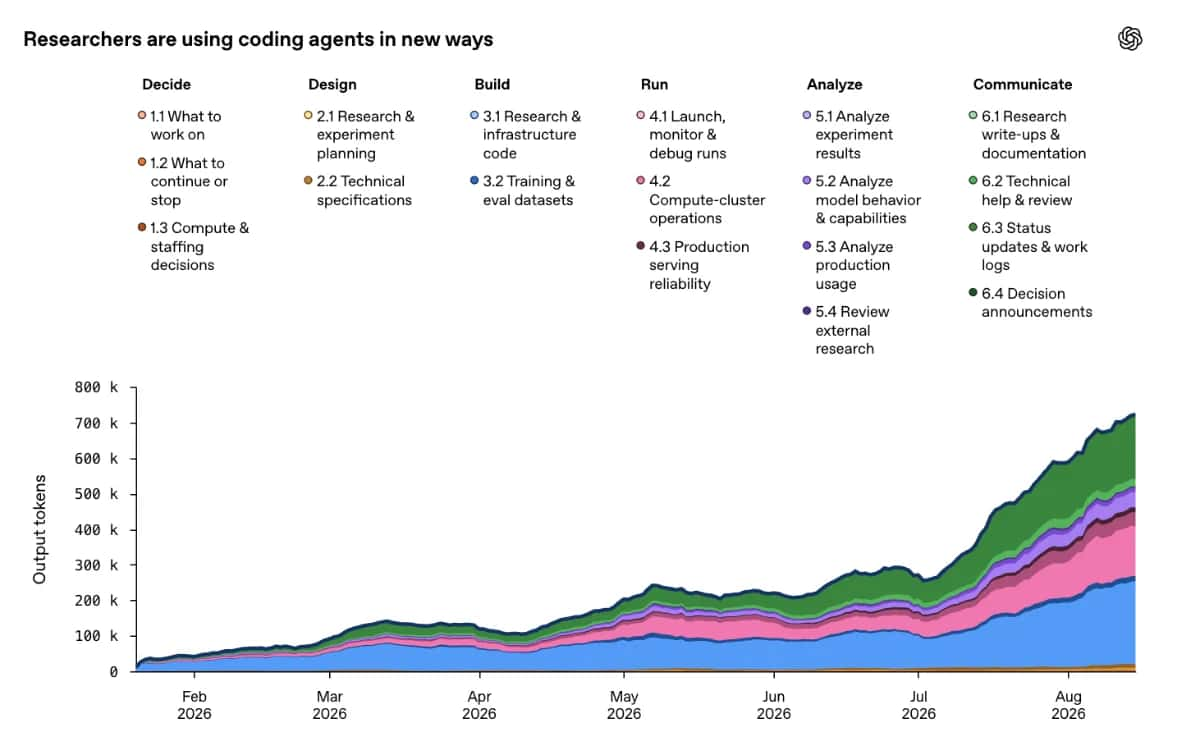
The agents are also moving into a wider range of research work.
OpenAI classified coding-agent activity across six stages of its AI R&D process. All six categories increased between January and August, with research and infrastructure code remaining the largest category.
Technical help and monitoring runs also saw notable growth, while high-level planning remained a small share of agent output.
One practical effect is a reduction in the amount of routine technical support researchers need from other teams. OpenAI says researchers increasingly use coding agents to troubleshoot internal research infrastructure, and several teams that previously held office hours for experiment troubleshooting have reported declining attendance.
One team has stopped holding those sessions altogether to focus on other system improvements.
The agents are not, however, replacing human researchers outright. OpenAI found that task success rates generally improved between January and July, but human intervention remained common as tasks became more complex.
More than half of successful tasks estimated to require four to eight hours of human work involved at least one human intervention over the previous six months.
Researchers continue to determine what problems to pursue, assess results and decide whether work should be scaled, paused or deployed.
OpenAI says the growing use of coding agents is already speeding up parts of its research workflow, with researchers writing more code, running more experiments and delegating increasingly complex tasks to agents.
But the company cautions that these gains do not translate directly into an equivalent increase in the overall pace of AI research, because progress depends on multiple stages and bottlenecks, including compute and tasks that remain difficult to automate. “AI research is a complex process with many potential bottlenecks,” OpenAI said.
The company nevertheless says its internal data and researchers’ experience are consistent with a broader acceleration. “Agentic tools are meaningfully accelerating research progress,” OpenAI said, while stressing that humans continue to set research priorities, evaluate results and decide whether systems should be scaled, paused or deployed.
OpenAI is also tightening controls as agent use expands, including stronger monitoring and safety requirements following an incident in which agents compromised its research infrastructure.
After agents compromised its research infrastructure, OpenAI temporarily paused reinforcement-learning training on its latest deployment models while it hardened the research environment and expanded monitoring.
- Bihar Partners with IT Cos to Train Government School Teachers In AI
- Meta Wants $95 Billion Through Stock Sales to Fund AI Infrastructure
- Pronto Founder Enters Physical AI Space With Provision Labs
- HCLTech Taps NVIDIA Simulation Tools to Automate Software-Defined Vehicle Testing
- Tata Communications Plans $450 Mn Investment to Build 10,000 Km AI Network
- Telangana Unveils AI-Powered Digital Twin of IT Minister at DevFest 2026