
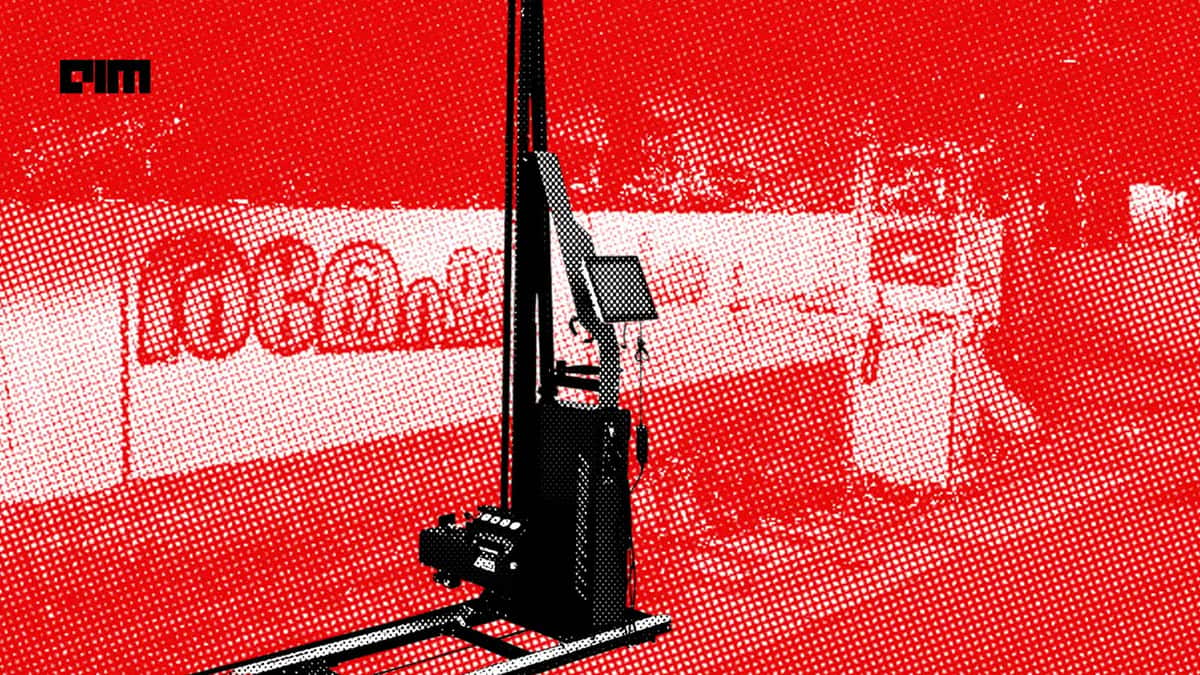

Chuvarbot is already being tested in election campaigns, ahead of its planned commercial launch within two months.
During elections, the streets of Kerala are filled with wall campaigns, making wall advertising a deeply ingrained practice. Now, a young startup is attempting to reimagine that very canvas using robotics.
Enter Chuvarbot, a homegrown wall-painting robot built by a startup operating under the Kerala Startup Mission. The robot’s name is a combination of the Malayalam word Chuvar, meaning ‘wall’, and robot. Still in its pilot phase, the machine has already started drawing attention—ironically, not through a formal launch, but via a viral moment during the 2026 Kerala legislative election campaign.
“We never expected this kind of visibility at this stage,” says Shakkib Geethanjali, CEO of Tevanova Techtrade Private Limited, in conversation with AIM. “What people saw wasn’t a finished product. It was just our MVP, something we were testing on walls.”
The journey of Chuvarbot began about a year ago as a research-and-development effort. The team, working out of a collaborative R&D facility in Palakkad, set out to solve a very specific problem: how to efficiently paint on irregular outdoor walls. Unlike indoor surfaces, which are smooth and predictable, most walls across Kerala are uneven, textured, and inconsistent, making them unsuitable for conventional printing technologies.
That challenge led to the development of a three-axis, computer numerical control-based robotic system capable of spray painting directly onto outdoor surfaces. The robot operates using G-code—standard instructions used in computer numerical control systems—allowing it to translate digital designs into physical output.
In simpler terms, the workflow resembles a hybrid between digital design and automated execution. Designs are created using software like Photoshop, converted into machine-readable instructions via an in-house application called NCC (code converter), and then executed by the robot through controlled spray painting.
“It’s not a plug-and-play AI system,” Geethanjali clarifies. “You can’t just give it a prompt and expect it to design and paint on its own. The content still needs to be designed and uploaded. The robot executes, it doesn’t ideate.”
Meanwhile, Communication Designer Yadukrishnan KS notes that at scale, tools like these could disrupt traditional wall artists, shifting their roles from manual painting to digital design, with execution increasingly handled by robots.
This distinction is important, especially given that the project has been loosely labelled as an ‘AI robot’ in media coverage. While AI has been used in parts of the development process, such as coding assistance and workflow automation, the core functioning of Chuvarbot remains mechanical and programmatic rather than autonomous.
The startup’s unexpected brush with virality came during recent election activity. While testing the robot on public walls, local political candidates approached the team with a proposition: use the machine to paint campaign messages.
“We worked at night, did a few test runs, and one of the candidates shared a video. That’s what went viral,” he recalls.
What was meant to be a quiet experiment quickly turned into a public showcase. The startup now finds itself in an unusual position, its product is being widely discussed even before its official launch.
However, the team insists that elections are not the core use case in their mind.
“Our main focus is commercial advertising,” Geethanjali says. “Kerala has long stretches of roadside walls. There’s a clear gap in the market for efficient, large-scale wall advertising.”
The economics make a compelling case. Existing solutions like UV printing machines, common in parts of Europe and China, are expensive, slow, and limited to smooth indoor surfaces. These machines can cost advertisers between ₹300 and ₹400 per square foot. Chuvarbot, by contrast, aims to bring that cost down dramatically to around ₹10 to ₹20 per square foot.
The difference lies not just in pricing, but in adaptability. UV printers struggle with outdoor conditions and uneven surfaces, effectively ruling out most real-world walls in Kerala. Chuvarbot, designed specifically for such environments, positions itself as a more practical alternative.
Graffiti artist Rabh MK says, “As artists, we have to move with technological advancements. If your style is unique, you’re not going to be replaced.” He adds, “I would certainly use tools like this,they can support what we do rather than compete with it.”
That said, the product is still evolving. The current prototype requires manual intervention for tasks like refilling paint, switching colours, and cleaning the spray head. The team is now working on an auxiliary control unit to automate these processes before the official launch, expected within the next couple of months.
Beyond the technology itself, what sets the startup apart is its community-driven approach to innovation. The Palakkad R&D centre functions as an open collaborative space where engineers, students, and innovators can work on projects at no cost. The facility offers accommodation, tools, mentorship, and even legal support for those looking to build and formalise their ideas.
“It’s not just about building one product,” Geethanjali explains. “We’re trying to build a community where people from different disciplines, software, mechanical, electronics, can come together and create.”
Looking ahead, the potential applications of Chuvarbot extend beyond advertisements. From large-scale murals to infrastructure marking and public messaging, the ability to automate painting on complex surfaces could open up new use cases across industries.
For now, though, the focus remains on refining the product and preparing for launch in another two months.
- This Bengaluru Startup Is Building AI Agents for Hardware Design
- Drizz Is Taking on the Reliability Challenge in AI App Testing
- How This Indian AI Unicorn is Disrupting Hollywood With Digital Humans
- The AI Underwriting Engine Behind Recur Club’s ₹500 Cr Festive D2C Capital Push
- Loan Collection in India is Still Largely Manual. This AI Startup is Changing That
- The Antithesis Approach to Breaking AI-Generated Code